View Instance Details
You can view details about a provisioned instance and perform tasks such as accessing the instance login page to design integrations, viewing custom endpoint details, editing an instance, adding tags, and deleting instances.
- In the Name column, click a specific instance name. The Details page is displayed. The word Active is displayed beneath the green circle to indicate that this instance is running.
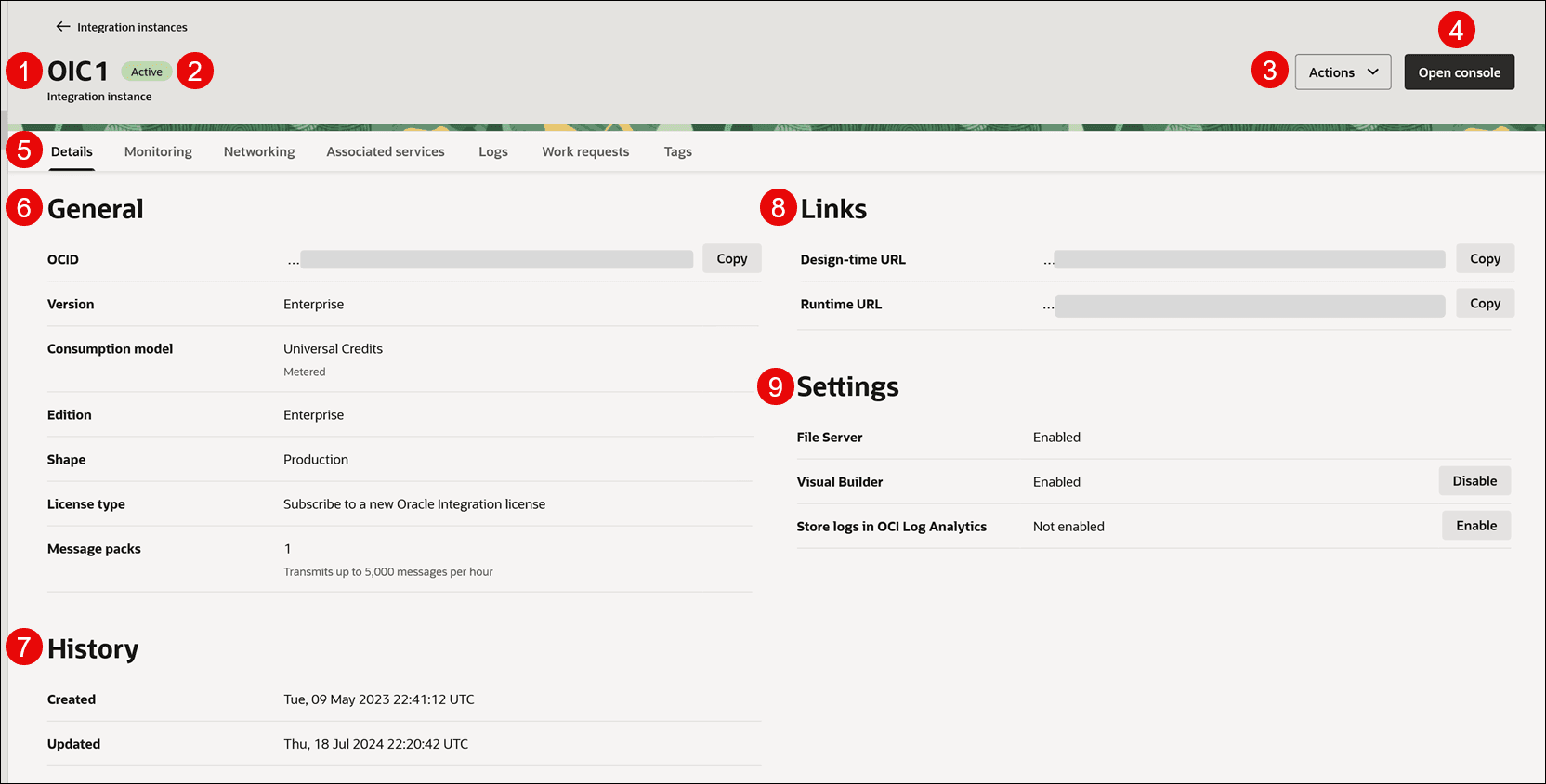 The following table describes the key information shown on the Integration instance details page:
Callout Element Description 1
Instance name
At the top of the details page, you see the name of the instance.
2
Status
Next to the instance name, you see the status of the instance:
- Active—the instance is running.
- Inactive—the instance is stopped.
3
Actions menu
Click Actions to see other options:
- Start/Stop—Click Stop or Start to stop or start the instance.
- Edit—Click Edit to edit the settings for your instance.
See Edit the Edition, Edit the License Type, or Edit the Number of Message Packs Using the User Interface.
- Move—Click Move to move the instance to a different compartment. This action can take some time to complete.
- Delete—Click Delete to delete the instance.
See Delete an Instance.
4
Open console button
Click Open console to access Oracle Integration.
See Get Familiar with the Home Page in Getting Started with Oracle Integration 3.
5
Tabs
Click a tab to see additional information about the service instance:- Monitoring—View service instance metrics.
- Networking
- Private endpoint—View and manage private endpoints associated with this instance.
- Custom endpoint—Configure a custom endpoint, or, if you've already configured one, view the custom endpoint URL, certificate details, and the original URL of the instance.
See Configure a Custom Endpoint for an Instance.
Note: You can view the Certificate Secret Name only if you are granted the necessary permissions.
- Network access—View and manage allowlist rules.
- Associated services—View services associated with this instance, such as File Server and Oracle Visual Builder.
- Logs—Enable and disable the capture of logging activity.
- Work requests—View instance life cycle activity, such as instance creation time, instance stop and start times, and so on.
- Tags—Use tags to categorize your instances in your tenancy and make them easier to find.
See Resource Tags.
6
General
Under General, you see the following general information:- OCID—Shows the value that uniquely identifies the instance. Click Copy to copy it.
- Version—Appears only when you have Oracle Integration Generation 2 and Oracle Integration 3 instances.
- Consumption model—Shows the consumption (billable) model used for the instance.
- Edition—Shows the edition selected for the instance—Standard or Enterprise.
- Shape—Shows the shape selected for the instance—Development or Production.
- License type—Shows the type of license used for the instance.
- Message packs—Shows the number of message packs and the quantity of messages in each pack.
See Edit the Number of Message Packs Using the User Interface.
7
History
Under History, you see the following information:
- Created: Shows the date the instance was created.
- Updated: Shows the date the instance was last updated (for example, the last time it was started).
8
Links
Under Links, you see the following information:- Design-time URL—Shows the URL to access the associated Oracle Integration instance application. Click Copy to copy it.
- Runtime URL—Shows the URL for the runtime applications created with this Oracle Integration instance. Click Copy to copy it.
- OCI Log Analytics log group—You see this field if you've enabled the option to send activity stream logs to Oracle Log Analytics. It shows the log group OCID.
See Use Oracle Log Analytics for Large Activity Stream Payloads.
9
Settings
Under Settings, you see the following information:- File Server—Shows whether File Server is enabled for the instance. If it isn't, you can click the button to enable it. This action can't be undone.
See Enable File Server in Using File Server in Oracle Integration 3.
- Visual Builder—Shows whether Visual Builder is enabled for the instance. Click the button to enable it or disable and delete it.
- Store logs in OCI Log Analytics—Shows whether sending activity stream logs to Oracle Log Analytics is enabled for the instance. If it isn't, you can click the button to enable it. Then, enter the Log group OCID.
See Use Oracle Log Analytics for Large Activity Stream Payloads.