About Autonomous AI Database on Dedicated Exadata Infrastructure
Autonomous AI Database provides an easy-to-use, fully autonomous database that scales elastically, delivers fast query performance, and requires no database administration.
Oracle Autonomous AI Database on Dedicated Exadata Infrastructure is a highly automated, fully managed database environment running in Oracle Cloud Infrastructure (OCI) with committed hardware and software resources. These isolated resources enable organizations to meet stringent security, availability, and performance requirements while reducing cost and complexity.
You can configure your database in two different modes based on the workload type, as:
- Autonomous AI Lakehouse
- Autonomous AI Transaction Processing
Autonomous AI Lakehouse
Oracle Autonomous AI Lakehouse is a cloud data warehouse service that eliminates virtually all the complexities of operating a data warehouse, securing data, and developing data-driven applications.
The service automates provisioning, configuring, securing, tuning, scaling, patching, backing up, and repairing of the data warehouse. Unlike other fully managed cloud data warehouse solutions that only patch and update the service, Autonomous AI Lakehouse features elastic, automated scaling, performance tuning, security, and a broad set of built-in converged database capabilities that enable simpler queries across multiple data types, machine learning analysis, simple data loading, and data visualizations.
Autonomous AI Lakehouse service is available in both the Oracle public cloud and your own data center on Exadata Cloud@Customer.
Autonomous AI Transaction Processing
Oracle Autonomous AI Transaction Processing is a cloud database service that eliminates the complexity of operating and securing high-performance databases.
The service automates provisioning, configuring, tuning, scaling, patching, encrypting, and repairing of databases. Additionally, the service includes all of Oracle’s advanced database options, such as real application clusters (RAC), multitenant, partitioning, in-memory, advanced security, and advanced compression. The service is built to support everything from simple web apps to large and sophisticated applications that are critical for business operation.
Autonomous AI Transaction Processing service is available in both the Oracle public cloud and your own data center on Exadata Cloud@Customer.
Key Features of Autonomous AI Database on Dedicated Exadata Infrastructure
Autonomous AI Database on Dedicated Exadata Infrastructure provides the following set of features to offer affordable, feature-rich database service in the cloud.
-
Fully Managed: Oracle simplifies end-to-end management of the database with self-driving Autonomous AI Database technology. With Autonomous AI Database, you do not need to configure or manage any hardware or install any software. Autonomous AI Database handles creating the database, backing up the database, patching and upgrading the database, growing or shrinking the database, and other routine database maintenance tasks without human intervention and with no service downtime.
-
Fully Tuned: Autonomous AI Database is designed as a Load and Go service to define tables, load data, and start running queries. Autonomous AI Database provides great performance out of the box. You can run your queries using Oracle database Client Drivers from all popular programming languages, any business analytics tool, cloud service, built-in SQL worksheet, or even a machine-learning notebook.
-
Fully Elastic: Autonomous AI Database is a fully elastic service. When you get started with Autonomous AI Database, you can simply specify the number of CPUs (a unit expression of Compute cores) and the database's storage capacity. Any time later, you can either enable an auto-scaling feature or manually scale, increase or decrease, either the CPUs or the storage capacity. When you enable auto-scaling or perform manual scaling, your database resources shrink or grow without any downtime or service interruptions. You can size the Autonomous AI Database to the exact compute and storage required or even shut off idle compute to save money.
-
Highly Available: Autonomous AI Database provides a highly available database with features such as:
-
Autonomous Data Guard that can be used to protect critical databases from failures and disasters.
-
Automatic and manual backups that can be used to restore and recover your database to any point-in-time within the retention period.
-
-
High Performing: Autonomous AI Database provides a high performing database with features such as:
-
Automated index management
-
Automatic real-time statistics gathering
-
Optimized high-frequency single-row inserts for applications
-
preconfigured resource profiles for different types of users to achieve optimized query performance and concurrent workloads
-
-
Easy to Use: Autonomous AI Database includes a complete REST based API and a cloud-based service console for managing the service (for tasks such as stopping, starting, or scaling the service) and monitoring the service (for functions such as viewing the recent activity levels on the data warehouse).
-
Compatible with Existing Applications and Tools: Autonomous AI Database is built upon Oracle Database so that the applications and tools that support Oracle Database also support Autonomous AI Database. These tools and applications can either be in your data center or a public cloud and connect to Autonomous AI Database using standard SQL*Net connections.
-
Integration with Third Party Tools and Utilities: With Autonomous AI Database, you can integrate your database applications with other Oracle Cloud services such as Oracle Analytics Cloud, Oracle GoldenGate Cloud Service, and Oracle Data Integration Platform Cloud. You can use the Database Migration Utility provided by Autonomous AI Database to easily migrate your data from MySQL, Postgre SQL, SQL Server, and other databases. Autonomous AI Database supports connectivity via SQL*Net, JDBC, and ODBC.
-
Enriched with Built-in Tools: Autonomous AI Database comes with built-in tools such as:
-
Oracle APEX AI Application Generator (APEX), a low-code development platform that enables you to build scalable, secure enterprise apps with world-class features.
-
Oracle REST Data Services (ORDS), a Java Enterprise Edition based data service that makes it easy to develop modern REST interfaces for relational data and JSON Document Store.
-
Oracle Database Actions, a browser-based interface of Oracle SQL Developer.
-
Deployment Choices for Autonomous AI Database on Dedicated Exadata Infrastructure
Autonomous AI Database on Dedicated Exadata Infrastructure offers three deployment possibilities for operational control and isolation:
-
Oracle Cloud Infrastructure: A private dedicated database within a public cloud that completely isolates your data and operations. Autonomous AI Databases on Oracle Public Cloud get dedicated system resources such as processor, memory, network, or storage to offer greater control over operational policies and runtime customizations.
With the Dedicated Region Cloud@Customer (DRCC) option, customers get an entire OCI region as it exists in Oracle’s Public Cloud, deployed inside the customer data center. Autonomous AI Databases deployed in DRCC are functionally the same as those deployed in Oracle Public Cloud regions, except that they get an OCI region inside customer data centers.
-
Exadata Cloud@Customer Infrastructure: An Autonomous AI Database in your data center to meet regulatory, data sovereignty, or network latency requirements for workloads that cannot move to the Public Cloud. This deployment option enables IT to easily deliver self-service databases to business users and developers while ensuring the security and governance of all data.
-
Multicloud : An Oracle Autonomous AI Database on Dedicated Exadata Infrastructure deployed in a multicloud region. These include AWS cloud regions and Azure cloud regions. This deployment option enables applications running within AWS or Azure that require high performance and low latency to benefit from a fully managed Oracle Database that is highly available, scalable, secure, and integrated with many operational services. All features supported on Oracle Public Cloud will also apply to Multicloud deployments, except for the features listed in Unsupported Features in Oracle Database@AWS and Unsupported Features in Oracle Database@Azure.
All the platforms support a standard set of features for Autonomous AI Databases with a few differences. All through this documentation, you will encounter the following badges as applicable:
-
APPLIES TO:
 Oracle Public Cloud only
 -
APPLIES TO:
Exadata Cloud@Customer only
For a glance at the features supported exclusively by Oracle Public Cloud or Exadata Cloud@Customer deployment choices, refer to Feature Parity Between Oracle Cloud and Exadata Cloud@Customer.
Components of Autonomous AI Database on Dedicated Exadata Infrastructure
The following diagram illustrates the infrastructure components of an Autonomous AI Database on Dedicated Exadata Infrastructure.
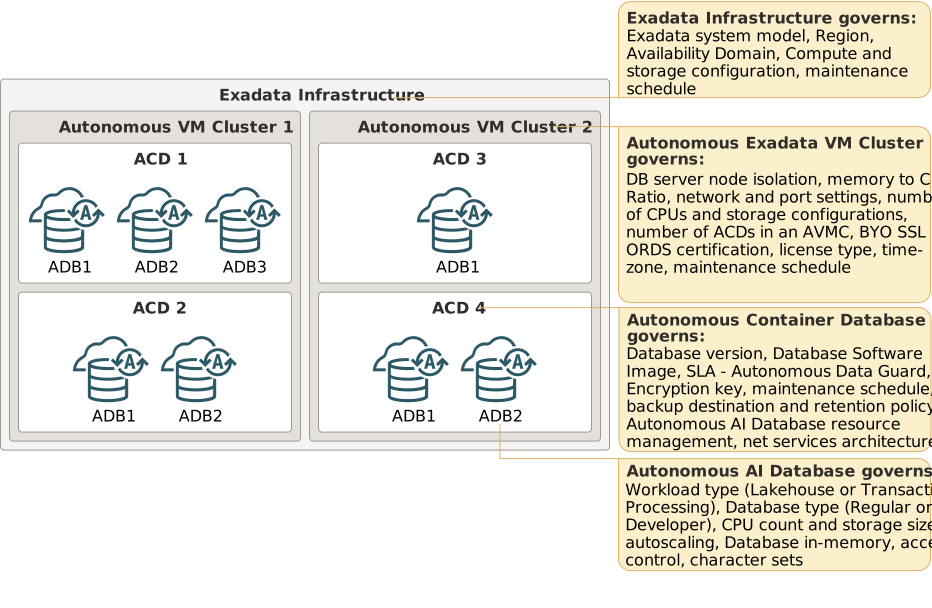
Description of the illustration adbdcomponents.svg
Tip: For a practical use case that demonstrates how to leverage these components to develop, test, and deploy a database application, refer to Configure Autonomous AI Database on Dedicated Exadata Infrastructure.
Autonomous AI Database on Dedicated Exadata Infrastructure is based upon these kinds of Oracle Cloud resources:
-
An Exadata Infrastructure resource represents the Exadata Database Machine system in your data center, together with the networking configuration that connects it to Oracle Cloud. For an overview of Exadata Infrastructure, its features, and how to use them, see About Exadata Infrastructure.
-
An Autonomous Exadata VM Cluster (AVMC) resource provides the link between the Exadata Infrastructure resource and the Autonomous Container Database resources in your deployment. It is a set of symmetrical VMs (virtual machines) across all compute nodes of the underlying Exadata Infrastructure resource. You can:
-
Create multiple AVMCs on a single Exadata Infrastructure resource. Support for multiple VM Clusters lets you:
-
Schedule separate maintenance runs for each AVMC on the same Exadata Infrastructure.
-
Choose different license models for Autonomous AI Databases on the same Exadata Infrastructure.
-
Create and test Autonomous Data Guard between AVMCs on the same Exadata Infrastructure.
-
Customize compute, storage, and memory of each AVMC configuration for the intended workload.
-
-
Create both Autonomous Exadata VM Clusters and Exadata Database VM Clusters on a common Exadata Infrastructure resource.
For an overview of AVMCs, their features, and how to use them, see About Autonomous Exadata VM Cluster.
Note: You can only create a Multiple VM - Autonomous VM Cluster (AVMC) on Exadata Infrastructure resources created in Oracle Cloud after the launch of the multiple VM Autonomous AI Databases feature. Please create a service request in My Oracle Support if you need to address this limitation and want to add an Autonomous VM Cluster to older Exadata Infrastructure resources. For help with filing a support request, see Create a Service Request in My Oracle Support.
-
-
An Autonomous Container Database (ACD) resource provides a container for your Autonomous AI Databases. You can create multiple ACDs in a single AVMC resource, but you must create at least one before you can create any Autonomous AI Databases. For an overview of ACDs, their features, and how to use them, see About Autonomous Container Database.
-
An Autonomous AI Database resource is a user database. You can create many Autonomous AI Databases in a single Autonomous Container Database resource. For an overview of Autonomous AI Databases, their features, and how to use them, see About Autonomous AI Database.
-
An Autonomous Backup resource is a backup of an Autonomous AI Database. Oracle creates these resources for you automatically. See Backup and Restore Autonomous Database for more details.
User Roles Associated with Autonomous AI Database on Dedicated Exadata Infrastructure
The tasks involved in setting up and using the Autonomous AI Database on Dedicated Exadata Infrastructure can be grouped into three logical roles: a few people act as fleet administrators, more act as database administrators, and even more act as database users. A given person can assume one or more of these roles, depending on how you decide to isolate and distribute duties.
-
Fleet Administrator. Fleet administrators create, monitor and manage the core (Exadata Infrastructure and Autonomous Exadata VM Cluster) and Autonomous Container Database resources.
To perform these duties, a fleet administrator must be an Oracle Cloud user whose permissions permit the management of these resources and permit the use of the networking resources that need to be specified when creating these resources.
-
Database Administrator. Database administrators create, monitor and manage Autonomous AI Databases. Additionally, they create and manage Oracle AI Database users within these databases, and provide others the information necessary access the database.
To perform these duties, a database administrator must be an Oracle Cloud user whose permissions permit the management of Autonomous AI Database and Autonomous Backup resources and permit the use of the Autonomous Container Database and networking resources that need to be specified when creating an Autonomous AI Database. When creating an Autonomous AI Database resource, the database administrator defines and gains access to the ADMIN administrative user account for the database.
-
Database User. Database users are the developers who write applications that connect to and use an Autonomous AI Database to store and access the data. Database users do not need Oracle Cloud accounts: they gain network connectivity to and connection authorization information for the database from the database administrator.