Previewing Template Imports, Importing Templates, and Reviewing Import Results
Before you import a template, you can preview it to visualize the changes that the template import will create in the target environment. After you run the import, you can review the results for each object.
Previewing Template Imports
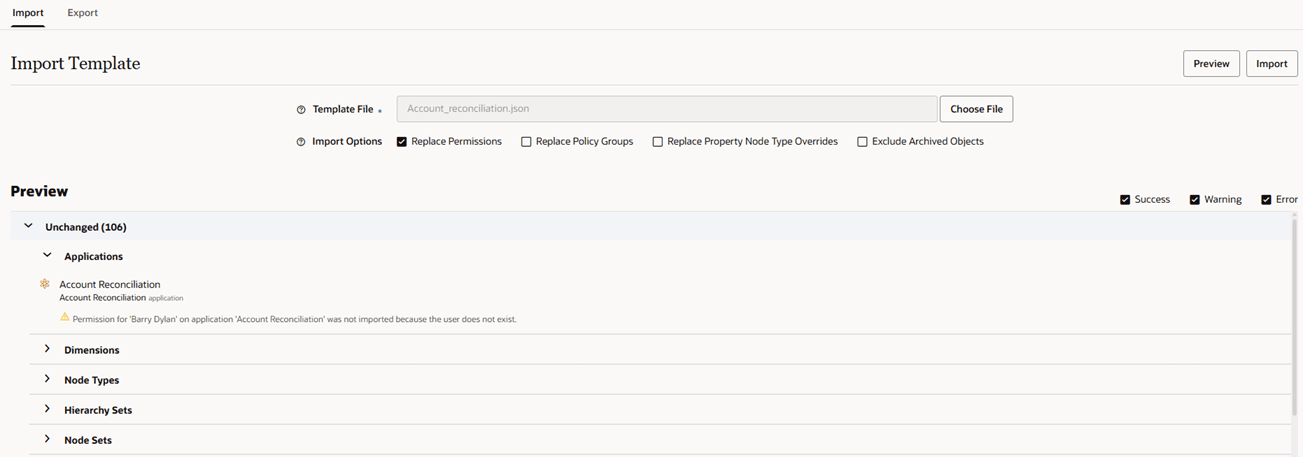
Previewing a template import enables you to identify the objects in the template file and to determine which ones will be added, modified, unchanged, and skipped by the import process. If there are issues with some of the objects in the template file, previewing the import enables you to identify those issues and take corrective action on them before the template is imported.
Use the preview status filters to identify potential issues with the template file before you import it:
- Success: The object is projected to be imported from the import file without any changes.
- Warning: The object is projected to be imported, but it will be changed from the import file in order to import it.
- Error: The object is not projected to be imported.
Click Download
 to download the preview results to an Excel file. The file contains a
Summary tab with information about the preview, such as the timestamp,
file name, and the preview options, as well as an Import Preview tab that
contains the preview information for the template import. The preview tab is sorted
by preview result and then object type.
to download the preview results to an Excel file. The file contains a
Summary tab with information about the preview, such as the timestamp,
file name, and the preview options, as well as an Import Preview tab that
contains the preview information for the template import. The preview tab is sorted
by preview result and then object type.
In the following example, the preview indicates that a permission for Barry Dylan will not be imported because the user doesn't exist in the target environment. You must add the user in the target environment in order to import the permissions for that users.
Importing Templates
To import a previously-exported template:
- From the Tools tile, select
Templates.
Note:
The Tools and Templates tiles are visible to Service Administrators or users with the Migrations - Administer granular role only. - On the Import tab, click Choose File.
- From your local file system, select a file with a
.jsonextension, and then click Open. - Optional: Choose one or more Import Options:
- Replace Permissions: Replace existing permissions in the target environment with permissions from the source template.
- Replace Policy Groups: Replace existing policy groups in the target environment with policy groups from the source template.
- Replace Property Node Type Overrides:
- Enabled: Existing property node type overrides in the
target environment are replaced by property node type overrides
from the source template.
Tip:
This enables you to remove node type overrides in the target environment if they have been removed in the source. - Disabled: Existing property node type overrides in the target environment are merged with property node type overrides from the source template.
- Enabled: Existing property node type overrides in the
target environment are replaced by property node type overrides
from the source template.
- Exclude Archived Objects: Excludes archived
objects in a template from a source environment from being imported into
the target environment if the source objects do not exist in the target
environment.
Note:
Archived objects in a source template which already exist in the target environment cannot be excluded from template preview or import.
- Click Preview to identify the objects in the template file and view the status of each. See Previewing Template Imports, Importing Templates, and Reviewing Import Results.
- Click Import, and then click Yes
on the confirmation message.
The template is imported, and the status of each object in the template is displayed. See Previewing Template Imports, Importing Templates, and Reviewing Import Results.
Reviewing Import Results
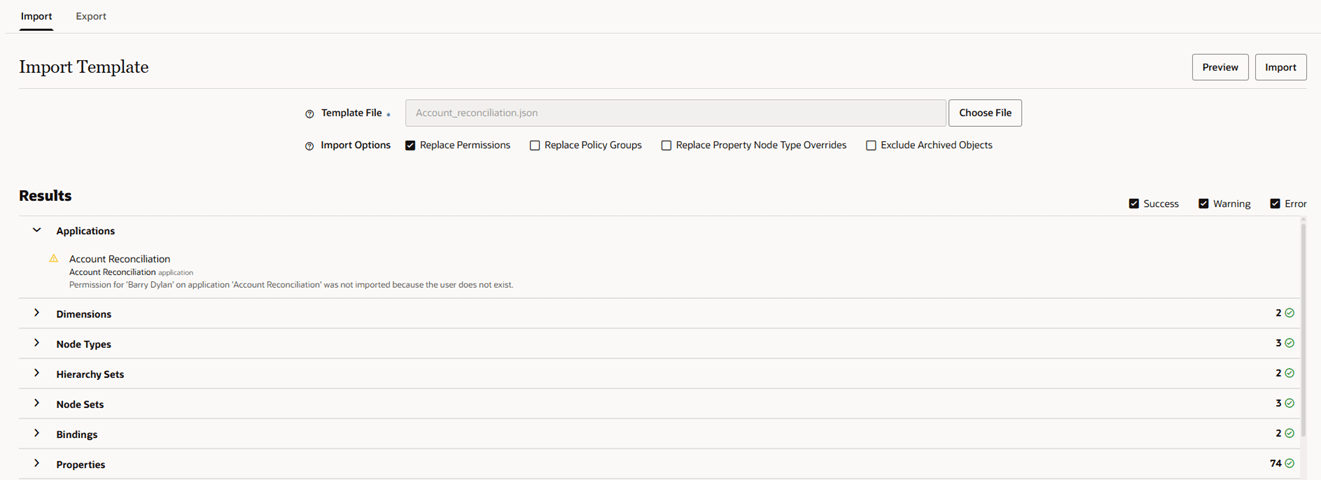
After you run the template import, review the results to identify the status for each of the objects in the template file:
- Success: The object was imported from the import file without any changes.
- Warning: The object was imported, but it was changed from the import file in order to import it.
- Error: The object was not imported.
You can enable and disable each of these filters to see just the objects that have a particular status. For example, you can view only the objects with warnings or errors.
Click Download
to download the import results to an Excel file. The file contains a
Summary tab with information about the import, such as the timestamp,
file name, and the import options, as well as an Import Results tab that
contains the results for the template import. The results tab is sorted by object
type.
In the following example, the permission for Barry Dylan in the template was not imported because the user does not exist in the target environment.