About the Home Page
The Home page is the launch point for accessing your Enterprise Profitability and Cost Management tasks.
The Home page uses Redwood styling and responsively adapts to different screen sizes, resolutions, and browser zoom levels. Navigation, cards, and other layout elements automatically resize to improve readability and accessibility.
The interface provides an intuitive user experience and an overview for quick access to commonly-used functions. Common tasks are represented as cards or in clusters that group related cards together. When you click a card to open a page, related cards are displayed along the top so you can easily get to them without returning to the Home page.
All Oracle Fusion Cloud Enterprise Performance Management services, business processes, and applications use Redwood Experience. Redwood Experience offers a default Oracle theme and these two additional appearance options: Custom Light and Custom Dark. You can switch between the Oracle, Custom Light, and Custom Dark themes on the Appearance page. You can also add a custom branding logo and custom background images to the Home page. To change appearance options for your environment, see Configuring Cloud EPM Appearance in Getting Started Guide for Administrators.
From the Home page:
-
Service Administrators can create applications, create dimensions, load dimensions into the application, enable localization and accessibility, install and configure clients, and set up user access.
-
Power Users can create POVs, load data, create rules, validate models, run calculations, and validate results.
-
Users can create reports, dashboards, analytics, and model views; trace allocations; and create profit curves.
-
Viewers can view reports, dashboards, analytics, and model; trace allocations, and view profit curves.
Example Home Page
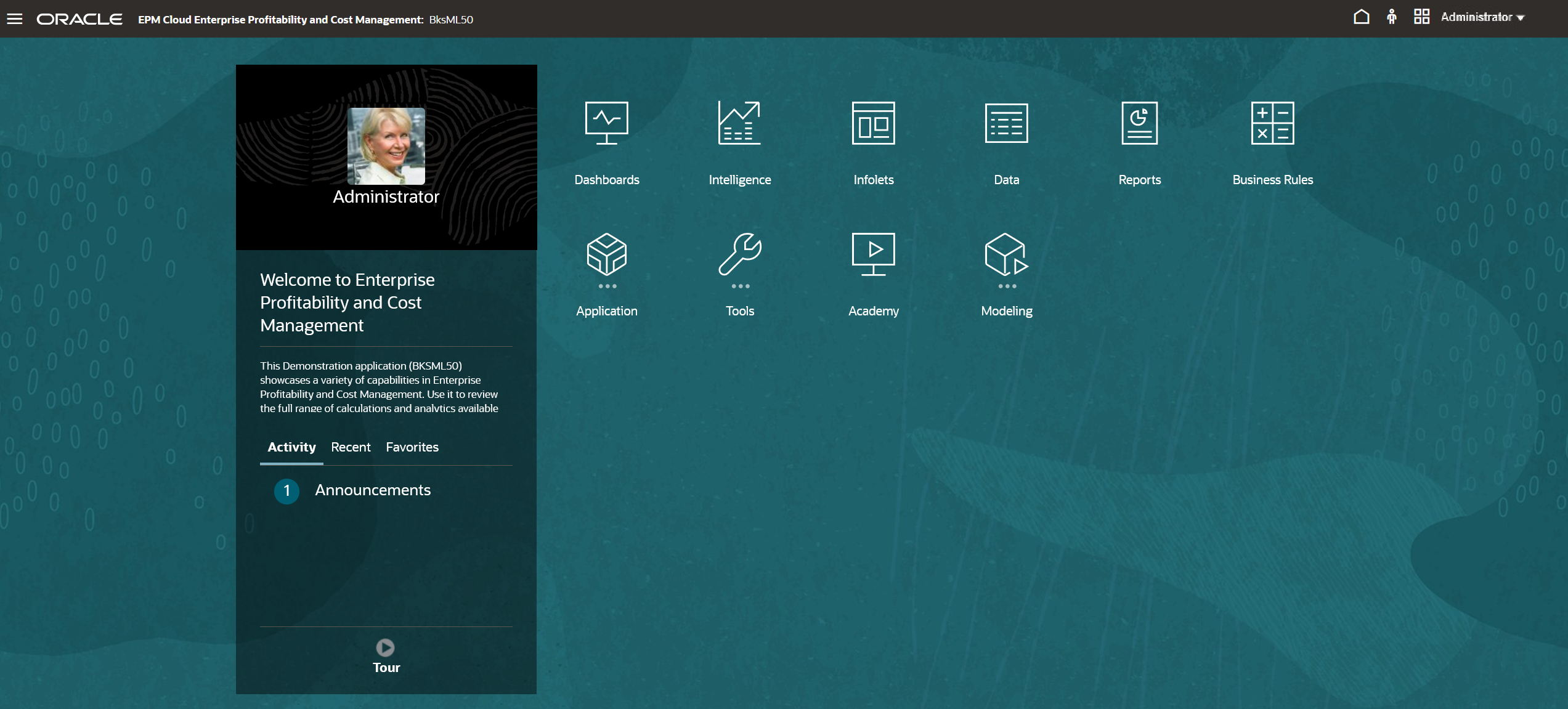
Global Header
The global header spans the top of the Home page and provides access to key navigation and user options. It includes navigation icons, accessibility settings, the Settings and Actions menu, and an option to switch between navigation flows.
For administrators, the global header includes drawers for Favorites, Recent Items, and Notifications. These drawers provide quick access to saved favorites, recently visited pages, and banner-message notifications, including previously dismissed messages.

Table -1 Parts of the Global Header from Left to Right
| Global Header Part | Description |
|---|---|
 |
The Navigator icon opens the Navigator menu, which serves as a sitemap of the business process and displays links to all of the business process pages to which you have access. Note: Some of the links in the Navigator menu are available only if you're accessing the business process from the desktop. |
 |
Click the Oracle logo to return to the Home page while working elsewhere in the business process. You can display a custom logo instead of the Oracle logo by selecting a Logo Image on the Appearance page (accessed from the Tools card). |
 |
The name of the current business process. You can hide the business process name by selecting No for the Display Business Process Name option on the Appearance page (accessed from the Tools card). |
 |
The Home icon refreshes the Home page or returns you to the Home page while working elsewhere in the business process. |
 |
Click the Accessibility Settings icon to enable accessibility features. |
 |
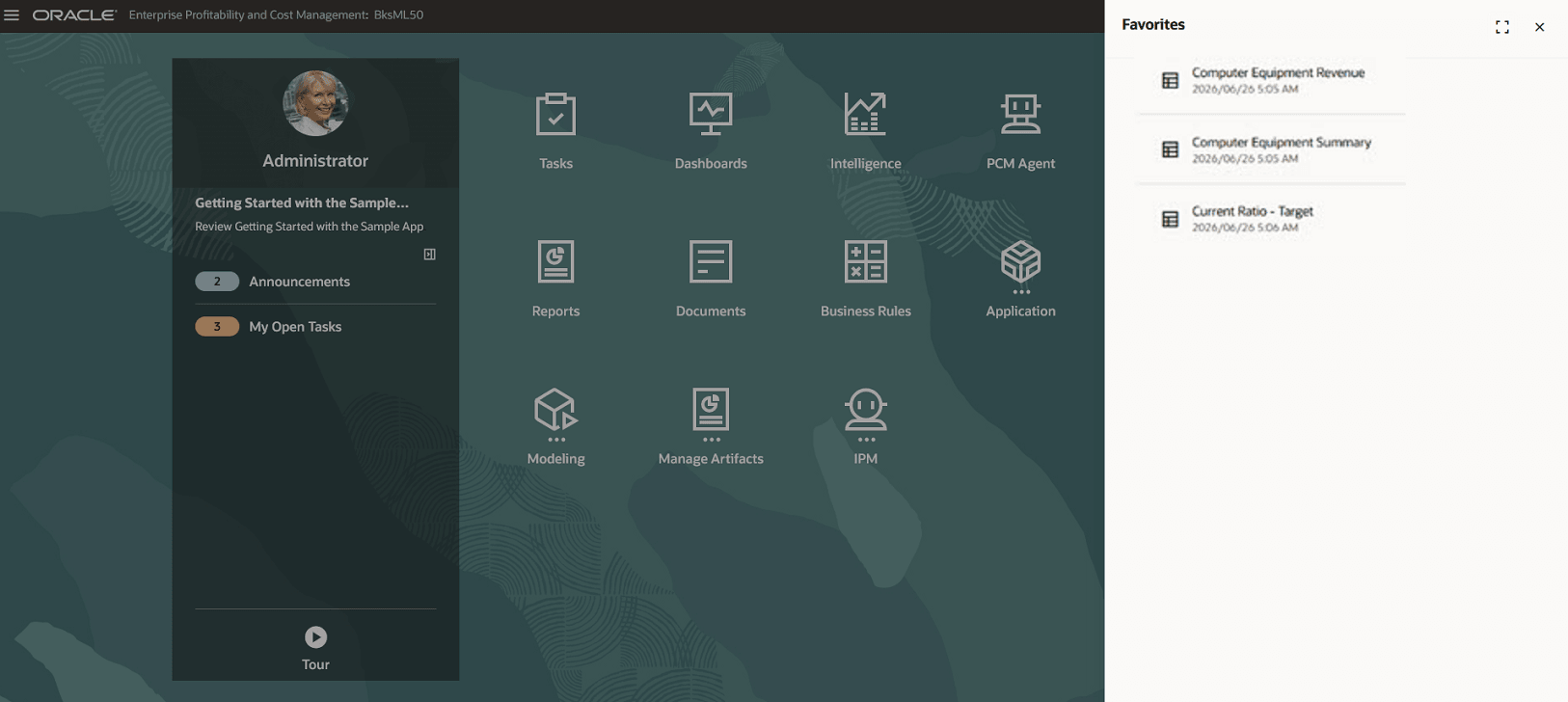
Click the Favorites icon to display links to forms or dashboards that were tagged as favorites. Click a link in Favorites to launch the item in a secondary window.
|
 |
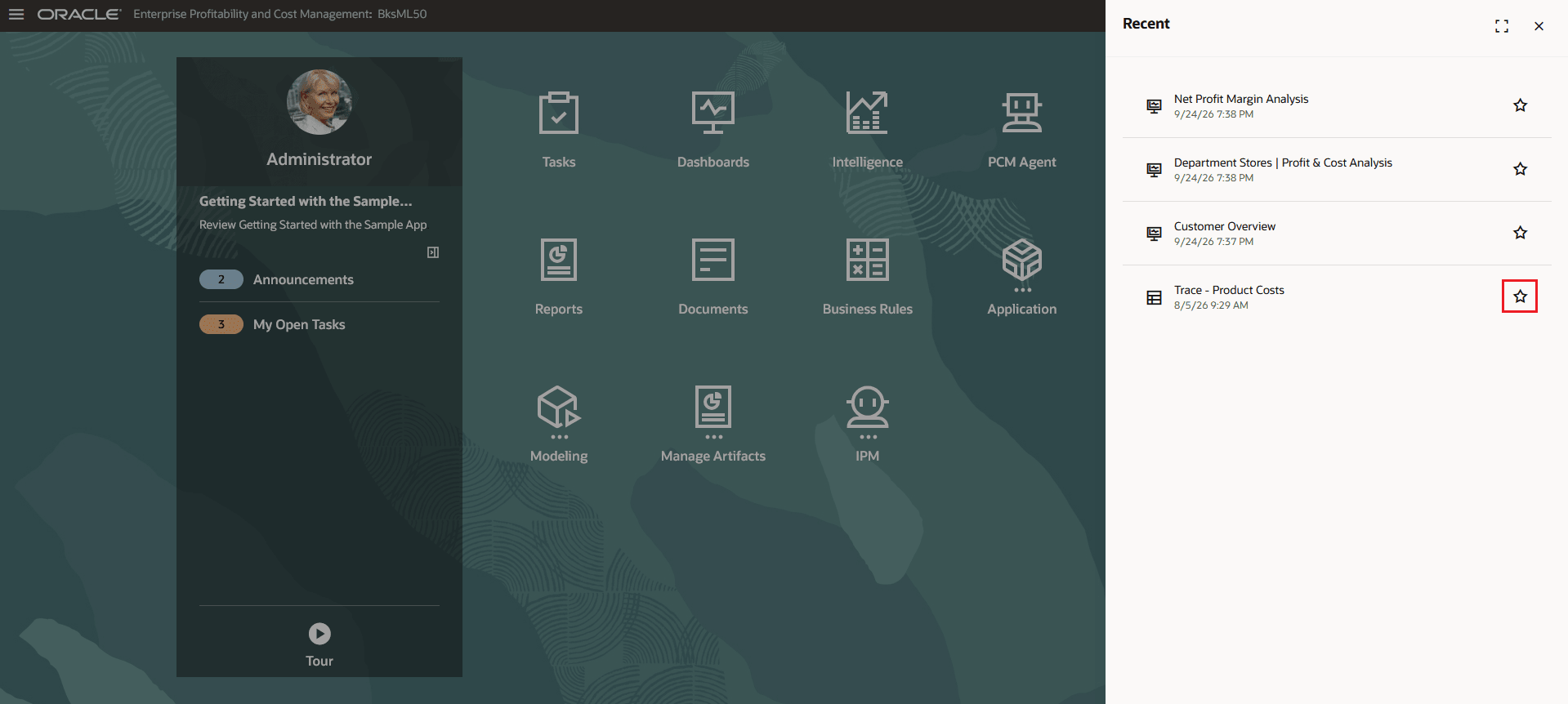
Click the Recent icon to display links to recently visited forms and dashboards (up to 15 items). Clicking a link launches the item in a secondary window. Clicking the star next to a link tags it as a favorite.
|
 |
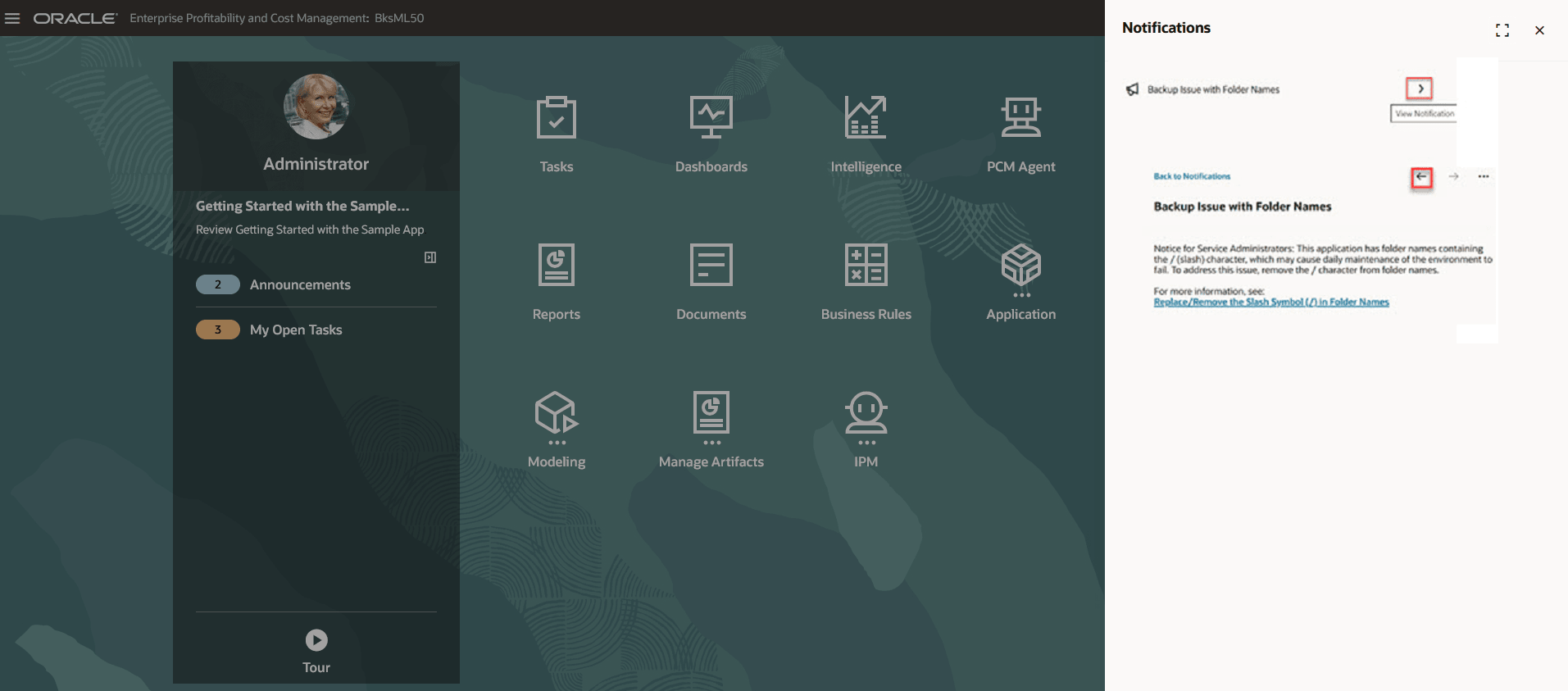
Click the Notifications icon to list instance-level banner messages for admin users. Administrators can review applicable notifications, including previously dismissed messages. The Notifications icon is visible only to administrators. To review and read a notification messages, click the
View Notifcation arrow (
|
 |
If you belong to multiple groups or if a navigation flow is assigned to a role, click the Navigation Flow icon to switch navigation flows at runtime. |
|
|
Click your user name to access the Settings and Actions menu. When you hover over the username, the label appears as <user_name>: Settings and Actions. |
 ).
).

Work Area
The cards that display in the work area link you to each functional area to which you have access.
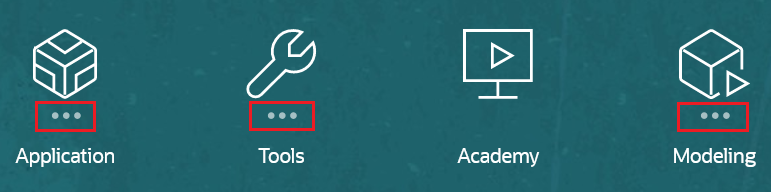
The three dots above a card label denotes that the card opens a grouping of sub-cards, called a cluster. In Enterprise Profitability and Cost Management, the Application, Tools, Modeling, Manage Artifacts, and IPM cards have associated sub-cards.
For example, clicking the three dots above Modeling opens additional options as follows:
Setting Your Profile Picture and Background Image
You can set your profile picture to display at the top of the Announcements panel of the Home page. To set your profile picture, select Tools, and then User Preferences.
To replace the default background image in the work area with a custom background image, select Tools, and then Appearance, and then select a Background Image on the Appearance page.
Announcements
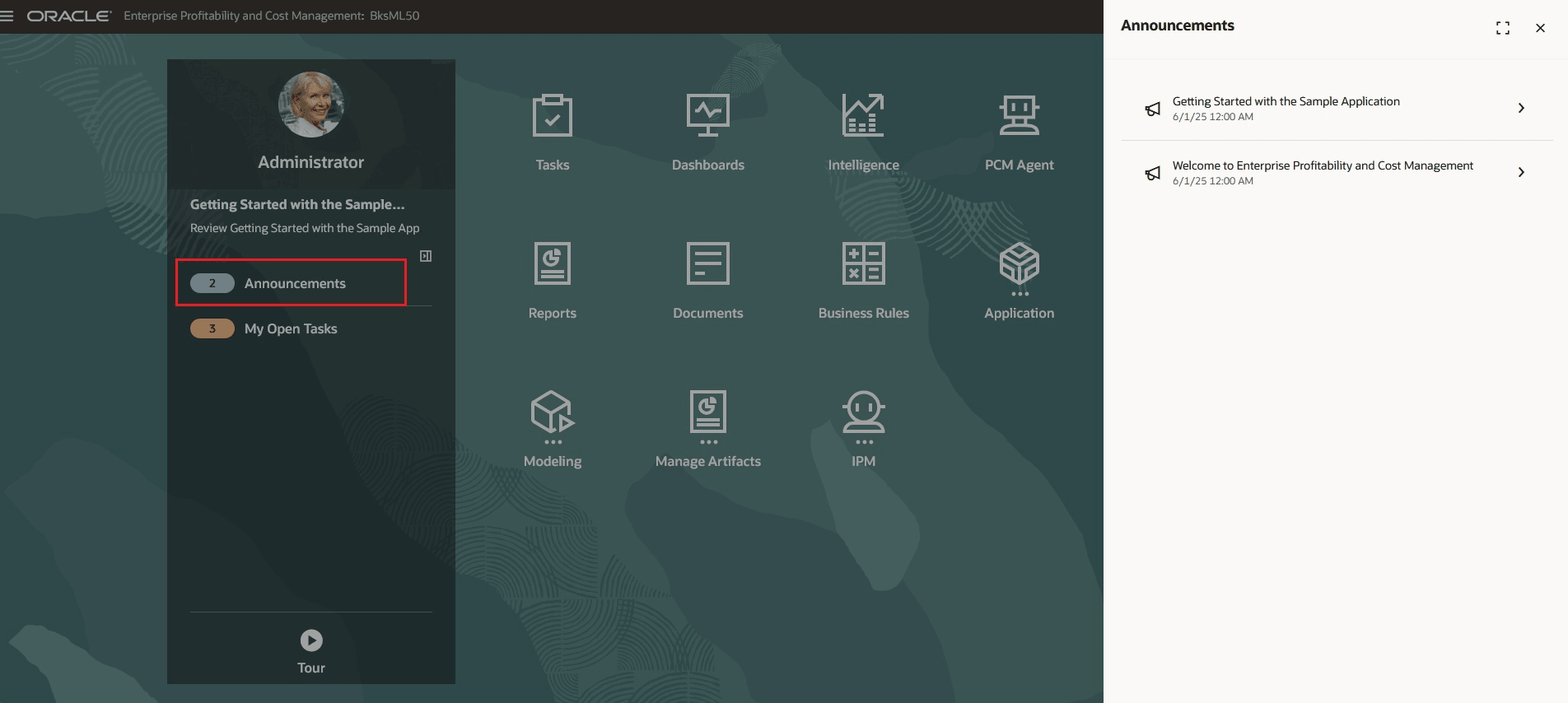
The Announcements Panel displays your user name and profile picture (if set), any system announcements entered by the Service Administrator, and helps you track your activity. The total number of announcements is displayed. Click Announcements to open the complete announcement list, where you can choose an announcement to read.
My Open Tasks
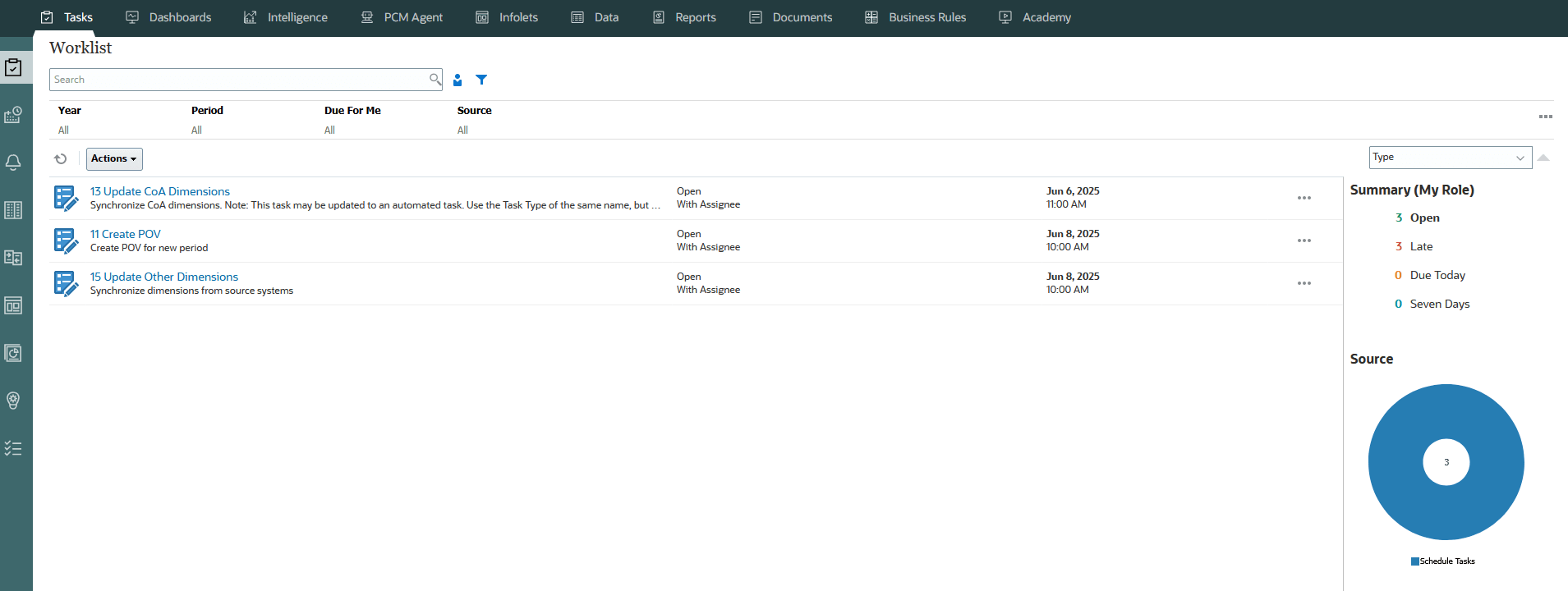
If Task Manager is enabled, click My Open Tasks to open the Worklist page in Task Manager where you can review and work on any relevant tasks.
Videos
Click the Tour icon ( ) to launch a video about key features in the business process.
Table -2 Other Available Videos
| Your Goal | Watch This Video |
|---|---|
| Explore the default Redwood theme. |  Overview: Announcing EPM Cloud's new Redwood Theme |
| Learn how to customize the interface to streamline workflow. | Overview: Customizing Workflow in Enterprise Performance Management Cloud |