Refer to the Parent Record of a Record
When writing rules in a decision service or flow project, use the "parent" keyword in combination with the colon operator to refer to the parent record of the record currently in scope.
For example, if you had the following object model (where → indicates a parent-child relationship between objects):
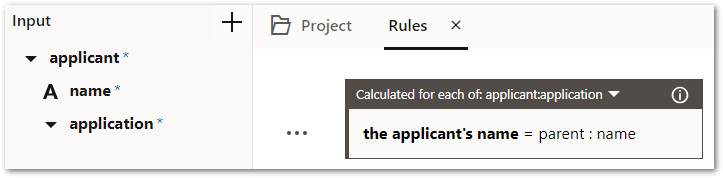
applicant → application
where each applicant record can have any number of child application records, then in a rule block with the scope of 'application', parent : name would return the value of the 'name' field in the 'applicant' object.
The "parent" keyword and the colon operator can be chained. For example, if you had an object model:
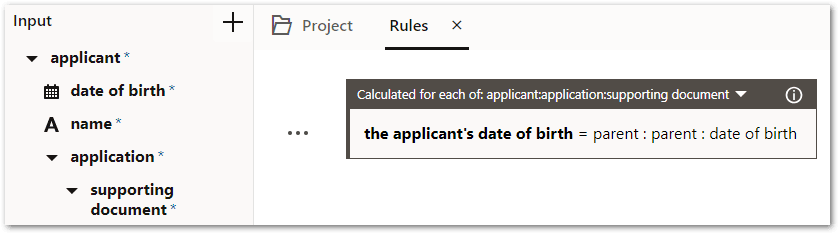
applicant → application → supporting document
where each application record can have any number of supporting document records, then in a rule block with the scope of 'supporting document', parent : parent : date of birth would return the value of the 'date of birth' field in the 'applicant' object.
Note that the parent record can never be null.
Tip: When you want to reference a field in the parent scope that also exists at the current scope, for example, when both the owner of a record list and its target records are of the same object, you need to use a scope alias. For more information, see Reference a field in the parent scope that also exists in the current scope.