Insert Standard Text Into an RTF Form Template
Once opened in Word, standard text and formatting can be added to the RTF template document using normal Word features.
Special consideration needs to be given to fonts in forms generated as PDF documents.
There are several options that you can specify for fonts in RTF form templates used to generate PDF documents:
- generate forms that conform to the PDF/A standard
- generate forms that conform to the PDF/UA standard
- embed TrueType fonts in generated PDF forms
- substitute fonts with other TrueType fonts in generated PDF forms
Generate forms that conform to the PDF/A standard
You have the option to override all the fonts you have defined in your RTF template and have the generated PDF document use and embed the Albany fonts instead. The generated forms will conform to the PDF/A standard which makes them suitable for long-term archiving. The PDF/A version supported is PDF/A-1b.
To generate forms that conform to the PDF/A standard:
- In Policy Modeling on the Projects tab, select the Forms subtab.
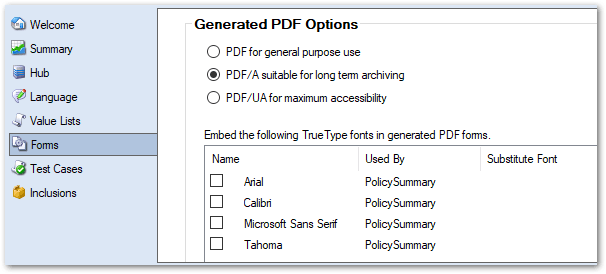
- In the Generated PDF Options section, select the option PDF/A suitable for long term archiving.
Generate forms that conform to the PDF/UA standard
You have the option to generate forms that conform to the PDF/UA standard to ensure maximum accessibility. To use this option, all fonts must be embedded or substituted. PDF/UA forms are compliant with ISO 14289.
To generate forms that conform to the PDF/UA standard:
- In Policy Modeling on the Projects tab, select the Forms subtab.
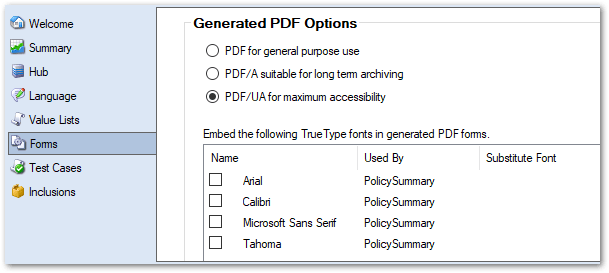
- In the Generated PDF Options section, select the option PDF/UA for maximum accessibility
Note that, by default, a PDF/UA form will have the title "RTF Template". This can be confusing if you have multiple different generated PDF forms open in your PDF reader as the tabs for each of them will be titled "RTF Template". To change the title of the generated PDF, you need to edit the Title property in the RTF form template in Microsoft Word. To do this, open the RTF form template in Microsoft Word and click File, then Info. Under Properties, add the title in the Title field, then save the file.
Embed TrueType fonts in generated PDF forms
You have the option to embed the TrueType fonts used in RTF templates in the generated PDF forms. This ensures that PDF forms match their desired appearance (for example, matching corporate font standards).
If the font is a Analytics Publisher predefined font, no additional setup is required (that is, the font will automatically be embedded in the output document).
If the font is not a Analytics Publisher predefined font, or you are not sure if it is, you can specify in Policy Modeling to embed the TrueType font (assuming the font is embeddable).
To do this:
- In Policy Modeling on the Projects tab, select the Forms subtab.
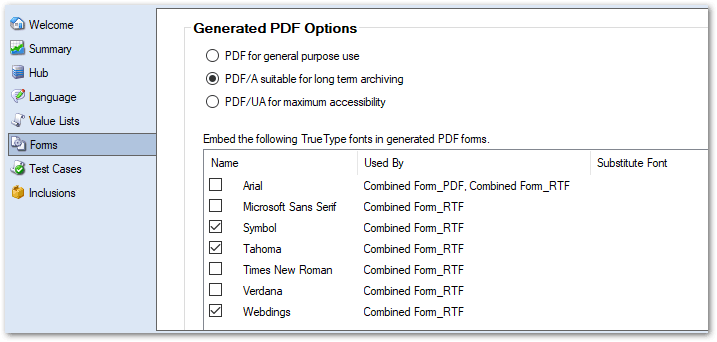
- In the Generated PDF Options section, select the check box next to each font that you want to embed. (The list of fonts displayed will be all of the TrueType fonts currently in use and correctly identifiable in the form templates.) This will copy the font to the FormTemplates/fonts folder in the project so that it can be embedded in the output document. You will only be able to select fonts that permit embedding.
Note: If you do not embed a TrueType font that is used in a template, and the font is not a Analytics Publisher predefined font, the font will be substituted with a Analytics Publisher predefined font in the PDF document. OpenType fonts with an .otf file extension are not supported in Intelligent Advisor RTF form templates. OpenType fonts with a .ttf extension are backwards compatible with TrueType fonts and can be used.
Tip: To include non-English characters (for example, Greek and Arabic) in a generated PDF form, you need to use an embeddable TrueType font that supports those characters, and select the TrueType font for embedding in Policy Modeling.
Substitute fonts with other TrueType fonts in generated PDF forms
You also have the option to substitute a font used in a RTF template with another TrueType font in the generated PDF form. This is used when inserting a barcode into a form. It can also be useful when you do not want to change the template itself (for example, if it is shared with other users).
To substitute a font:
- In Policy Modeling on the Projects tab, select the Forms subtab.
- In the Generated PDF Options section, for the font that you wish to substitute, click in the Substitute Font column.
- Click the drop-down arrow and in the menu select the substitute font. This will copy the substitute font to the FormTemplates/fonts folder in the project so that it can be embedded in the output document. (There is no need to specifically select the font for embedding.)
