Degrees of Relationships
The degree of relationship (also known as cardinality) is the number of occurrences in one entity which are associated with the number of occurrences in another entity. Relationships can be one-to-many, one-to-one, many-to-one or many-to-many.
One-to-many
A one-to-many relationship is where one instance of the source entity interacts with many instances of the target entity. This is the traditional hierarchical model relationship and is the most common relationship type. For example, one university has many students. Each student goes to only one university. The relationship from university to student is one-to-many.
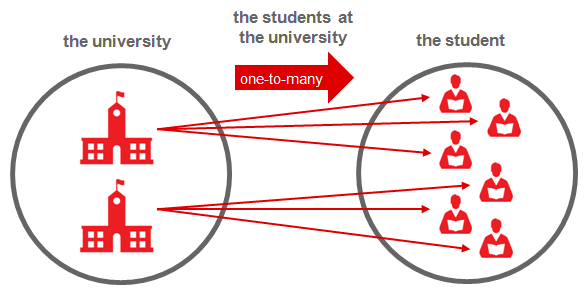
Source entity: the university
Target entity: the student
Relationship type: one-to-many
Relationship text: the students at the university
One-to-one
A one-to-one relationship is where one instance of the source entity interacts with only one instance of the target entity. For example, each student is allocated one laptop. The relationship from student to laptop is one-to-one.
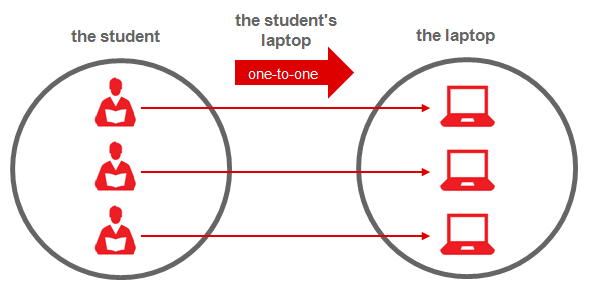
Source entity: the student
Target entity: the laptop
Relationship type: one-to-one
Relationship text: the student's laptop
Many-to-one
A many-to-one relationship is where many instances of the source entity belong to only one instance of the target entity. This is the reverse of a one-to-many relationship. For example, many students attend each university. The relationship from student to university is many-to-one.
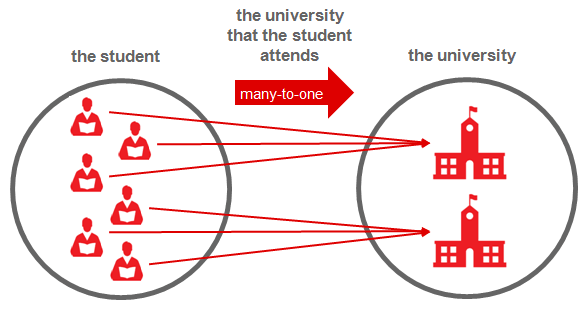
Source entity: the student
Target entity: the university
Relationship type: many-to-one
Relationship text: the university that the student attends
Many-to-many
A many-to-many relationship is where multiple instances of the source entity can interact with many instances of the target entity. For example, each student may have many teachers and each teacher has many students. The relationship from student to teacher is many-to-many.
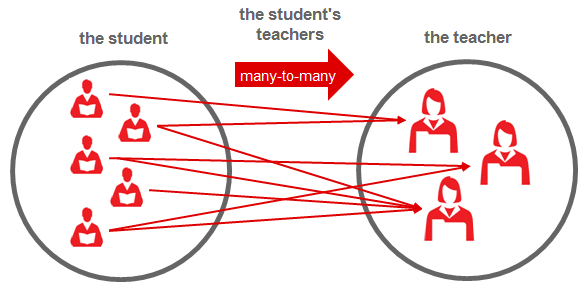
Source entity: the student
Target entity: the teacher
Relationship type: many-to-many
Relationship text: the student's teachers