Reverse Relationships
A reverse relationship describes the relationship from the target entity back to the source entity. For example, if the parent is the source entity and the child is the target entity, then the reverse relationship is the relationship from the child to the parent.
All relationships have a reverse relationship, however, not all reverse relationships are relevant to the policy model. For example, it might be useful to collect that an applicant has applied for multiple benefits but there is no need to identify all of the applicants for a particular benefit.
If both directions of the relationship will be used in your rules, or (for reference relationships) you have a screen which collects it, then you must give the reverse relationship a name in the Edit Relationship dialog in Policy Modeling. Note that relationships from the global entity to a non-global entity do not require a name on the reverse relationship (because you can always use global attributes in the rules).
Relationships can be collected or inferred only in the primary (forwards) direction. The reverse relationship automatically becomes known when the relationship becomes known.
Note that in the case of many-to-one and many-to-many relationships, this can result in the reverse relationship being partially known. Take the following example:
-
Two entities: "the customer" and "the product"
-
Three instances of the customer: Dakota, Winona and Anakin
-
Three instances of the product: laptop, monitor, hard drive
A many-to-many relationship between the customer and the product called "the customer's chosen products". The reverse (many-to-many) relationship called "the customers who chose the product".
If Winona's chosen product is set to laptop (solid grey line below), then Winona is automatically set as one of the customers who chose laptop (solid yellow line). There is no information about Dakota and Anakin however. The customer's chosen product is unknown for both of these entity instances. Hence, it is not known whether Dakota and Anakin are members of the customers who chose laptop. They may or may not be, which is why they are represented with a yellow dotted line.
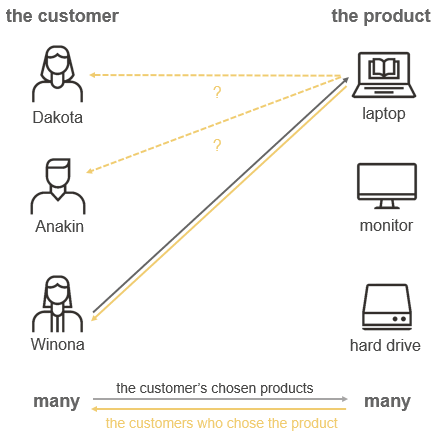
This leads to a situation of partial knowledge. For laptop, the customers who chose the product is a partially known relationship. There is one known target, Winona, and Dakota and Anakin may or may not be members of the relationship.