Connect with Your Oracle Eloqua Data Source (Preview)

If you’ve subscribed for Oracle Fusion CX Analytics and want to load data from your Oracle Eloqua data source into NetSuite Analytics Warehouse, then create a connection using the Eloqua connection type.

The Oracle Eloqua data that you load into NetSuite Analytics Warehouse enables you to augment the data in your warehouse and create varied customer experience-related analytics. Ensure that Oracle Eloqua is enabled on the Enable Features page prior to creating this connection. See Make Preview Features Available.

The Oracle Eloqua data source connector supports the use Oracle Cloud Infrastructure Vault to store your Oracle Eloqua data source connection secrets. When you create a connector for your Oracle Eloqua data source, you can choose to use Oracle Cloud Infrastructure Vault (Customer Vault option) to store your sensitive connection secrets such as passwords. You must add the OCI Identity and Access Management (IAM) policy in the root compartment of your tenancy to allow NetSuite Analytics Warehouse to retrieve the Eloqua connection password from the specified OCI Vault.

  1. In Oracle NetSuite Analytics Warehouse Console, click Data Configuration under Application Administration.
  2. On the Data Configuration page, select Oracle Eloqua in Data Source, then click Manage Connections under Configurations.
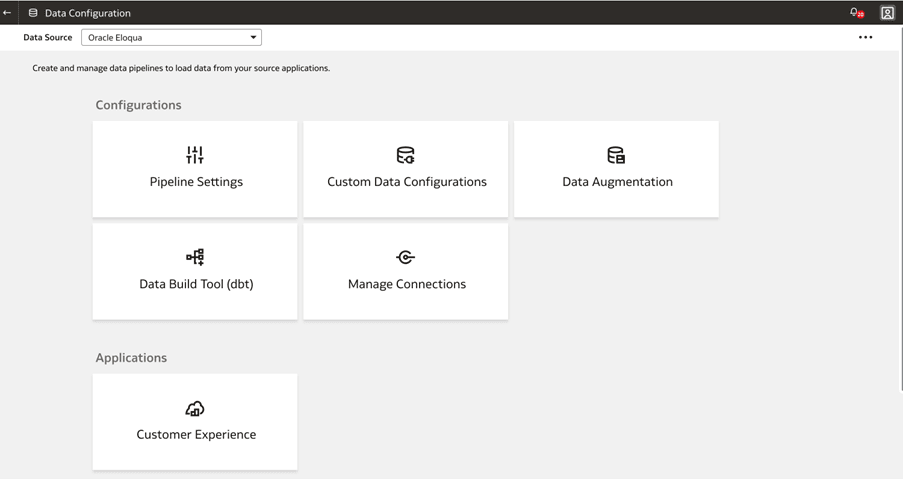
    Select Oracle Eloqua as the Data Source

  3. On the Manage Connections page, click Create and then click Connection.
  4. In Create Connection, select Data Extraction in Usage Type, verify that Connectivity Type and Connection Name are populated automatically.
  5. If you want to store your password for Oracle Eloqua data source connection in Oracle Cloud Infrastructure Vault (OCI Vault) in your tenancy, make sure you have selected the Customer Vault option for Store Secrets.

    To allow Oracle NetSuite Analytics Warehouse to retrieve the Eloqua connection password from the specified OCI Vault, you must add the following Identity and Access Management (IAM) policy in the root compartment of your tenancy.

    allow any-user to {SECRET_BUNDLE_READ, SECRET_READ} in tenancy where all {
      request.principal.type in ('fawextsvc'),
      target.secret.id in ('SECRET_OCID')
    }
    

    Replace SECRET_OCID with the password secret OCID (Oracle Cloud Identifier) string that points directly to the Oracle Eloqua connection password stored inside the OCI Vault or Secret Management service.

    For example,

    allow any-user to {SECRET_BUNDLE_READ, SECRET_READ} in tenancy where all { 
    request.principal.type in ('fawextsvc'), 
    target.secret.id in ('ocid1.vaultsecret.oc1.iad.amaaaaaa4us7r3yahhfbawhyxkyomxnl')
     }
    
  6. Provide the details to connect with the Oracle Eloqua source.
    • User Name - Enter the username as "CompanyName\UserName", where "CompanyName" is the name of your company in the Eloqua instance and "UserName" is the username in the Eloqua instance.
    • Customer Tenancy OCID – Enter your tenancy OCID (Oracle Cloud Identifier) that identifies your root cloud account
    • Vault Tenancy OCID – Enter your vault tenancy OCID where your OCI Vault resides.
    • Password Secret OCID – Enter your password secret OCID (Oracle Cloud Identifier) string that points directly to a secure password stored inside the OCI Vault or Secret Management service.
    • URL - enter the URL for your Eloqua server in this sample format: https://<your eloqua server>/api/odata.
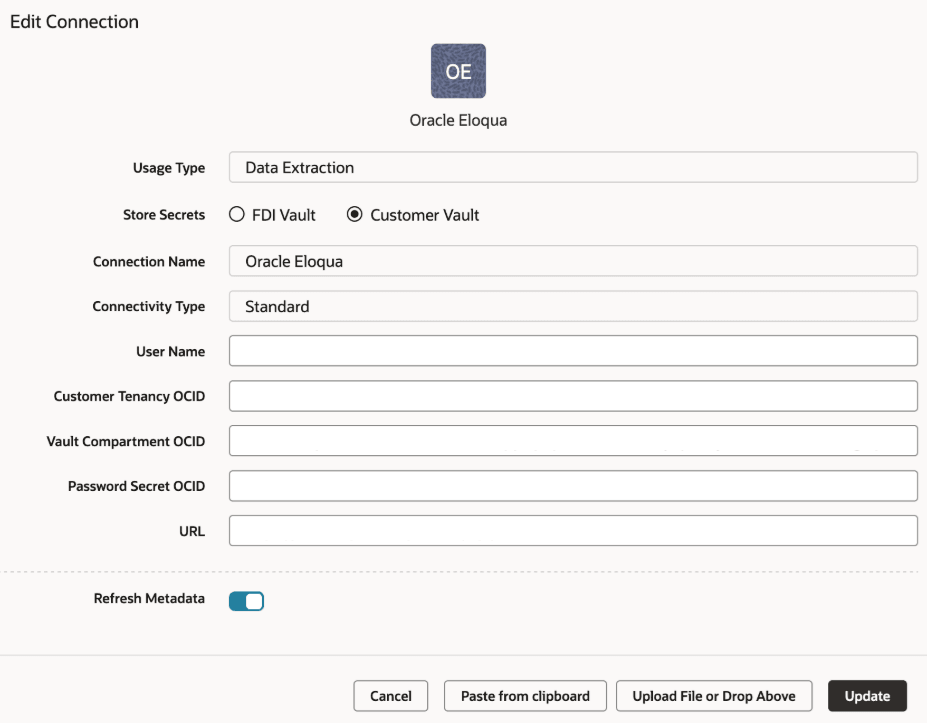

  7. Verify that the Refresh Metadata toggle is enabled to ensure that the metadata is refreshed when you save the connection.
    You can later refresh the metadata from the Actions menu on the Manage Connections page, if required.

    Note:

    You can’t create augmentations for Eloqua unless you perform a metadata extract.
  8. Click Save.
  9. On the Manage Connections page, select Actions for the Eloqua connection and then select Test Connection.
  10. To delete a connection, on the Manage Connections page, click Actions for the applicable connection and select Delete.

    Note:

    Ensure that you delete the data augmentations and data applications related to the data connection before deleting it. You can't update or load data from deleted data connections to the warehouse.
  11. After the connections are successfully established, navigate to the Data Configuration page, select the connection in Data Source, then click the Data Augmentation tile, and create a data augmentation using the Eloqua data. Select the applicable Eloqua source tables. See Augment Your Data.