Example of Resource Mapping Using Rules of Precedence
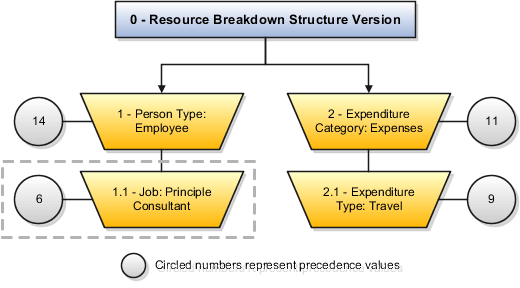
In this example, a time card transaction for a principle consultant who incurs travel expenses maps to two branches.
-
The first branch consists of two levels (1-Person Type: Employee and 1.1-Job: Principle Consultant). The highest level has a precedence number of 14, and the lowest level has a precedence number of 6, for a sum of 20 for the branch.
-
The second branch also consists of two levels (2-Expenditure Category: Expenses and 2.1-Expenditure Type: Travel). The highest level has a precedence number of 11, and the lowest level has a precedence number of 9, for a sum of 20 for the branch.
The transaction cost amount is mapped to the Job: Principle Consultant resource element because it has the lowest number (6) at the lowest level.