Use Supply Chain Orchestration to Support Contract Manufacturing for Process Manufacturing In Your Plan-to-Produce Flows
Oracle Supply Chain Planning will send a planned order to Oracle Supply Chain Orchestration, then Supply Chain Orchestration will create a process work order to track the manufacturing progress at the contract manufacturers facility and a purchase order on the contract manufacturer to pay for the manufacturing services. Supply Chain Orchestration will also manage the demand changes that it receives from Supply Chain Planning and supply changes from the Contract Manufacturer to keep demand and supply synchronized with each other.
Realize these benefits:
- End-to-End Supply Chain Visibility and Control
- Real-time Progress Tracking: Oracle Supply Chain Orchestration provides seamless creation and monitoring of process work orders at the contract manufacturer’s facility, enabling OEMs to track order status and production milestones with full transparency.
- Proactive Exception Management: Immediate awareness of deviations in production or supply allows quicker resolution and better risk mitigation.
- Automated Supply and Demand Synchronization
- Dynamic Alignment: Automated management instantly updates orders based on Supply Chain Planning’s demand changes and contract manufacturer’s supply updates, minimizing mismatches and reducing the risk of shortages or overages.
- Agility in Demand Fluctuations: Quick response to demand changes lets businesses seize new opportunities or adjust to market shifts efficiently.
- Streamlined Financial and Operational Processes
- Integrated Purchase and Work Order Management: Automatic generation of purchase orders ensures swift, accurate payment for contract manufacturing services and reduces manual administrative effort.
- Accurate Cost Control: Direct linkage between manufacturing activity and payment cycles improves traceability and financial planning.
- Focus on Core Business and Innovation
- Resource Reallocation: Automation and outsourcing free up internal resources to focus on innovation, customer relationships, and market development rather than complex manufacturing oversight.
You can now completely outsource a process manufactured product to an external contract manufacturer and track the progress of the manufacturing progress at the contract manufacturer's facility. You, as an OEM can supply one or more ingredients to the contract manufacturer that are required to manufacture a product. You can either pre-position some of the ingredients in bulk at the contract manufacturer's facility or you can transfer the ingredients for every order you place on your contract manufacturer.
This is how it works:
Forward Flow:
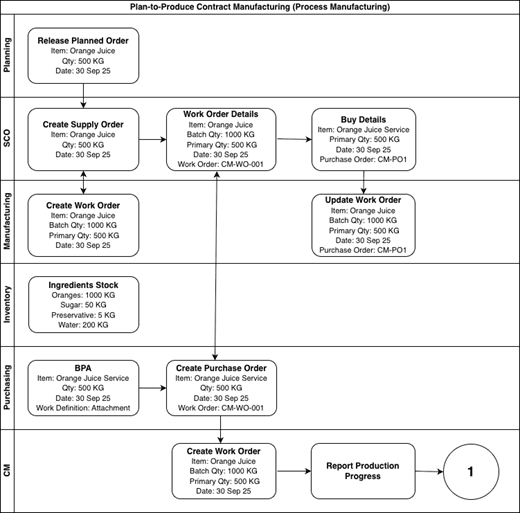
- Supply Planning will release planned order for a Primary Product to Supply Chain Orchestration (SCO).
- Supply Planning will also send the work definition id/name for the primary product. Planning will also send the work method used in the work definition as part of the supply request
- SCO receives the supply request from supply planning for the Primary Product
- SCO will identify this supply request as a contract manufacturing request based on the item attribute of the primary product
- SCO will also identify that this supply request needs to be fulfilled using process manufacturing based on the work method code sent by supply planning
- SCO will create a supply order, supply order line, supply tracking line for the primary product with the requested Qty and requested need by date, and assigns the Plan-to-Produce Contract Manufacturing orchestration process and initiates the execution process for fulfilling the demand
- SCO will send a work order create request for Primary Product to MFG with Requested Qty mapped to Primary Product Quantity in the create request
- MFG will calculate the Batch Qty based on the primary product qty passed as per the scaling logic that exists within MFG and will create a process Mfg work order
- Once the process work order is created, SCO will capture the work order details in SCO. SCO will also capture the work order batch size and store it in SCO
- SCO will then, send a purchase requisition create request to PRC for Primary Product Service item with primary product Qty as the requested Qty. SCO will also, send the CM Work Order Details along with the purchase requisition create request
- PRC will create a purchase requisition and will stamp the CM work order details. Once the PR is created, based on the BPA setup for the Primary Product Service item, PRC will auto create the PO and the CM work order details are stamped on the CM PO as well
- The PO is sent to the contract manufacturer. The work definition Pdf or json file will go as an attachment to the PO.
- SCO will capture the PR/PO details in SCO and will start tracking the PO
- SCO will then send an Update request to MFG to update the CM Work Order with the CM Purchase Order Details
Production Progress Reporting:
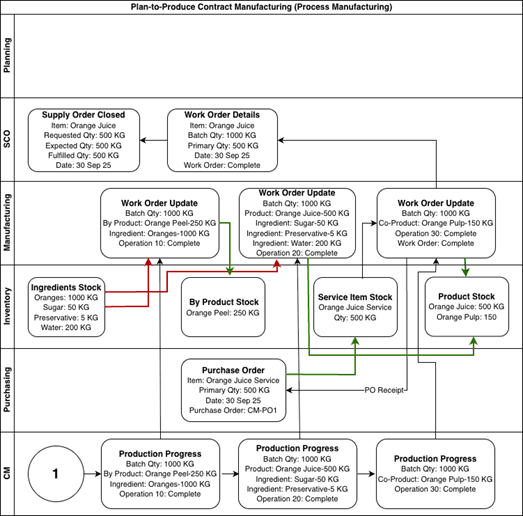
- Contract Manufacturer will be reporting the production progress for every count point operation
- Contract Manufacturer can report production progress per below options:
- Via email or phone (In this case production supervisor will manually update the process work order)
- MFG REST services.
- The contract manufacturer will report the following details at a minimum with each production progress reporting:
- CM WO number
- Primary Product number & Quantity
- Co-Product or By-Product number & Quantity if any
- Operation Sequence
- Operation Status
- Ingredient / Material number & Quantity if any
- As and when the CM reports production progress, the process work order will be progressed as per the reported production progress. If there are any outputs reported like the primary product, co-product or a by-product, they will be recorded in the work order and the inventory for the same will be reflecting in the CM Org. This inventory will be owned by the OEM. Any material consumptions reported by the CM will consume the materials stocked in the CM Org which are owned by the OEM. Thus, accounting for the material and product stocks stored in the CM facility that are owned by the OEM.
- When the CM reports the completions at the last operation, MFG will first invoke the receipt of the service item:
- MFG will read the primary product Qty completed so far from the work order details and will receive the CM service item Qty equal to the primary product Qty
- In cases where the primary product Qty is completed in a prior operation to the last operation and the CM reports partial batch Qty completion, MFG will use the scaling logic to determine the primary product quantity based on the batch quantity completed in the last operation. MFG will receive the CM service item Qty equal to the deduced primary product Qty
- The CM service item is received into the CM org. Then, MFG will complete the last operation for the same quantity. Once the last operation is completed, the CM service item will be automatically issued to the work order as the CM service item will be set to backflush.
- SCO will be tracking all completions at the last operation of the CM work order. SCO will record the completed quantities of the primary product and mark those quantities as fulfilled.
- SCO will also manage all the changes, be it from demand side or supply side and will always keep the CM work order in sync with the CM purchase order.
- The CM work order will be created in Released status and all the updates on CM work order will be disabled except for the ability to close the work order. The work order will be progressed only through work execution.
Create Flow:
Production Reporting Flow:
Steps to enable and configure
You don't need to do anything to enable this feature.
Tips and considerations
Setup Requirements:
- Create a Contract Manufacturing Org
- Enable the Contract Manufacturing Org for Process Manufacturing
- Create Primary Product in Dual UOM
- Create CM Service item in Dual UOM with same UOMs as the Primary Product UOMs
- Primary Product, Co-Product and By-Product will be defined as planned items and planning will have visibility to these items in the CM Org
- CM Service item will NOT be a planned item and hence planning will not plan for this item
- Create OEM supplied ingredients and CM supplied ingredients
- OEM supplied ingredients stock can be maintained within the CM premises by setting these items as Min-Max Planned items
- OEM supplied ingredients can be shipped to the CM against each purchase order that OEM places on the CM. This can be achieved setting up such ingredients as planned items with transfer sourcing. Planning will release Planned Transfer Orders to SCO in such cases
- Create a Process Manufacturing work definition (Work Method = Process Manufacturing)
- All operations where Primary Product, Co-Product and By-Product are yielding needs to be defined as count point operations in Process Manufacturing Work Definition
- Associate the Service item to the last operation in the Process Work Definition
- Primary Product, Co-Product & By-Product can be output from any operation and need not be from the last operation
- Print Process Work Definition PDF
- Create BPA for Service Item.
- Associate the Work Definition PDF to the BPA
Key resources
Access requirements
Users who are assigned a configured job role that contains these privileges can access this feature:
- Process Supply Order Interface (DOS_PROCESS_SUPPLY_ORDER_INTERFACE_PRIV)
- View Supply Orders (DOS_VIEW_SUPPLY_ORDERS_PRIV)
- Manage Supply Request Exceptions (DOS_MANAGE_SUPPLY_REQUEST_EXCEPTIONS_PRIV)
- View Supply Order Exceptions and Status (DOS_VIEW_SUPPLY_ORDER_EXCEPTIONS_AND_STATUS_PRIV)
These privileges were available prior to this update.