Rollup Costs for Parallel Work Order Operations Using Precedence Constraints
Work orders aren’t limited to a strictly linear execution model, and quantities can split, merge, and flow across multiple operational paths. You can plan for your product costs even when your work definitions have parallel operations enabled. This allows for accurate calculation of your product costs when using the standard cost method. You can cost work orders with parallel operations across both process manufacturing and discrete manufacturing.
Process Manufacturing
In process manufacturing work definitions, when you roll up the costs of your products, the transfer percentage indicates the percentage of batch quantity that moves to the next operation. The impact of transfer percentage continues until the parallel operations merge, and this is calculated as the cumulative transfer percentage. If you also use operation yield with parallel operation, the cumulative yield needs to account for the transfer percentage.
When an operation has multiple predecessors, cumulative values are calculated by summing the contributions from each incoming path:
- Cumulative yield for operation with multiple previous operations = Sum (Cumulative yield of previous operation * Operation yield of current operation * Transfer percentage from previous operation)
- Cumulative transfer percentage for operation with multiple previous operations = Sum (Cumulative transfer percentage of previous operation * Transfer percentage from previous operation)
Let’s consider this example where the process manufacturing work definition has the operations dependency setup as described in the table.
| From Operation | To Operation | Transfer Percentage |
|---|---|---|
| Null | 10 | 100% |
| 10 | 20 | 50% |
| 10 | 30 | 50% |
| 20 | 40 | 100% |
| 30 | 40 | 100% |
| 40 | Null | Null |
With operation yield defined for operations, the cumulative yield and cumulative transfer percentage are calculated as described in this table:
| Operation | Operation Yield | Cumulative Yield | Cumulative Transfer Percentage |
|---|---|---|---|
| 10 | 0.5 | 0.5 | 100% |
| 20 | 0.6 | 0.15 | 50% |
| 30 | 0.25 | 0.0625 | 50% |
| 40 | 0.85 | 0.180625 | 100% |
For calculating the costs, the ingredients and resources planned to be consumed on a variable basis are scaled as follows:
- Ingredient scaling factor = Cumulative yield of the operation where ingredient or resource is consumed / (Operation yield of operation * Cumulative transfer percentage of operation)
- Product scaling factor = Cumulative yield of the operation where product is yielded / Cumulative transfer percentage of operation
When an operation has multiple previous operations, the cumulative costs at the start of the operation will be sum of the carried over costs from all immediate previous operations.
On the Rolled-up Costs page, you can review the operations and percentage details across these columns: Previous Operation Sequence, Transfer Percentage, and Cumulative Transfer Percentage. However, reverse cumulative yield values aren't displayed on this page for process manufacturing work definitions.
Discrete Manufacturing
In discrete manufacturing work definitions with parallel operations, to calculate the costs of outputs it's assumed that the cost is split evenly across parallel operations. When an operation has multiple previous operations, the cumulative costs at the start of the operation will be sum of the carried over costs from all immediate previous operations.
Let’s look at this example of a discrete manufacturing work definition with operation dependencies as described in the table.
| From Operation | To Operation |
|---|---|
| Null | 10 |
| 10 | 20 |
| 10 | 30 |
| 20 | 40 |
| 30 | 40 |
| 40 | Null |
As the cost is split evenly between parallel operations, the carried over cost from Operation 10 is split evenly between Operation 20 and Operation 30, thereby making the transfer percentage as 50. In all other cases, the transfer percentage will be assumed to be 100%.
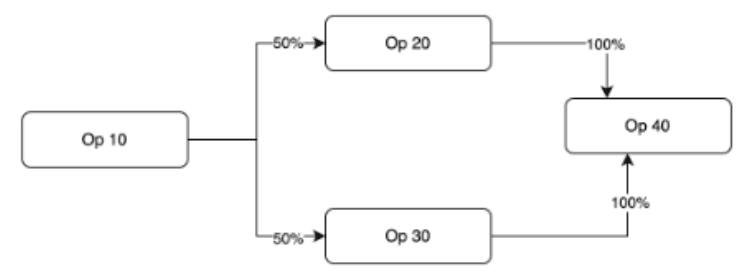
With multiple previous operations, at the start of Operation 40, the cumulative cost will be the sum of carried over costs from Operation 20 and Operation 30, which are its immediate previous operations.
There's no difference in calculating the estimated scrap loss for these work definitions. The cumulative yield attribute isn’t shown for these work definitions.