Shipment Management
Calculation of Loaded Equipment Dimensions for External Distance Engines
For the purpose of insuring the proper street level routing, OTM needs to send equipment dimensions (weight, length, width and height) to the external distance engines (EDEs). Correct dimensions are needed for street level directions for tunnel and overhead height restrictions, bridge weight restrictions and so on. Some configuration is needed for sending equipment dimensions to external distance engines.
Not all EDEs use the same data, the same way, so results may vary. For example, some EDE vendors will not provide a route if the height, length, width or weight are beyond the maximum allowed. Refer to the vendors documentation for further details.
Calculation for PC*Miler
Currently, PC*Miler uses the external dimensions of the equipment instead of calculated length,width and height.
Equipment Dimensions for HERE
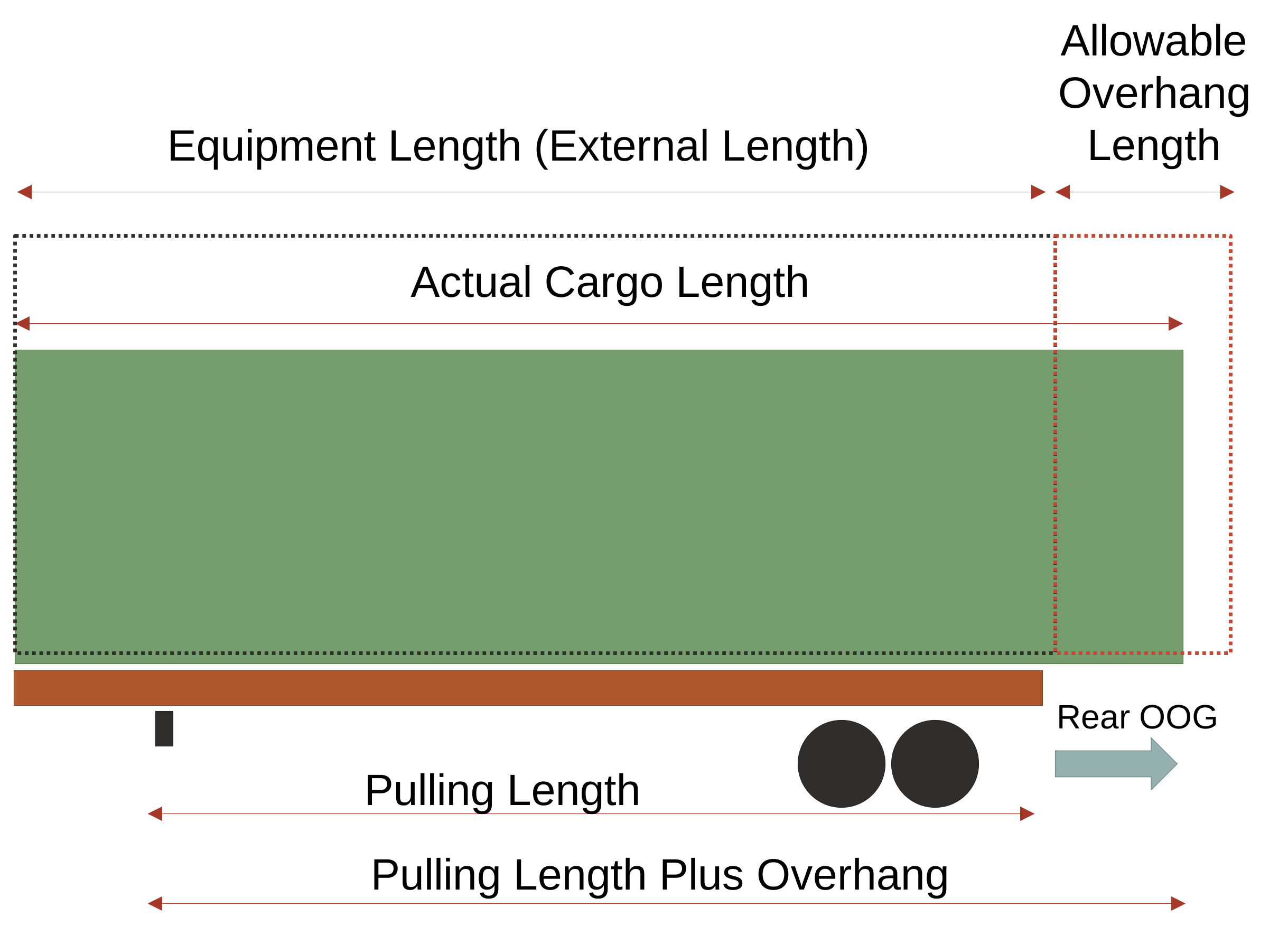
Equipment dimensions include the weight, length, width and height of the total equipment. This includes the proper weight (tare weight of the trailer, power unit weight, and then freight content/shipment weight). It also includes the dimensions - length of trailer (or trailers in the case of a combo) plus power unit - or potentially - length and height - considering the freight itself - in the case of a flatbed. It also includes out-of-gauge goods and pulling length (in case of semi-trailers, combo equipment, and so on).
- Self-contained: If the equipment is self contained, OTM will use the external length.
- Semi-trailer or B-train leader: OTM will get the pulling length of a tractor or dromedary and combine with the pulling length of the trailer. Pulling length is used in all cases except for self contained. So, Equipment Length = Pulling Length (power Unit) + Pulling Length (Trailer1).
- Overhang allowed: If there is overhang, as indicated by the Allow Rear Overhang checkbox on the truck type, the Pulling Length on the equipment group and the Lengthwise Forward Offset on the compartment, the additional length will be used. The lengthwise forward offset is the shift of the compartment forward by a distance lengthwise offset towards the front of the equipment origin (0,0,0).
The parameter "DEFAULT POWER UNIT FOR LENGTH CALCULATION" is used by OTM to calculate the Truck Length used in external distance engines. The power unit length is needed for length calculation as well as the trailer length. During planning, OTM does not know the power unit for a given shipment. This parameter specifies a default power unit which OTM will use for truck length calculation. The default is "DEFAULT FOR PLANNING".
OTM will use the external width defined unless it is an out of gauge case. Out of Gauge is defined by setting the Allow Side Overhang on the truck type and Widthwise Offset field on the compartment on the Equipment Group manager. The widthwise offset is the shift of the compartment by that distance towards the left of the equipment origin (0,0,0). The widthwise offset shifts the compartment towards the left of the equipment but the load will not be centered in the equipment. A user defined Load Configuration 3D pattern is needed for that.
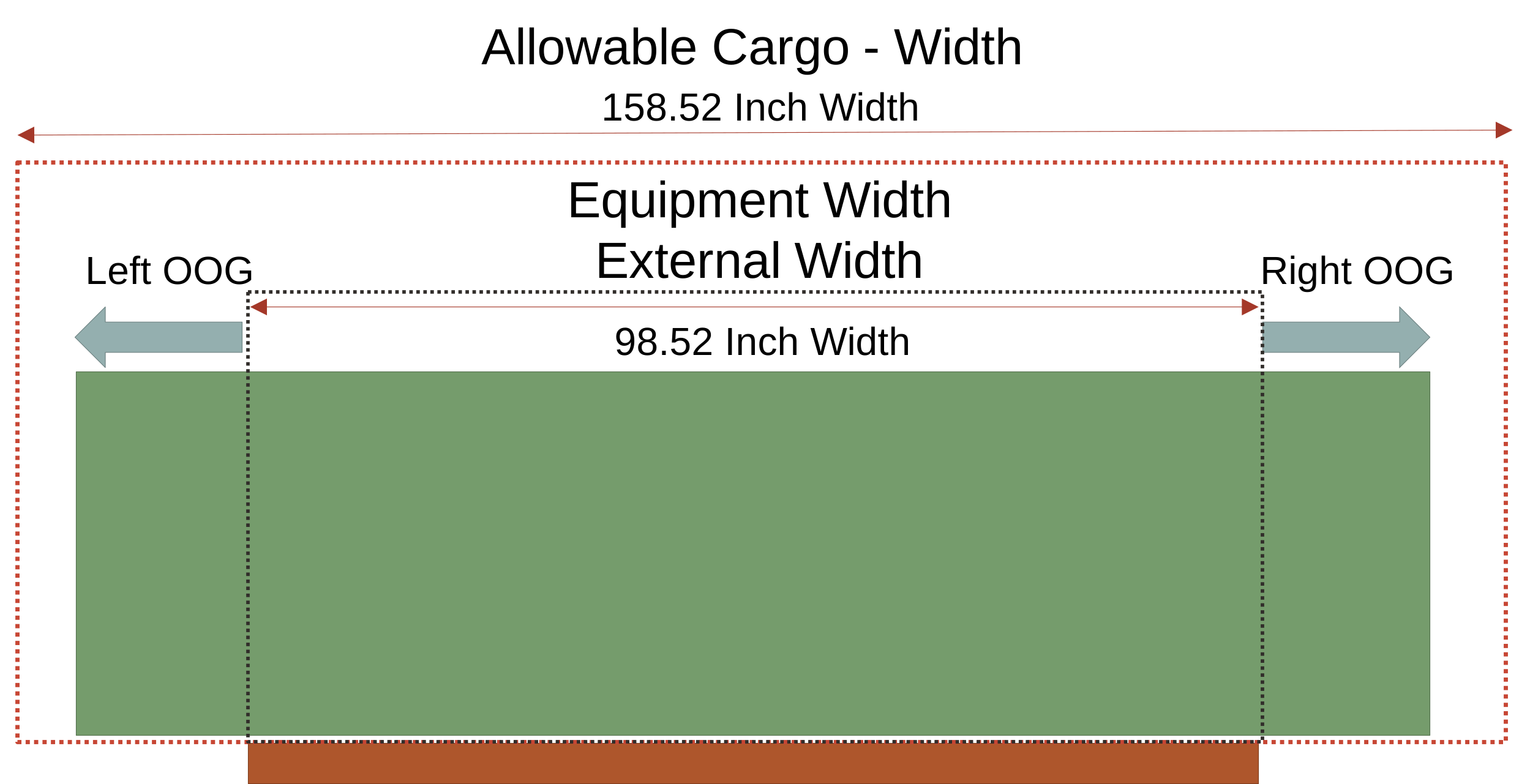
The pictorial representation of the OOG Loading is illustrated above where:
- black dotted lines represent the width of the equipment envelope (98.52 IN).
- red dotted lines represent the Out of Gauge envelope (158.52 IN).
- green box shows the width of the actual cargo.
- and grey arrows represent the OOG dimensions of the actual cargo.
The height is calculated based on the roof type on the truck type.
- Closed: fixed height – Use the external height dimension. For truck equipment with permanent wheels, this is fixed.
- Flatbed: no roof – The floor height plus the cargo height.
- Open Top: Calculation for open top truck types is the maximum of floor height plus cargo height or the exterior height, whichever is greater.
Related Topics
