Redwood: Smart Search and Results
You can use Smart Search to narrow down the search results. Then, you can use the Results section of the page to create, edit, or delete a record.
Using Smart Search
Below, you see the Smart Search on the Redwood Equipment Types manager.

Smart Search offers several ways to narrow down your search results:
- enter words, partial word, numbers, etc. to search by
- select one of the filters directly below the search bar and when prompted enter numbers or text
- select in the search bar to see a full list of all filters available and select one, then enter numbers or text
- if available, select the Saved Searches to see a list of saved queries
Filters
To filter the search results, select filters or enter words, partial word, numbers, etc. to search by. Then, select Enter or anywhere outside the search bar to filter the search results. Each time you select Enter, the filter word or words that you type appear in the search bar and the results below are limited based on the filters entered. You can enter multiple filters and you see all search terms listed in the search bar. Select the x next to a search term to remove it.
Using the Filters
There are multiple ways to use the filters provided for you. By default, all fields on the screen set.
The Smart Search uses the fields on screen set search tab to load the filters shown below the search bar. Select a filter. For example, Equipment Type ID.
- Enter the first few letters or numbers in the text box that appears.
- Then, select outside the Smart Search field to search for all Equipment Type IDs that start with the letter or numbers that you entered above.
- You see the results in the table directly below the Smart Search.
Search by Unit of Measure
Some fields can be searched based on specific units of measure such as weight, volume, temperature, numbers, currencies, and size in length/width. In these cases, you can control your search by selecting a unit of measure and then
You can set a Minimum and a Maximum
- Between: This is the default. Enter a Minimum and a Maximum
- More than: Enter a Minimum
- Less than: Enter a Maximum
Examples
Let's look at some example filters:
- A contains search is applied when you enter a single filter value.
For example, if you enter the filter ship the search returns only rows that contain the text ship. - If you enter multiple search criteria, each criteria limits the search further. When you add another filter, the filter is expanded by searching for both the initial filer AND the new one.
For example, if you add two filters ship and 111, the results display all records that contain both ship (or its combinations) and 111 (or its combinations) across all searchable fields. - If you enter multiple words as a filter by separating the word by a space within the same filter, an OR search is performed. Multiple spaces treated as single space. Any leading and trailing spaces are ignored.
Searching by purchase order returns all rows that contain either purchase (or its combinations) or order (or its combinations) across all searchable attributes. - If filter is enclosed within double quotes, "filter filters", the search is conducted for a entire value within the quotes (search is still case insensitive). For example, if you enter a filter of "purchase order" the search returns all rows with purchase order (or its combination) as a substring in one or the searchable attributes.
- If there are columns that have true/false as the possible values, you can enter true in the search field and only records with a value of true are returned.
Note: Search pages are configured to display up to 1,000 records as the result of any search. This limit can be changed by your System Administrator.
Using Saved Searches
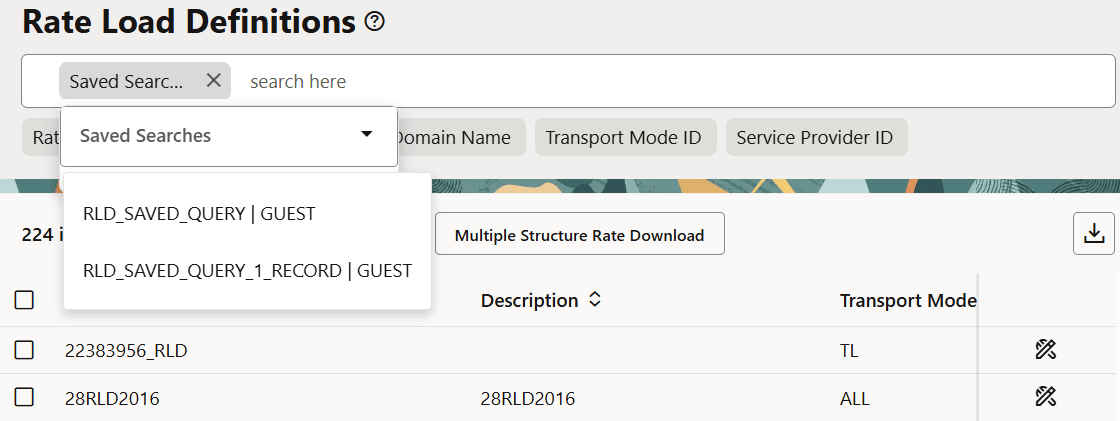
If there are saved queries available, select the Saved Searches filter to see a drop-down list as shown on the screen shot below. If there is no Saved Searches filter, then are no saved queries available.
Viewing Search Results
The results section of the page populates automatically based on what is in the search bar. You can use Results pages to perform the following tasks:
- Review the list of resulting records
- Edit a record
- Delete a record
- Add a new record
The number counter lists the number of records that resulted from your search. The default record limit for display is 1,000.
New Business Object
The Search and Results pages display a Add button for creating new business objects and power data.
Use the following generic steps to add a new business object.
- Select Add and enter data for the fields that are presented.
- Select Submit to save the business object to the database.
You can use Results pages to perform the following tasks (depending on the business object):
- Review the list of resulting records.
- Edit a record inline on the results page.
- Navigate to the manager for record to make edits.
- Delete a record.
- Execute a new filter or saved query.
The results section of the page displays the records that result from the default search with does not use any filters.
The following icons appear on each Results page:
- Select
 (Add) to create a business object and display the first data-entry page for an object that you want to create.
 - Select
 (Export) to save the selected records to Microsoft Excel file.
 - If the record is editable inline,
 (Edit) and you can edit any fields that are set to Editable in the screen set.
 - Select the
 (Edit) to edit the object inline in the results table. Or, select Edit to display three icons:
- Select
 (View) to display a summary page for the selected business object.
 - Select (Edit) to open the record in an edit page.
- Select
 (Delete) to delete the selected business object.
- Select
Always select the Submit button at the top of any page to save changes for all records that you have edited.
Note: Some page sections have Save buttons that save the data just for that section (or grid). However, always use the Submit button to save all of your modifications to the database.
Inline Editing of Search Results
Inline editing allows you to edit records on the results page without additional navigation. When you double-click a row, you enter edit mode. You can also enter edit mode as follows:
- Double-click a row to activate inline edit. Or, select (Edit) and then select the second (Edit) icon.
- Edit any fields that are configured to be editable. Use the Results tab of the screen set manager to make fields editable.
- To discard your changes, select
 (Cancel). Note that the values cannot be reverted once the data has been saved.
 - Edit a value and select the Save icon (
 ) to save the value to the database. Or, select out of the row to automatically save the changes.
Note: Not all Finders are compatible with Inline Editing functionality. For example, you cannot edit fields on any SERPROV table using the inline editing functionality.
Export (to Microsoft Excel)
Use the Export button to display the results of your query in a Microsoft Excel spreadsheet. The total number of records appears first as a result of the search criteria entered. Select OK to display those records in spreadsheet format.
You can then open the file in Microsoft Excel. The column headings are the same as those that would appear on the Results page (as defined in the active Screen Set) if you performed a standard search.
Smart Search and Enhanced Workbench
You can use Smart Search in the Enhanced Workbench by enabling the Smart Search Population Method when creating or editing a layout. The Smart Search appears as follows on an Enhanced Workbench layout:

Related Topics
Redwood: About the Redwood Experience
Redwood: Ask Oracle Landing Page
Redwood: Working with Qualifiers
