14.8.1 Studying API Handler Package Layers
Study how ORDS handlers call a REST layer that delegates to shared core API logic.
v1 module template
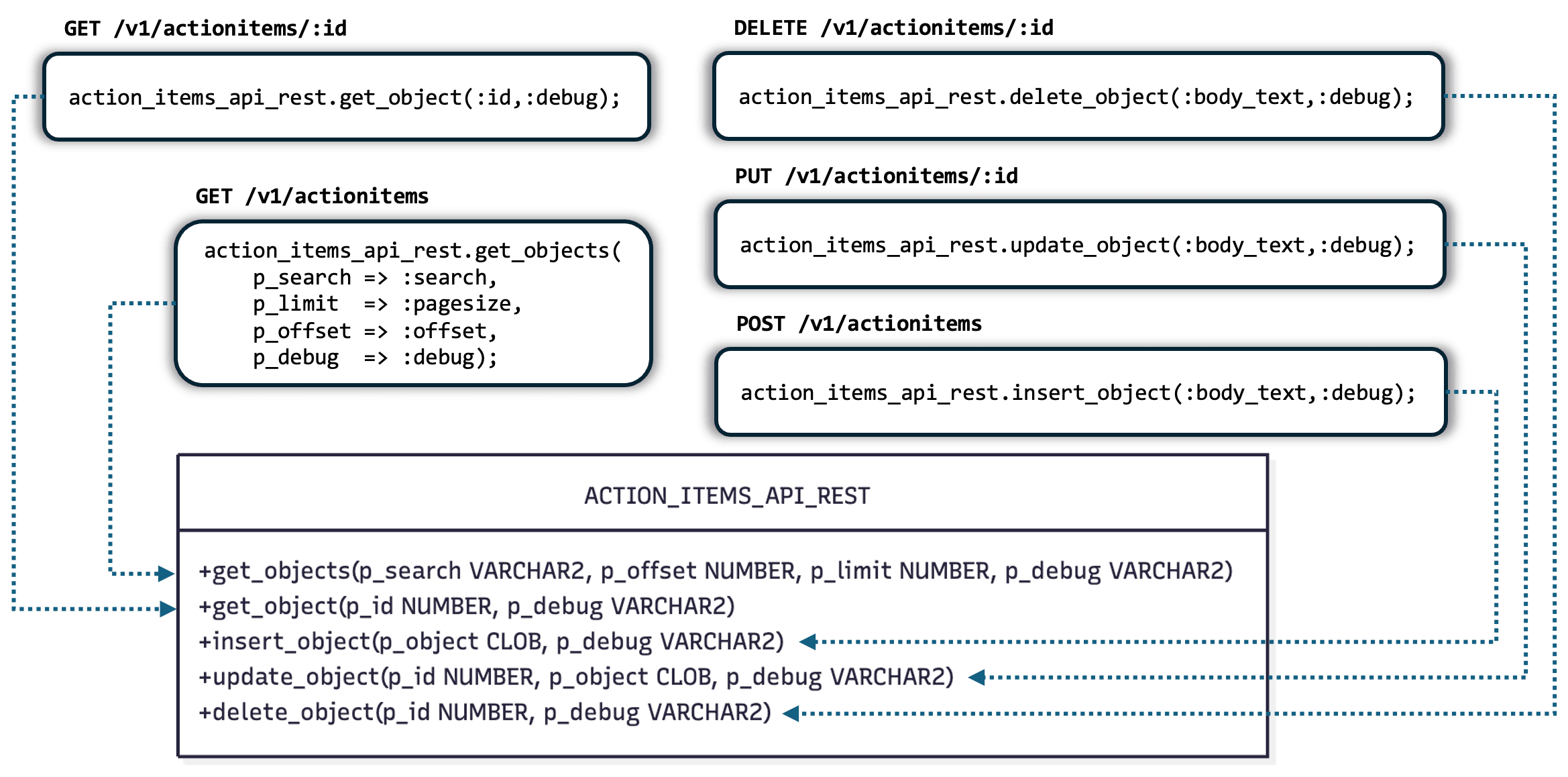
handlers call appropriate procedures in the ACTIONS_ITEMS_API_REST
package. Each handler uses a combination of ORDS implicit and explicit parameter bind
variables to pass incoming request information to the corresponding package procedure.
The digram shows the following ORDS handlers and the
ACTION_ITEMS_API_REST procedure each invokes:
GET/v1/actionitems→get_objectsGET/v1/actionitems/:id→get_objectPOST/v1/actionitems→insert_objectPUT/v1/actionitems/:id→update_objectDELETE/v1/actionitems/:id→delete_object
Figure 14-22 Each ORDS Handler Call an ACTION_ITEMS_API_REST Procedure
The package specification for ACTION_ITEMS_API_REST appears below.
package action_items_api_rest as
    ------------------------------------
    procedure get_objects(
        p_search in varchar2,
        p_offset in number   default 0,
        p_limit  in number   default 10,
        p_debug  in varchar2 default null);
    ------------------------------------
    procedure get_object(
        p_id in number,
        p_debug  in varchar2 default null);
    ------------------------------------
    procedure insert_object(
        p_object in clob,
        p_debug  in varchar2 default null);
    ------------------------------------
    procedure update_object(
        p_id     in number,
        p_object in clob,
        p_debug  in varchar2 default null);
    ------------------------------------
    procedure delete_object(
        p_id     in number,
        p_debug  in varchar2 default null);
end action_items_api_rest;
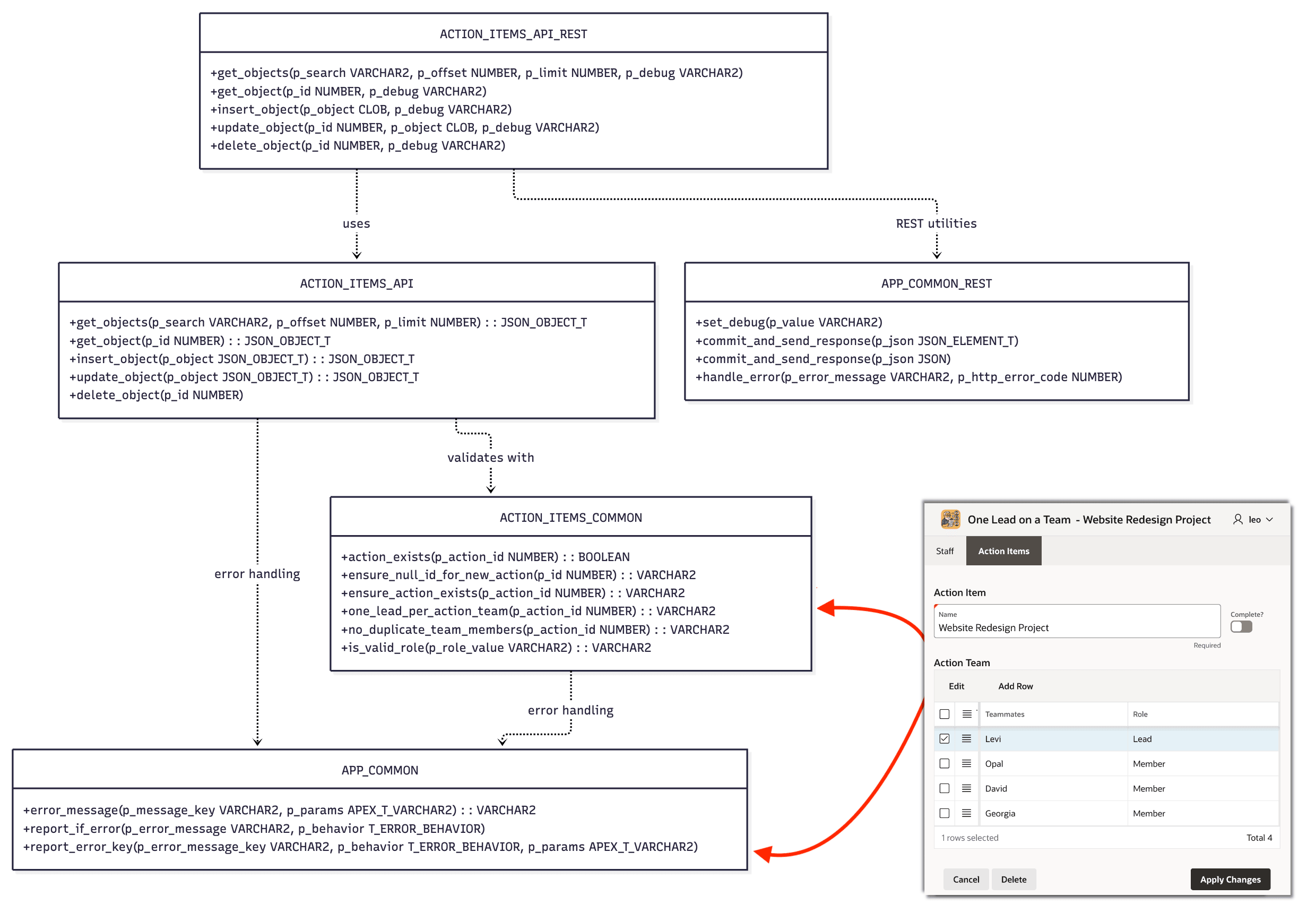
As shown below, the ACTION_ITEMS_API_REST package is a REST-specific layer on top of the ACTIONS_ITEM_API package that contains the core of the API logic. Its simple procedures essentially convert the incoming JSON CLOB payloads into a JSON_OBJECT_T types to pass to the core Action Items API package. Then they use the common functionality in APP_COMMON_REST to write out the response or error details. This layering keeps the ORDS handler PL/SQL blocks extremely simple.
Notice in the diagram how the ACTION_ITEMS_API package reuses application-wide common code from APP_COMMON and Action Item specific common validation logic from ACTION_ITEMS_COMMON. This layering maximizes reuse so your application pages and REST APIs apply the same checks to modified data, regardless of how the users or external systems submit it.
ACTION_ITEMS_API_RESTusesACTION_ITEMS_APIfor logicAPP_COMMON_RESTas a REST services helper
ACTION_ITEMS_APIusesACTION_ITEMS_COMMONfor validationAPP_COMMONfor error handling
ACTION_ITEMS_COMMONalso usesAPP_COMMONfor error handling
ACTION_ITEMS_COMMONfor validationAPP_COMMONfor error handling
Figure 14-23 Layered Package Design for Sharing Business Logic with a Page
Parent topic: Layering Packages for Modularity