Import a Notebook
You can import notebooks into your Oracle Machine Learning UI projects.
Oracle Machine Learning UI supports the import of notebooks in the native format
(.dsnb), Zeppelin (.json) and Jupyter
(.ipynb) notebooks. Oracle Machine Learning UI also supports importing
notebooks from your GitHub repository.
Oracle Machine Learning UI supports the import of both Zeppelin
(
.json) and Jupyter (.ipynb) notebooks.
You can import a notebook on the Notebooks page. To import a notebook, go to
the OML Notebooks page.
Import Notebook from File
To import a notebook from file:
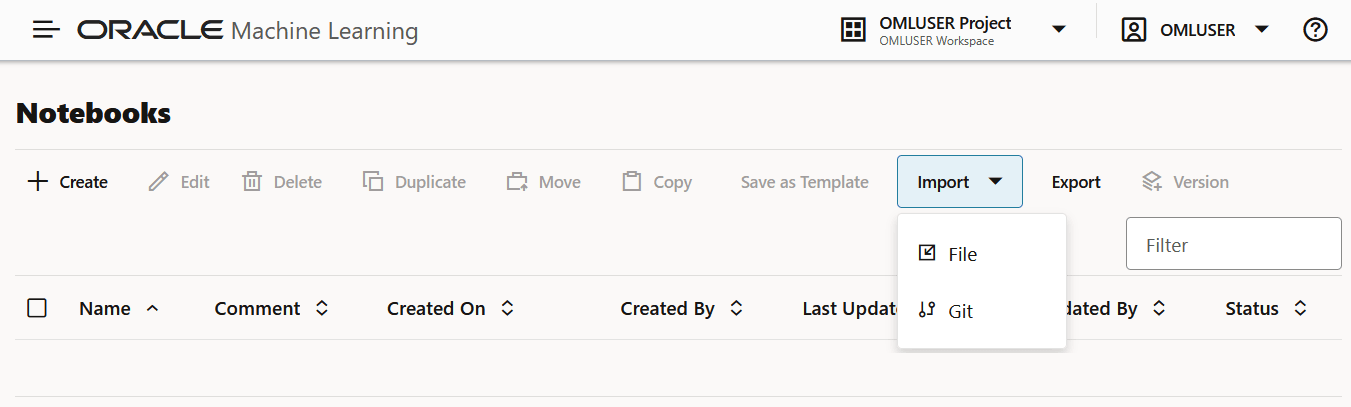
- On the Notebooks page, click Import. Here, you have
two options—File and Git.
- Click File. This opens the File Upload dialog.
- In the File Upload dialog, browse and
select the notebook to import.
Note:
You must have the notebook saved as a.jsonfile or.dsnbfile to import it. You can import notebooks exported from non-Oracle Apache Zeppelin environments, but only paragraphs types that are supported may be run. - Click Open.
This completes the task of importing a notebook file into your project.
Import/Clone Notebooks from GitHub
- On the Notebooks page, click Import. Here, you have two options—File and Git.
- Click Git. This opens the GitHub
Checkout page.
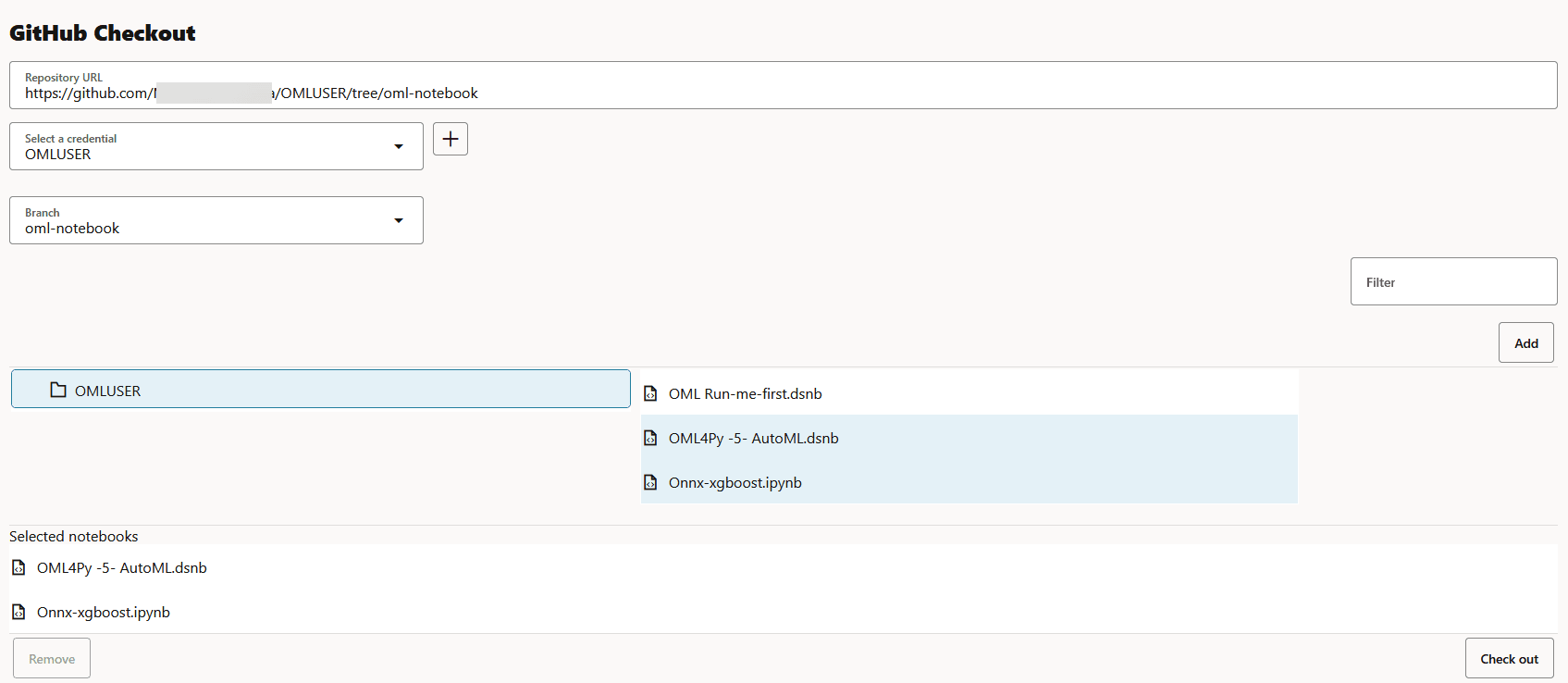
- On the GitHub Checkout page, enter these
details:
- Repository URL: Enter the URL of
the GitHub repository you want to access. You have the following
options to provide the GitHub repository URL:
- Minimum valid URL:
You can provide the GitHub URL containing only the
repository name and the owner. For example,
https://github.com/RepoOwner/RepoName. This loads the branches found in the remote repository. - Base URL and branch:
Enter the GitHub repository URL along with the branch
you want to clone. For example,
https://github.com/RepoOwner/RepoName/tree/BranchName/orhttps://github.com/RepoOwner/RepoName/blob/BranchName/. This automatically loads the Branches field. Select the Branch Name defined in the URL. and this will trigger the load of the directory structure found in the repository. - Base URL, branch and
directory: You can also provide the
GitHub URL containing one or several sub-directories in
the remote repository. For example,
https://github.com/RepoOwner/RepoName/tree/Branch/Dir/Di2rThis loads the directory structure and pre-select the directory specified in the URL. - Complete file path:
You can also enter the complete file path in the remote
GitHub repository. For example,
https://github.com/RepoOwner/RepoName/blob/Branch/Dir/file.dsnb. This loads the branches, directories and the file in the Selected notebooks field at the bottom of the dialog.
- Minimum valid URL:
You can provide the GitHub URL containing only the
repository name and the owner. For example,
- Select a credential: Click the down arrow and select a credential. If you do not have a credential created, click the + icon to create one. See Create GitHub Credentials for more information.
- Branch: The drop-down menu displays the branches available in the remote GitHub repository based on the specified repository owner, repository name, and credential combination. Select a branch. The notebooks available in the branch are listed. You can also filter the notebooks you are looking for by typing in the notebook name in the Filter field.
- Select the notebooks you want to clone and click Add. The notebooks you selected are now listed in the Selected notebooks section.
- Click Checkout. This starts cloning all the GitHub notebooks you selected. Once completed, it displays the message "Notebooks successfully cloned". Click Open Notebook listing on the message box to go to the Notebooks listing page.
This completes the task of cloning and importing a notebook from your GitHub repository.
- Repository URL: Enter the URL of
the GitHub repository you want to access. You have the following
options to provide the GitHub repository URL:
Parent topic: OML Notebooks