XMLSERIALIZE
Syntax
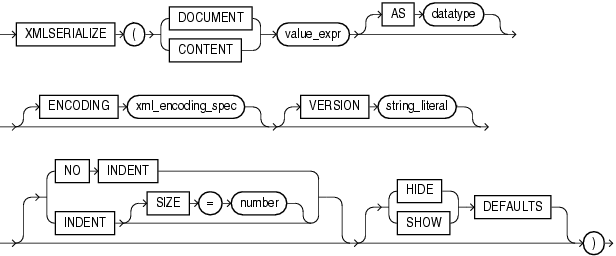
Description of the illustration xmlserialize.gif
Description of the illustration xmlserialize.eps
Purpose
XMLSerialize creates a string or LOB containing the contents of value_expr.
Any lob returned by XMLSERIALIZE will be read-only.
-
If you specify
DOCUMENT, then the value_expr must be a valid XML document. -
If you specify
CONTENT, then the value_expr need not be a singly rooted XML document. However it must be valid XML content. -
The datatype specified can be a string type (
VARCHAR2orVARCHAR, but notNVARCHAR2),BLOB, orCLOB. The default isCLOB. -
If datatype is
BLOB, then you can specify theENCODINGclause to use the specified encoding in the prolog. The xml_encoding_spec is an XML encoding declaration (encoding="..."). -
Specify the
VERSIONclause to use the version you provide as string_literal in the XML declaration (<?xml version="..." ...?>). -
Specify
NOINDENTto strip all insignificant whitespace from the output. SpecifyINDENT SIZE =N, where N is a whole number, for output that is pretty-printed using a relative indentation of N spaces. If N is0, then pretty-printing inserts a newline character after each element, placing each element on a line by itself, but omitting all other insignificant whitespace in the output. IfINDENTis present without aSIZEspecification, then 2-space indenting is used. If you omit this clause, then the behavior (pretty-printing or not) is indeterminate. -
HIDE DEFAULTSandSHOW DEFAULTSapply only to XML schema-based data. If you specifySHOW DEFAULTSand the input data is missing any optional elements or attributes for which the XML schema defines default values, then those elements or attributes are included in the output with their default values. If you specifyHIDE DEFAULTS, then no such elements or attributes are included in the output.HIDE DEFAULTSis the default behavior.
See Also:
-
Oracle XML DB Developer’s Guide for more information on this function
-
in Oracle Database Globalization Support Guide for the collation derivation rules, which define the collation assigned to the character return value of
XMLSERIALIZE
Examples
The following statement uses the DUAL table to illustrate the syntax of XMLSerialize:
SELECT XMLSERIALIZE(CONTENT XMLTYPE('<Owner>Grandco</Owner>')) AS xmlserialize_doc
   FROM DUAL;

XMLSERIALIZE_DOC
----------------
<Owner>Grandco</Owner>