Using True Cache with Global Data Services
Learn how to Improve application performance and scalability by integrating True Cache with GDS for dynamic workload management.
Oracle True Cache is an in-memory, consistent, and automatically managed SQL cache for the database. True Cache improves application response time while reducing the load on the database. Automatic cache management and consistency simplify application development, reducing development effort and cost.
You can deploy Oracle True Cache with Oracle database Global Data Services (GDS) to manage workload routing, dynamic load balancing, and service failover across multiple True Caches and other database replicas.
Global services are functionally similar to the local database application services that are provided by single instance or Oracle Real Application Clusters (Oracle RAC) databases. The main difference between global services and local services is that global services span the instances of multiple databases, whereas local services span the instances of a single database.
This diagram illustrates a basic True Cache configuration with GDS in a single region:
Figure 5-1: True Cache Integration with GDS
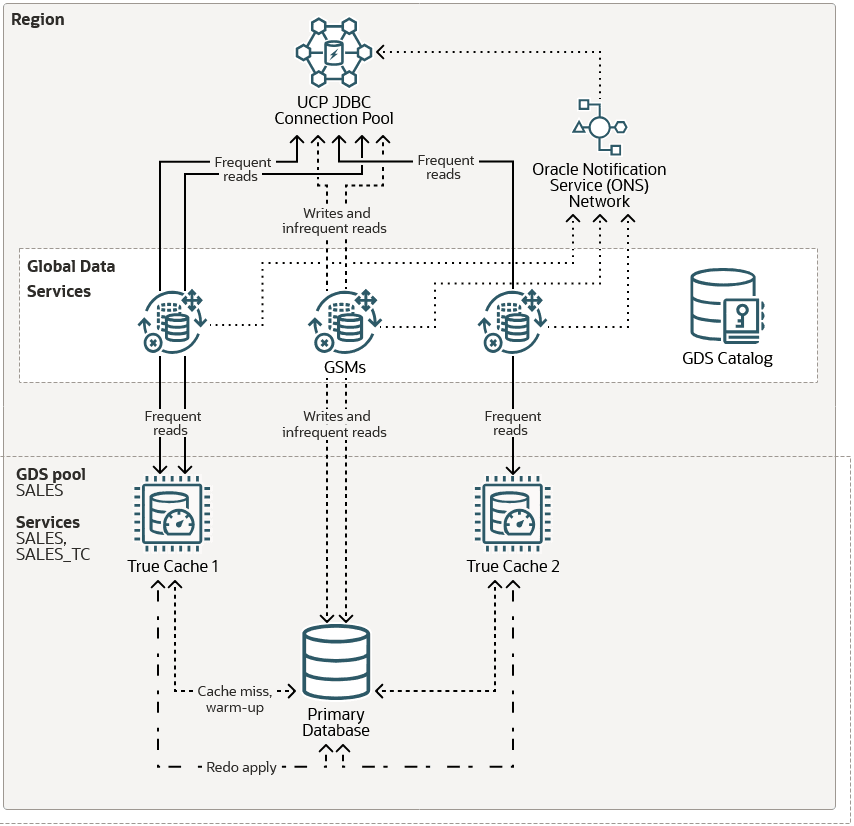
In this example, there is one region with two True Caches and one primary database. True Cache reads from the primary database to warm up the cache or when there's a cache miss. After a block is cached, it's updated automatically through redo apply from the primary database. Applications are configured so that frequent reads go to the True Caches and writes and infrequent reads go to the primary database.
The GDS configuration includes the following components:
- The GDS catalog stores configuration data for the GDS configuration. In this example, the GDS catalog is hosted outside the primary database.
- Global service managers (GSMs) provide service-level load balancing, failover, and centralized management of services in the GDS configuration. For high availability, the best practice is to include two GSMs in each region.
- The GDS pool provides a common set of global services to the primary database and True Caches. A region can contain multiple GDS pools, and these pools can span multiple regions.In this example, the
SALESpool provides theSALESglobal service for the primary database and theSALES_TCglobal service for the True Caches. - An Oracle Notification Service (ONS) server is located with each GSM. All ONS servers in a region are interconnected in an ONS server network. The GSMs create runtime load balancing advisories and publish them to the Oracle universal connection pool (UCP) JDBC connection pool through the ONS server network. Applications request a connection from the pool and the requests are sent to True Caches or the primary database depending on the application configuration and the GDS configuration.
True Cache provides the following integrations with Oracle Global Data Services (GDS).
- GDS provides the
-role TRUE_CACHEoption for global services. - The True Cache application programming model using
JDBC SetReadOnly()supports global services. - GDS provides load balancing and service failover between multiple True Caches.
Deploying True Cache with Oracle GDS has the following restrictions.
- When adding True Cache services in GDSCTL, the
-failover_primaryoption requires the patch for bug 36740927. - If the application uses the JDBC programming model, both the primary database service and True Cache service names must be fully qualified with the domain name (for example,
sales.example.comandsales_tc.example.com). This is because GDS has a default domain name and is different from the database'sdomain_nameparameter. This also limits the fully qualified service name to a maximum of 64 characters.
For more detailed instructions regarding the deployment of Oracle True Cache with Oracle GDS, please see Deploying Oracle True Cache with Oracle Global Data Services
Parent topic: Using Global Data Services (Architectures, Use Cases, Application Development)