Understand and Choose an Iceberg Access Model
Understand the Iceberg Model and Read Path
Iceberg is a table format. Oracle does not discover an Iceberg table by recursively treating every file under a storage prefix as one table. It begins with a table metadata location, resolves a snapshot, reads the relevant manifest metadata, and opens the selected data or delete files that the Oracle access path supports.
Image 4-1. Iceberg Query Resolution
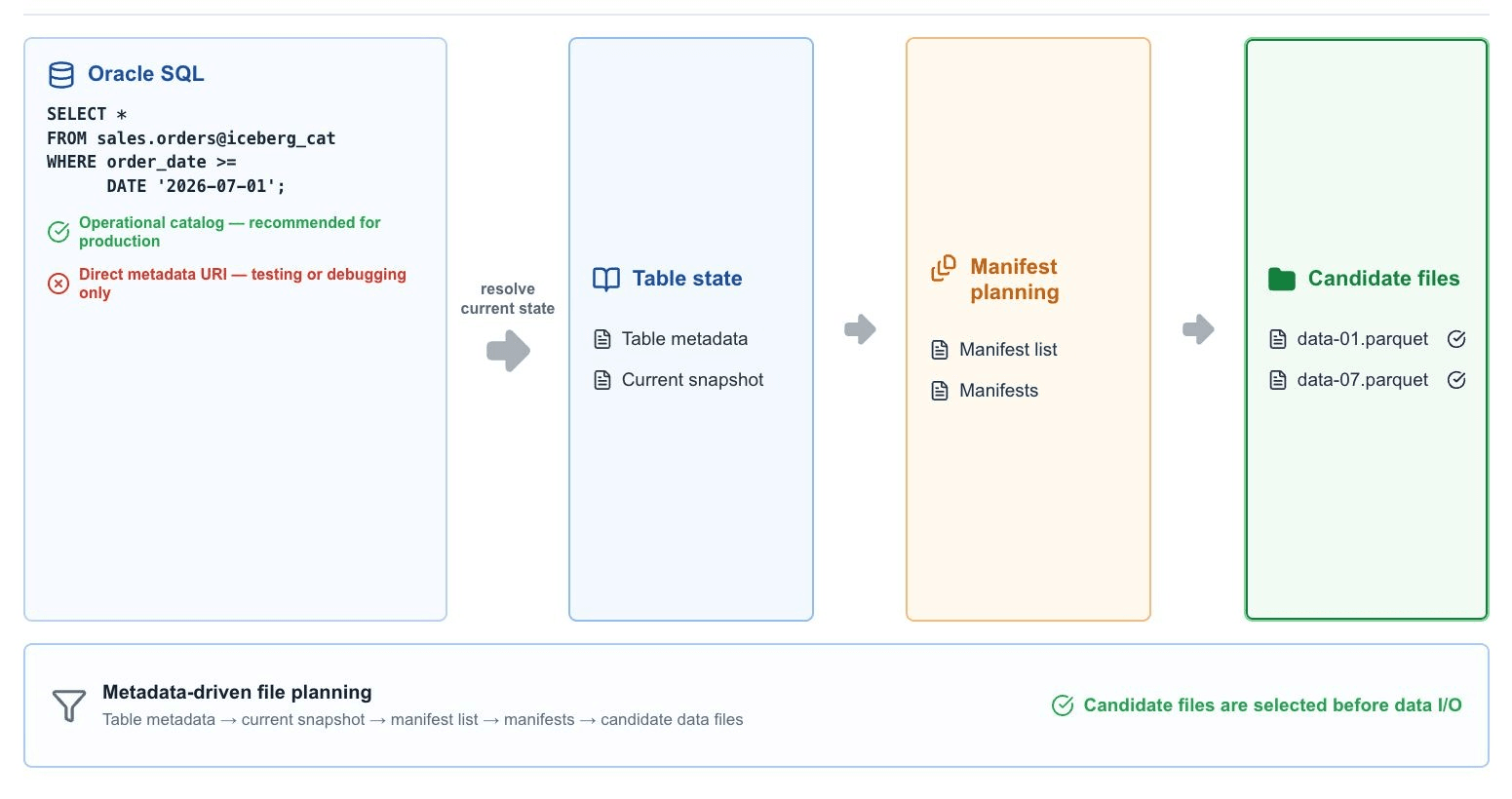
The entry point determines freshness. A catalog can resolve the table’s current metadata location. A direct metadata URI continues to reference the supplied metadata version until the Oracle definition is changed.
Select an Access Model
| Access model | Definition lifecycle | Use when | SQL surface |
|---|---|---|---|
| Persistent external table | Stored in the Oracle data dictionary. | A stable Oracle object, grants, views, and repeated queries are required. | orders_iceberg |
| Inline external table | Exists only in one statement. | A direct or catalog-backed mapping is needed for exploration or a query-specific location. | FROM EXTERNAL (...) |
| Mounted catalog table | The operational catalog remains authoritative; one database stores the mount. | Users must discover and query many catalog-managed tables without creating a local table for each one. | sales.orders@iceberg_cat |
Direct metadata is a resolution choice within the persistent or inline model; it is not a fourth table type.
Understanding the Metadata Objects
| Iceberg Object | Purpose | Why it matters to Oracle |
|---|---|---|
| Table metadata | Defines format version, schemas, partition specifications, properties, snapshots, and the current snapshot reference. | Establishes the table state and logical schema. |
| Snapshot | Identifies a consistent table state and its manifest list. | Determines the complete file set visible to that version. |
| Manifest list | Lists manifests and summary metadata. | Supports scan planning before individual manifests are opened. |
| Manifest | Describes data and delete files, partition values, and file metrics. | Lets Oracle eliminate files that cannot satisfy a query where the access path supports that pruning. |
| Data or delete file | Contains table rows or row-level change information. | The data-storage identity must read every selected object, and the Oracle release must support the file semantics. |
| Catalog | Maps namespaces and table names to current metadata locations. | Provides name-based discovery and current-table resolution. |
For details about snapshots, manifests, partition specifications, and schema evolution, see the Apache Iceberg specification.