StartNode
The enclosing Flow identifies one node through its start_node field. When execution begins, the runtime starts at that node.
Values supplied through the flow input contract become available through the StartNode's named outputs. Downstream nodes receive those values only through declared data-flow connections.
StartNode Fields
| Field | Requirement | Purpose |
|---|---|---|
component_type | Required | Identifies the component as a StartNode. |
id | Required | Unique identity used by the Flow reference and edges. |
name | Required | Provides a human-readable component name. |
inputs | Optional | Declares values accepted at the Flow-entry boundary. |
outputs | Optional | Declares values that can be transferred to other nodes. |
branches | Optional | Branches that outgoing control-flow edges can reference. |
The Flow's start_node reference, the StartNode id, and its referenced component key must agree where references are used.
StartNode Example
The caller supplies a string named request. The StartNode exposes that value as a named output that can be connected to another node:
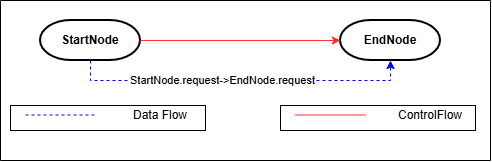
Description of the illustration StartNode Data Handoff to EndNode
{
"component\_type": "StartNode",
"id": "start",
"name": "start",
"inputs": \[{"title": "request", "type": "string"}\],
"outputs": \[{"title": "request", "type": "string"}\],
"branches": \["next"\]
}
This fragment defines only the StartNode. A separate control-flow edge describes a possible next node, and a separate data-flow edge transfers the request output to a declared input of a downstream node.
Complete Runnable Agent Spec
The following example places the StartNode in a complete Flow. The caller supplies request, the StartNode publishes it, and a data-flow edge
transfers it to the EndNode. The Flow then returns the same value through its output contract.
SET SERVEROUTPUT ON SIZE UNLIMITED
SET DEFINE OFF

DECLARE
  l_agent_spec CLOB := q'~
{
  "component_type": "Flow",
  "agentspec_version": "25.4.1",
  "id": "start-node-example-flow",
  "name": "start_node_example_flow",
  "inputs": [
    {
      "title": "request",
      "type": "string"
    }
  ],
  "outputs": [
    {
      "title": "request",
      "type": "string"
    }
  ],
  "start_node": {
    "$component_ref": "start"
  },
  "nodes": [
    {
      "$component_ref": "start"
    },
    {
      "$component_ref": "end"
    }
  ],
  "control_flow_connections": [
    {
      "component_type": "ControlFlowEdge",
      "id": "start-to-end",
      "name": "start_to_end",
      "from_node": {
        "$component_ref": "start"
      },
      "to_node": {
        "$component_ref": "end"
      }
    }
  ],
  "data_flow_connections": [
    {
      "component_type": "DataFlowEdge",
      "id": "request-to-end",
      "name": "request_to_end",
      "source_node": {
        "$component_ref": "start"
      },
      "source_output": "request",
      "destination_node": {
        "$component_ref": "end"
      },
      "destination_input": "request"
    }
  ],
  "$referenced_components": {
    "start": {
      "component_type": "StartNode",
      "id": "start",
      "name": "start",
      "inputs": [
        {
          "title": "request",
          "type": "string"
        }
      ],
      "outputs": [
        {
          "title": "request",
          "type": "string"
        }
      ],
      "branches": [
        "next"
      ]
    },
    "end": {
      "component_type": "EndNode",
      "id": "end",
      "name": "end",
      "inputs": [
        {
          "title": "request",
          "type": "string"
        }
      ],
      "outputs": [
        {
          "title": "request",
          "type": "string"
        }
      ],
      "branches": [],
      "branch_name": "next"
    }
  }
}
~';

  l_inputs CLOB := TO_CLOB(
    '[{"name":"request","value":"Where is order 7812?"}]'
  );

  l_outputs CLOB;
BEGIN
  l_outputs := DBMS_AI_AGENT.EXECUTE_IMMEDIATE(
    agent_spec => l_agent_spec,
    inputs     => l_inputs
  );

  DBMS_OUTPUT.PUT_LINE(
    DBMS_LOB.SUBSTR(l_outputs, 32767, 1)
  );
END;
/
The returned JSON has the following form:
{
  "request": "Where is order 7812?"
}
In this execution:
- The execution input named
requestenters the Flow throughStartNode. StartNodepublishes the value through itsrequestoutput.- The data-flow edge transfers the value to
EndNode.request. - The control-flow edge identifies
EndNodeas the possible next node after
StartNode. EndNodereturns the value through the Flow output namedrequest.