Overview
Oracle Trusted Answer Search maps natural-language questions to curated search targets that applications can use to render approved reports, URLs, or SQL-driven views. This overview describes the product approach, architecture, and user roles.
What Is Trusted Answer Search?
Oracle Trusted Answer Search is a purpose-built language-to-target mapping system for enterprise applications. It maps natural-language user questions to curated, application-defined search targets, such as reports, URLs, or SQL-driven views.
Trusted Answer Search is designed for scenarios where accuracy, speed, security, and repeatability are required. Instead of generating free-form responses, the platform returns curated, structured results that the application can use to render the appropriate report or direct the user to the right page.
Trusted Answer Search combines Oracle AI Vector Search, lexical search, re-ranking techniques, and optional LLM-assisted re-ranking to improve relevance. Search Space Experts can mark returned targets as relevant or irrelevant to a query in the Admin application. That feedback can improve how later queries are matched to search targets.
The platform includes operational controls for enterprise deployment, including change management, versioning, query regression analysis, and staged testing.
The Trusted Answer Search platform is intended to be integrated into applications that want to expose a natural language interface to their users to access the application’s functionality and reports.
Trusted Search Versus Agentic AI
The Enterprise Requirement
Many application experiences require deterministic and auditable outcomes. Users expect the same question to produce the same result, and organizations must ensure confidential data is never exposed.
Limits of General Agentic Patterns for Bounded Tasks
General-purpose Large-Language Model (LLM) and Retrieval-Augmented Generation (RAG) approaches are effective for broad, open-ended questions. However, for bounded, application-specific questions, they can introduce the following issues:
-
Non-deterministic output and potential hallucinations
-
Higher latency and compute cost than required
-
Variable responses across model updates
-
Limited understanding of enterprise-specific jargon since LLMs are not trained on it
-
Low reliability of NL2SQL for complex enterprise schemas
Trusted Answer Search Approach
Trusted Answer Search addresses these issues by using constrained retrieval and controlled outputs:
-
Manages search spaces that contain the search targets.
-
Enables creation of search targets within search spaces. Text Targets use descriptions and sample questions; Regex Targets use rules that match query patterns.
-
Maps natural-language questions to search targets using the search method configured for the search space and target type. Text Targets can use keyword and semantic matching; Regex Targets use their configured rules.
-
Returns pre-curated, non-LLM generated responses that the application interprets to reliably take next steps such as opening a specific report, or redirecting the user to the URL.
-
Supports extraction of parameters from the user’s query, for example: dates, regions, categories, people, companies. These parameters are returned to the application along with the target.
-
Enables feedback and correction workflows so that search space experts can review mismatches, mark matches as valid, propose new search target descriptions or sample questions, or create new search targets, creating a structured loop for improving quality over time.
-
Includes change management and versioning for safe rollout.
-
Preserves security boundaries by relying on targets that are already built to honor end-user identity.
-
Provides out-of-the-box administration and end-user experiences, plus APIs for custom integration.
The result is a practical, enterprise pattern for trusted, repeatable language interfaces.
Architecture and Personas
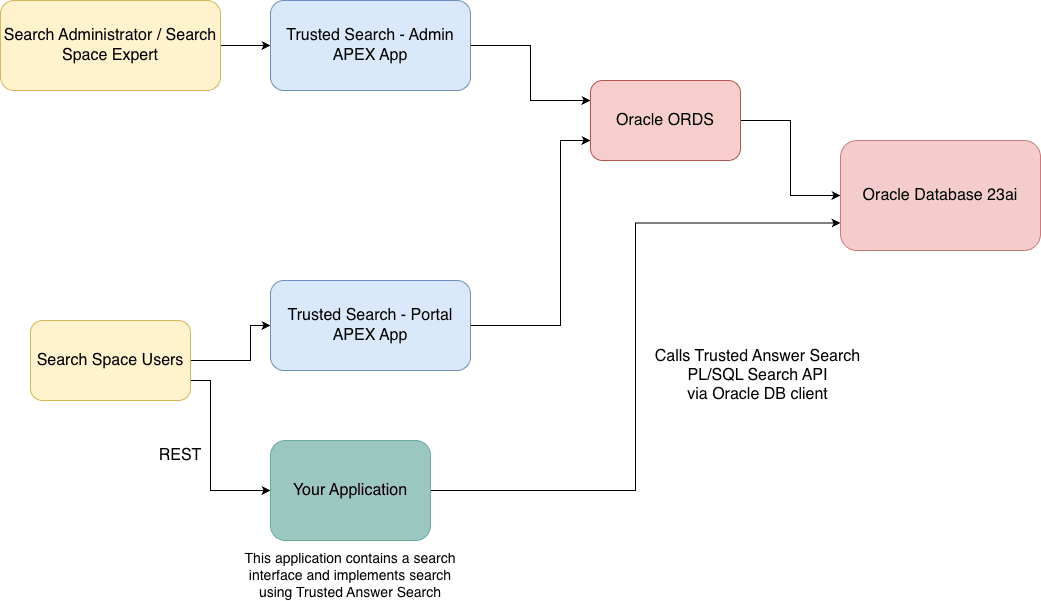
Architecture
Trusted Answer Search includes these components:
-
Admin APEX application: used by search space experts to configure and manage search spaces
-
Search Widgets: pre-built JavaScript widgets that embed Trusted Answer Search into an existing application page as a search bar or floating search icon
-
Search API: used by developers who want the maximum flexibility to integrate the Trusted Answer Search solution into their application or platform, and who prefer not to use the packaged APEX applications
-
Search back end: the core Trusted Answer Search platform containing code and metadata built on Oracle AI Database 26ai.
Personas and Access
-
Search Space Users: End-users can search within their permitted search spaces and report unsuccessful searches through the search widget.
-
Search Space Experts: Experts have access to assigned search spaces. They curate targets and natural language descriptions for targets. Experts can perform all actions that a user can perform.
-
Search Administrators: Search Admins have complete access across all search spaces; they can manage search space experts, and perform all expert/user actions.
The following diagram shows how the Admin APEX interface and an application with the search widget access the Trusted Answer Search back end through Oracle REST Data Services (ORDS).
For definitions of search spaces, search targets, target value sets, and versions, and an explanation of the search flow, see Concepts.