Overview of Oracle RAC
Learn about Oracle Real Application Clusters (Oracle RAC), and the differences in functionality between Oracle RAC and a single-instance Oracle AI Database.
Non-cluster Oracle AI Database instances have a one-to-one relationship between Oracle AI Database and the instance. Oracle RAC environments, however, have a one-to-many relationship between the database and instances. An Oracle RAC database can have several instances, all of which access one Oracle AI Database. All database instances must use the same interconnect, which can also be used by Oracle Clusterware.
Oracle RAC databases differ architecturally from a non-cluster Oracle AI Database, in that each Oracle RAC database instance also has:
- At least one additional thread of redo for each instance
- An instance-specific undo tablespace
The combined processing power of the multiple servers can provide greater throughput and Oracle RAC scalability than is available from a single server.
A cluster comprises multiple interconnected computers or servers that appear as if they are one server to end users and applications. The Oracle RAC option with Oracle AI Database enables you to cluster Oracle AI Database instances. Oracle RAC uses Oracle Clusterware for the infrastructure to bind multiple servers so they operate as a single system.
Oracle Clusterware is a portable cluster management solution that is integrated with Oracle AI Database. Oracle Clusterware is a required component for using Oracle RAC that provides the infrastructure necessary to run Oracle RAC. Oracle Clusterware also manages resources, such as Virtual Internet Protocol (VIP) addresses, databases, listeners, services, and so on. In addition, Oracle Clusterware enables both non-cluster Oracle AI Databases and Oracle RAC databases to use the Oracle high-availability infrastructure. Oracle Clusterware along with Oracle Automatic Storage Management (Oracle ASM) (the two together comprise the Oracle Grid Infrastructure) enables you to create a clustered pool of storage to be used by any combination of non cluster and Oracle RAC databases.
Oracle Clusterware is the only clusterware that you need for most platforms on which Oracle RAC operates. Starting with Oracle Database 19c, the integration of vendor clusterware with Oracle Clusterware is deprecated, and is not supported in Oracle Database 21c and later releases.
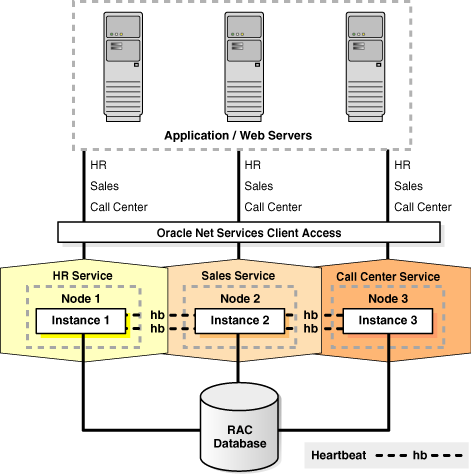
The following figure shows how Oracle RAC is the Oracle AI Database option that provides a single system image for multiple servers to access one Oracle AI Database. In Oracle RAC, each Oracle instance must run on a separate server.
Figure: Oracle AI Database with Oracle RAC Architecture
Traditionally, an Oracle RAC environment is located in one data center. However, you can configure Oracle RAC on an Oracle Extended Cluster, which is an architecture that provides extremely fast recovery from a site failure and allows for all nodes, at all sites, to actively process transactions as part of a single database cluster. In an extended cluster, the nodes in the cluster are typically dispersed, geographically, such as between two fire cells, between two rooms or buildings, or between two different data centers or cities. For availability reasons, the data must be located at both sites, thus requiring the implementation of disk mirroring technology for storage.
If you choose to implement this architecture, then you must assess whether this architecture is a good solution for your business, especially considering distance, latency, and the degree of protection it provides. Oracle RAC on extended clusters provides higher availability than is possible with local Oracle RAC configurations. However, an extended cluster may not fulfill all of the disaster-recovery requirements of your organization. A feasible separation provides great protection for some disasters (for example, local power outage or server room flooding), but it cannot provide protection against all types of outages. For comprehensive protection against disasters-including protection against corruptions and regional disasters-Oracle recommends the use of Oracle Data Guard with Oracle RAC, as described in the Oracle Data Guard Concepts and Administration, and on the Maximum Availability Architecture (MAA) Web site.
Oracle RAC is a unique technology that provides high availability and scalability for all application types. The Oracle RAC infrastructure is also a key component for implementing the Oracle enterprise grid computing architecture. Having multiple instances access a single database prevents the server from being a single point of failure. Oracle RAC enables you to combine smaller commodity servers into a cluster to create scalable environments that support mission critical business applications. Applications that you deploy on Oracle RAC databases can operate without code changes.
Oracle RAC allows multiple instances running on different nodes to access the database. Oracle RAC Cache Fusion automatically ensures changes from multiple sessions running on different instances are coordinated. In Oracle Database 21c and later releases, these background processes that perform Oracle RAC Cache fusion functionality have been enhanced to handle irrecoverable errors. Depending on the cause, Oracle RAC can retry the operation or correct the error to prevent instance failure. This reduces the occurrence of instance failures and helps to prevent these workload impacts.
Related Topics