1 System Overview
Overview
Introduction
This chapter provides a high-level overview of the application. It explains the basic functionality of the system and lists the main components.
It is not intended to advise on any specific Oracle Communications Convergent Charging Controller network or service implications of the product.
What is Short Message Charging Bundle?
About SMCB
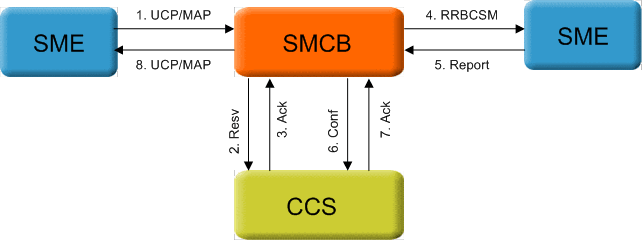
The Short Message Charging Bundle) (SMCB) service allows the sending of Short Messages (SMS) to be billed using the Charging Control Services (CCS) platform. The charging of Mobile Originating (SMS_MO) and Mobile Terminating (SMS_MT) services can be applied differently, because the Short Message Charging service differentiates between Originating and Terminating. This means that different Advanced Control Services (ACS) control plans can be used for each service.
The handle name of the SLEE Service Key is analyzed to check for the suffix “SM_MO” or “SM_MT”. This means the Mobile Originating or Mobile Terminating InitialDPs must come from different service keys for SMCB to be able to differentiate between Originating and Terminating services.
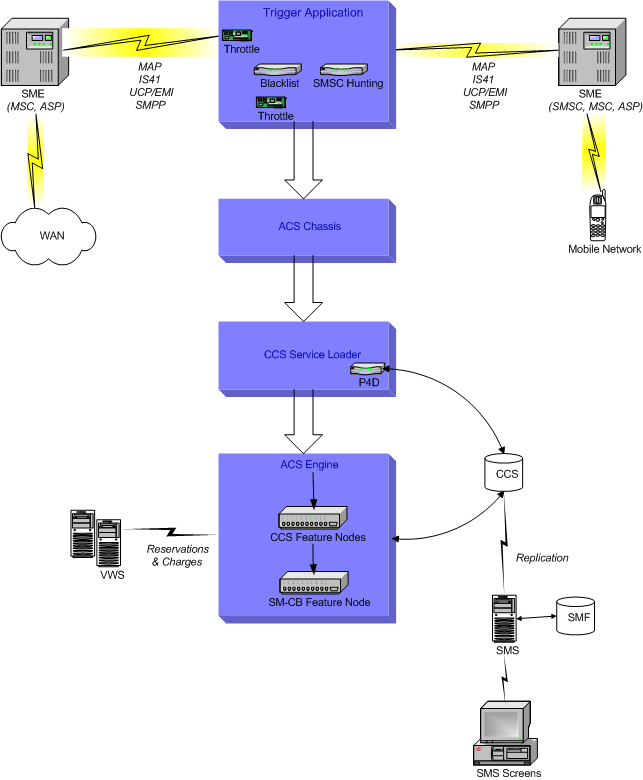
The SMCB Service can be used in conjunction with a UCP Trigger Application to allow Application Service Providers (ASPs) to connect and bill for Short Message sending. The login, and connection management of ASPs is provided within the UCP trigger application. The interface to ACS is a CAMEL Phase 2 InitialDP regardless of whether the UCP trigger application is used, or the Short Message Charging service is invoked directly.
Note: The use of the Mobile Originating and Mobile Terminating services are licensed separately, so throughout this document, license controlled features are marked with (1). This means those features may not be present if the relevant license has not been purchased.
EDRs
Overview
The Billing Engine EDRs are used to record the billing events produced by SMCB.
For a detailed description of the EDRs, refer to Event Detail Record Reference Guide.
The Short Message Charging Tariff Types are based on existing BE EDRs as follows:
| Tariff Type | Original EDR Type | SMCB EDR Type | Additional Fields |
| CDR_TYPE=5 | CDR_TYPE=12 | TN, WALLET_TYPE, CLI, LOCADD | |
| N/A | N/A | None – this tariff type does not interact with the Billing Engines. | |
| CDR_TYPE=1 | CDR_TYPE=13 | WALLET_TYPE, LOCADD |
Where:
- CLI = Logical Calling Number (MSISDN of subscriber)
- LOCADD = Network Calling Number (Global Title of MSC/VMSC)
- TN = Logical Called Number (Terminating Number)
SMS User Templates
Template descriptions
The SMCB service has three user template permissions to control the access to MO or MT functionality.
| Access Name | Description |
|---|---|
| (1) CCS SM Origination |
Grants access to the following Mobile Originating specific functionality:
|
| (1) CCS SM Termination |
Grants access to the following Mobile Terminating specific functionality:
|
| CCS Short Message Charging | Grants access to the Short Message Charging Rating screens. |
SMS Reports
Reports
This table lists the available SMS reports for the SMCB service.
| Report Name | Description |
|---|---|
| Peak Usage Report | Reports the maximum number of MO and MT calls in a single statistics period for a given time period. |
| (1) SMSMO Summary Report | Provides sum totals for each SMSMO statistic for a given time period. |
| (1) SMSMO Detailed Report | Lists the detailed SMSMO statistics for a given time period. |
| (1) SMSMT Summary Report | Provides sum totals for each SMSMT statistic for a given time period. |