1 Convergent Charging Controller System Architecture
This chapter introduces the Oracle Communications Convergent Charging Controller system architecture.
Convergent Charging Controller System Architecture Overview
This diagram depicts the Convergent Charging Controller system from a network architecture perspective:
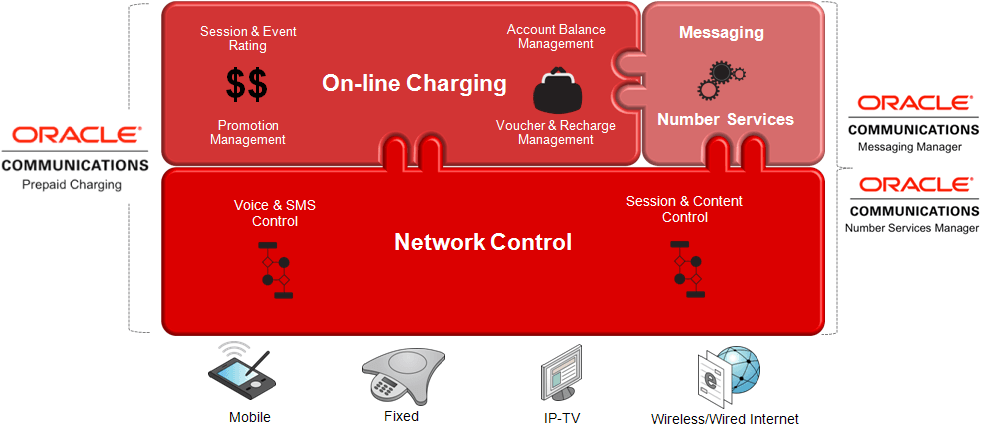
System components
The architectural diagram, starting from the bottom layer, includes the following components:
- A number of disparate telecommunications services (for example, mobile, fixed, IP) showing the ability of the Convergent Charging Controller system to handle convergence.
- Secondly, the network control aspect is handled using services templates (for example, fixed, mobile, data and TV).
- Finally the on-line charging layer handles the service rating, subscriber balance management (and voucher/promotion management if appropriate).
- Two optional additional products are also depicted in this diagram, Messaging Manager and Number Services Manager, which are out of the scope of this document.
Server components diagram
This diagram shows how the three main server components of the Convergent Charging Controller system combine to form the system architecture.
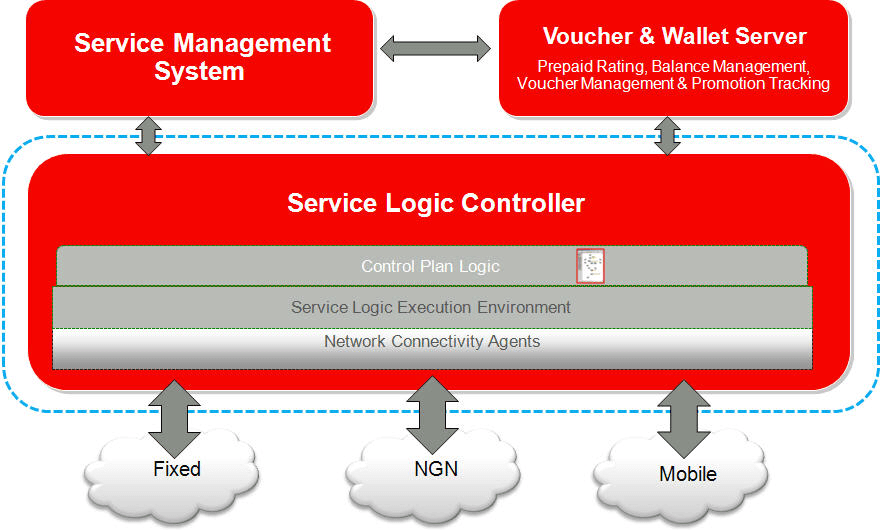
Server descriptions
The server components are as follows:
-
The Service Logic Controller (SLC) is the main interface to the network and handles all service processing (voice/SMS/data content).
Service processing is handled through the Service Logic Execution Environment (SLEE), with the various network connectivity agents (for example, diameter, radius, MAP, SIP and the ACS control plan logic, defining the service logic for all enabled services.
- The Service Management System (SMS) provides the base system management functionality, including:
- The Java administration UI
- Centralized data storage
- Replication functionality
-
The Voucher and Wallet Server (VWS) is essentially the billing component of the system (this could also be provided by a third-party billing system, such as Oracle Communications Billing and Revenue Management (BRM).
Billing provides:
- Prepaid Rating
- Balance Management
- Voucher Management
- Promotion Tracking facilities
Multiple servers configuration diagram
The system architecture can support multiple server configurations as shown in this diagram:
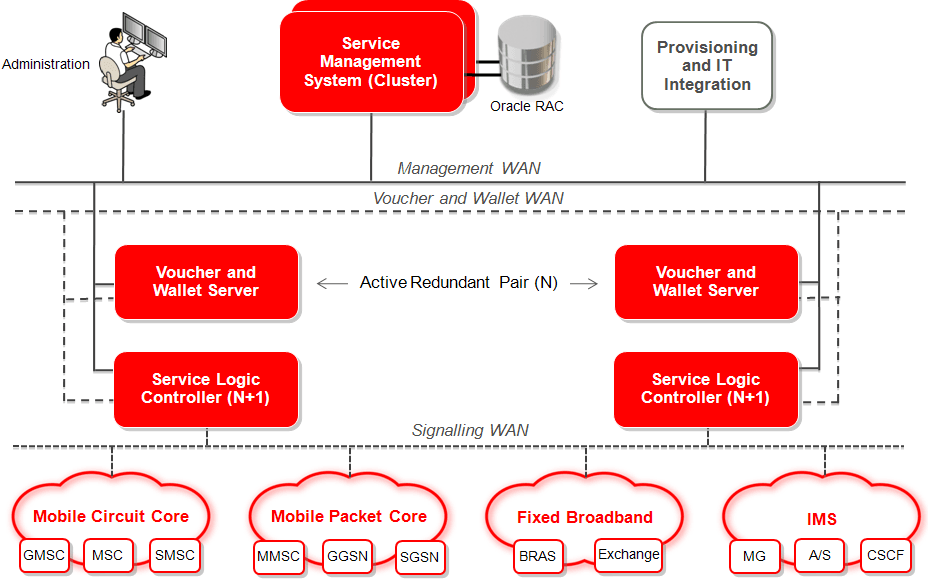
Note: The configuration of the VWS in a redundant pair set-up and the SLC running in an N+1 configuration. Here the SMS is set up in a redundant cluster configuration using Oracle RAC for the database component.
SMS and SLC Server Operation
This diagram shows the main components and operation of the SMS and SLC servers:
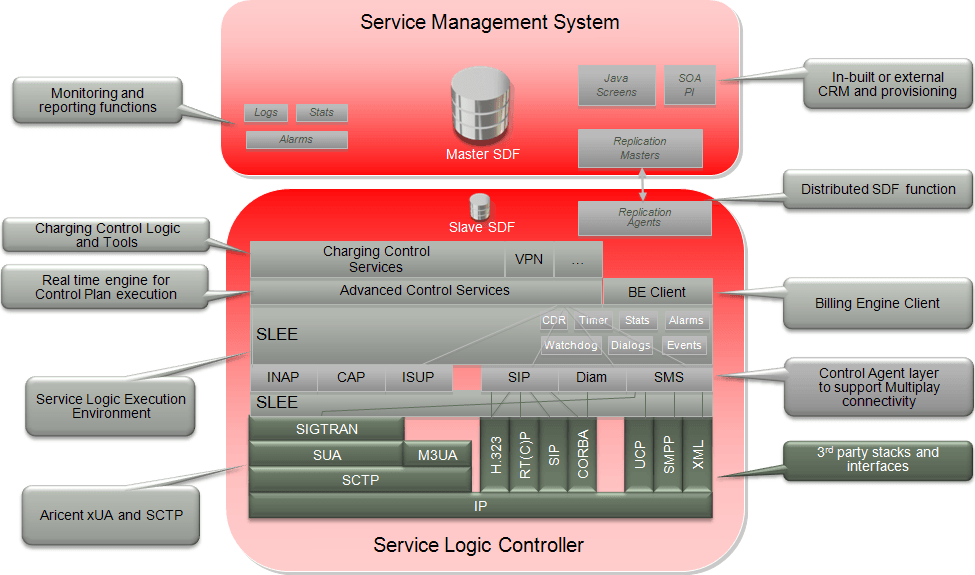
SLC component list
This table describes the main components for the Service Logic Controller.
| Component | Description |
|---|---|
| Charging Control Services (CCS) | Provides the charging control logic and tools. |
| Advanced Control Services (ACS) | Provides the real time engine for control plan running, effectively the call processing engine. |
| Billing Engine Client | Provides the interface which processes requests from the call processing engine to the Voucher and Wallet servers. |
| Service Logic Execution Environment (SLEE) | Routes calls to the ACS and to other machines through the SLEE interfaces (TCAP and Billing Engine Client). |
SMS component list
This list describes the main components for the Service Management System
- Centralized storage of logs, alarms, statistics.
- In-built CRM system which can be provisioned directly or externally via the provisioning interface.
- Replication method used to transfer relevant data from the main database on the SMS to the VWS and SLC servers, including:
- Subscriber and account wallet data
- Tariff and rate tables, for example.
VWS Server Operation
This diagram shows the main components and operation of the Voucher and Wallet (VWS) server:
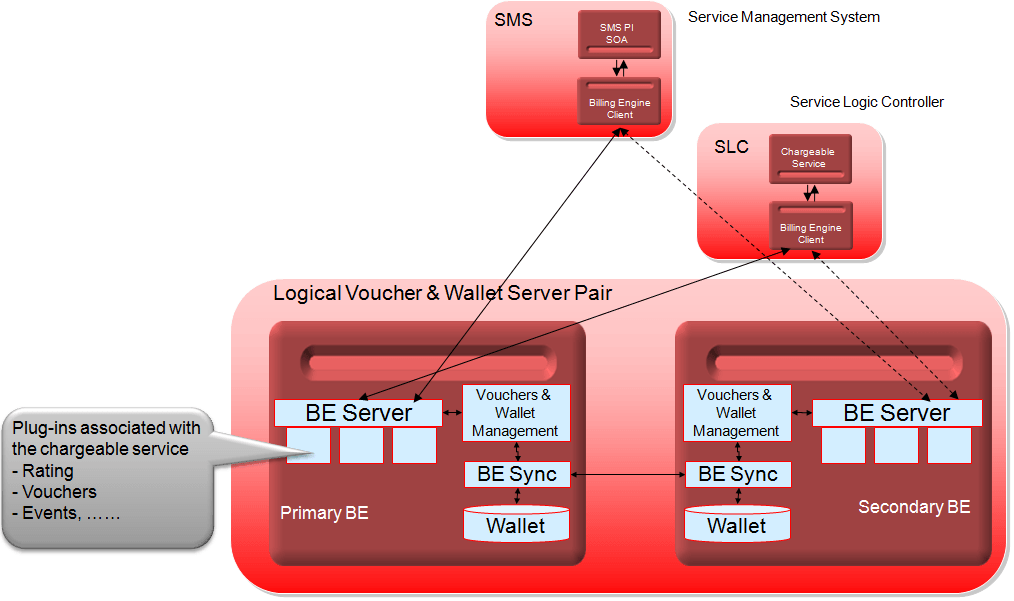
VWS component list
This list describes the main components for the Voucher and Wallet Server.
- The BE Sync component, which runs on each VWS, synchronizes the subscriber wallet data between the databases on the two servers, here depicted running in a redundant pair set-up.
- The BE Server component, which runs on each VWS, handles all incoming requests from the SMS and SLC client processes, and can be extended using plug-ins.