What is Unified Assurance?
Oracle Communications Unified Assurance enables you to manage services on a single platform: this includes siloed tools that run across varied and hybrid networks to ensure availability of communications, information, and product offerings.
Unified Assurance enables:
-
Consolidation and management of legacy tools.
-
Visibility and control of end-to-end services.
-
Operationalize network functions virtualization (NfV) for production.
-
Automation of redundant and repetitive Service Management tasks.
-
Consolidation of data to a single source of truth.
Unified Assurance brings together fault, performance, topology and service level management in a single scalable software platform. This unification provides significant performance, scalability and cost advantages over legacy and silo tool sets, resulting in an improved user experience.
Unified Assurance Hyperscale Architecture
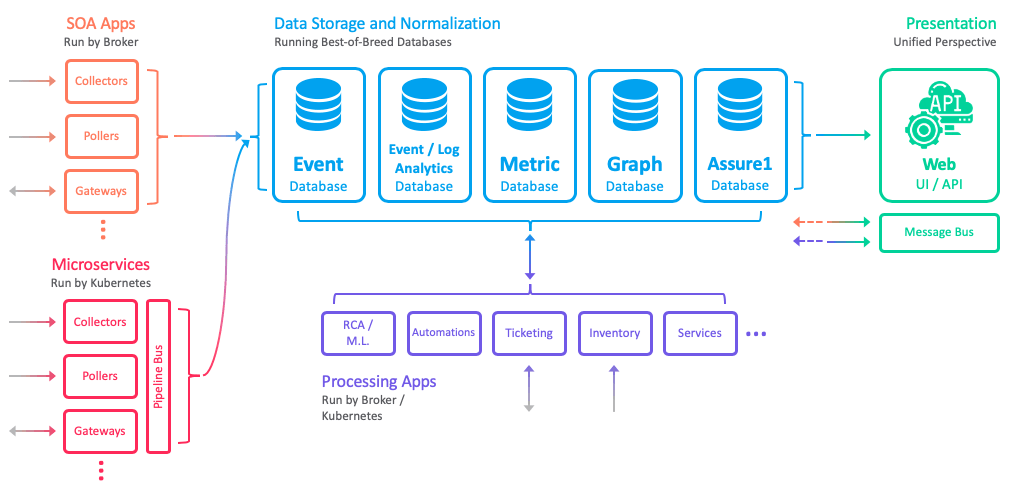
Description of illustration unified-assurance-hyperscale-architecture.png
A Deeper Dive
This section takes a look at the respective four areas of Fault Management, Performance Management, Topology Architecture, and finally Configuration Management. The technologies mentioned in the first section will be placed in the context of the Low-Latency Information Stack.
Unified Assurance Fault Architecture
-
The Presentation Layer consists of: Event Lists, Dashboards, Diagrams, and Analytics.
-
The Unified Assurance Cognitive Engine (UACE) Processing Layer consists of the SLM Engine, Watcher, CAPE, RCA, Mechanizations, Analytics Ingestor, Ticket Connector, and Anomaly Detection.
-
The Oracle Communications InfoLake takes data from the UACE Processing Layer and the Collection Layer. The Oracle Communications InfoLake consists of:
-
Real Time Events.
-
Observability Analytics using OpenSearch.
-
-
The following list shows the two sets of elements in the Collection Layer. The first set of elements takes data from the network, conversely the second set of elements sends data to the network:
-
FIFO, PIPE, SMTP, Syslog, TCPServer, Trap, and WebHook.
-
Generic Agent, Generic Connector, Generic DB, eMail, TCP Clients, and TL1.
-
Unified Assurance Performance Management Architecture
Unified Assurance has the following two architectural models for performance monitoring:
-
Microservice architecture
-
Service-oriented architecture
Microservice Architecture
Microservice architecture provides the following deployment models for performance monitoring:
-
The Observability Analytics database (OpenSearch):
-
The collection layer consists of poller microservices.
-
The processing layer consists of the Standard Threshold Processor microservice.
-
The database layer consists of data from the collection layer that has passed through the processing layer for storage in the Observability Analytics database.
-
The presentation layer consists of OpenSearch dashboards on the presentation server.
-
-
The Metrics database (InfluxDB):
-
The collection layer consists of metrics collected from microservices through the metrics pipeline.
-
The database layer consists of data from the collection layer for storage in the Metric database.
-
The presentation layer consists of classic Unified Assurance dashboards, augmented with Grafana, on the presentation server.
-
In addition to monitoring the devices in the network, microservices include self-monitoring metrics collected by Prometheus, which allow you to monitor the health and throughput of the Unified Assurance microservice pipelines.
Service-Oriented Architecture
-
The Presentation Layer consists of all Broker Control UIs, Dashboards, Diagrams, and Metrics UIs in the Analytics menu.
-
The UACE Processing Layer consists of Post Calculations, SLM Engine, Standard Thresholding Engine, Trend Threshold Engine, Abnormal Thresholding Engine, and the Missing Data Threshold Engine.
-
The Oracle Communications InfoLake takes data from the UACE Processing Layer and the Collection Layer. The Oracle Communications InfoLake consists of the Metrics Database powered by InfluxDB.
-
The following list shows the three sets of elements in the Collection Layer. The first and second sets of elements sends data to the network, conversely the third set of elements takes data from the network:
-
Custom Poll Discovery, PIPE Discovery, Discovery Agent, Device Discovery, SNMP Discovery, and SNMP Interfaces.
-
Ping Poller, Generic Poller, Generic DB, SNMP Poller, Network IF Poller, TCP Client Poller and the Transaction Poller.
-
File and TCP Servers.
-
In addition to monitoring the devices in the network, SOA apps include self-health metrics which allow you to monitor the health and throughput of the Unified Assurance system. See Understanding the Self-Health Metrics for more information.
Unified Assurance Topology Architecture
-
The Presentation Layer consists of: Network Details, Dashboards, Diagrams and Analytics.
-
The UACE Processing Layer consists of Graph Stitchers and RCA.
-
The Oracle Communications InfoLake takes data from the UACE Processing Layer and the Collection Layer. The Oracle Communications InfoLake consists of the Topology Database powered by Neo4j.
-
The following list shows the two sets of elements in the Collection Layer. The first set of elements sends data to the network, conversely the second set of elements takes data from the network:
-
Gather Network Inventory, Database Stitcher, TCP Client Stitcher, Subversion Stitcher.
-
File Stitcher and TCP Server Stitcher.
-
Unified Assurance Configuration Management Architecture
-
The Presentation Layer consists of: Dashboards, Diffs and History.
-
The Oracle Communications InfoLake uses Config DB.
-
The following elements in the Collection Layer interface with your network, Configuration Discovery and Gather Configurations (e.g. SSH and Telnet).