3 Implementation Overview
This section provides an overview of how Oracle AI Services are implemented.
Components
The components and systems involved in implementing Oracle Utilities AI Services include the following:
- A customer information system (CIS), such as Oracle Utilities Customer to Meter (C2M) or Oracle Utilities Customer Care and Billing (CCB)
- A Computer Telephony Integration (CTI) system
- A middleware orchestrator system capable of facilitating messages and API calls between the CIS, CTI, and the AI services
- The individual Call Transcription and Call Summarization services
Implementation Guidelines
The diagram below illustrates how Oracle Utilities AI Services can be integrated with Oracle Utilities Customer to Meter (C2M) and a CTI system.
Figure 3-1 AI Services - Integrating with Customer to Meter
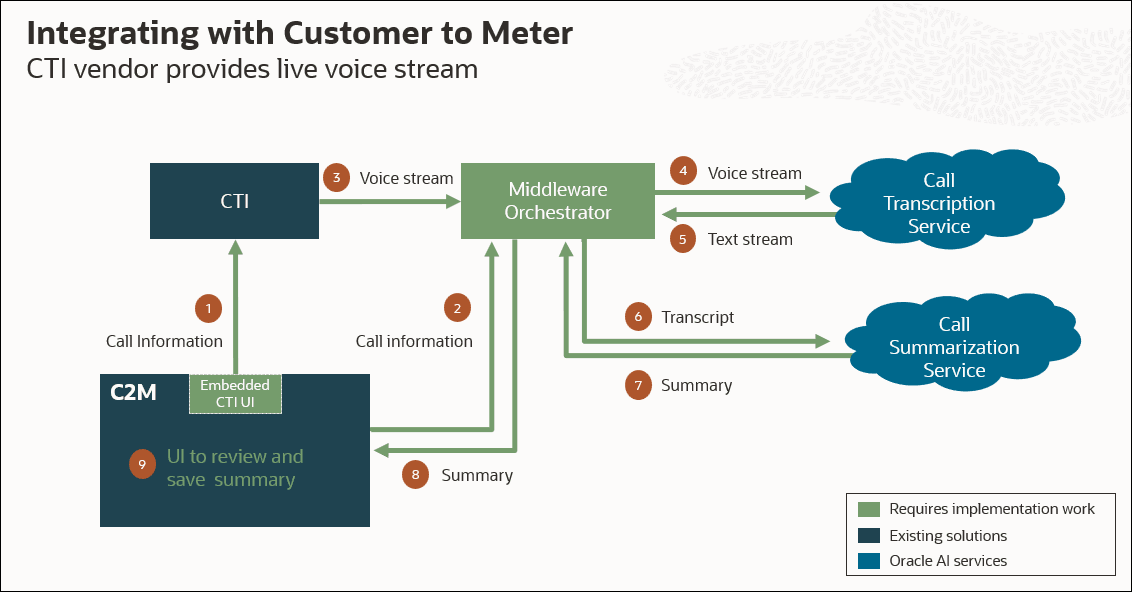
The transaction flow for this implementation includes the following (numbers are based on the above diagram):
- An agent receives a call. The CTI system provides Call ID, Agent, customer phone number, and IVR information.
- Implementation Option 1: Develop a C2M javascript to embed a CTI user interface within C2M. Use this option if your current CTI solution and current C2M version support embedding UI iFrame.
- Implementation Option 2: If option 1 is not supported, develop an inbound web call from CTI to C2M to pass call status and other relevant information (such as call ID, phone number, etc.).
- At the beginning of a call, C2M initiates a call to the middleware orchestrator.
- This involves development of a customization in the middleware to orchestrate the transcription and summarization process.
- The middleware orchestrator establishes a WebSocket connection with the CTI system for each call participant.
- WebSocket connections are used to access the call’s voice stream.
- The middleware orchestrator establishes a WebSocket connection to the Call Transcription service for each call participant.
- The middleware orchestrator establishes the transcription session with Oracle Transcription Service and forwards the audio streams of the received call.
- The Transcription Services utilizes the OCI Speech Service for voice-to-text conversion and accumulates transcription chunks separately for each call.
- Upon call completion, C2M notifies the middleware orchestrator to obtain a full transcript of the call.
- The middleware orchestrator obtains the full transcript from the Transcription Service and terminates the streaming session for the completed call.
- The middleware orchestrator calls the Call Summarization service providing the call transcript and client-specific configuration.
- The Call Summarization service utilizes the OCI GenAI Service for summarization.
- The Call Summarization service provides the generated summary along with the call classification tags.
- The middleware orchestrator calls the Call Summarization service requesting the call summary and client-specific configuration.
- The middleware orchestrator sends the generated summary to C2M via an API call.
- Depending on specific requirements, this could be a base product or custom API.
- C2M displays the generated summary on the user interface for agent review and update (if necessary).
- Depending on specific requirements, the user interface could be a customer contact in C2M where the summary is captured as customer contact notes, or a custom user interface that displays the summary that users can copy & paste to a customer contact.
Considerations
Other considerations related to implementations of Oracle Utilities AI Services include the following:
- If not already set up, establish single sign-on (SSO) verification between CTI and the CIS.
- Oracle will provide a single authentication credentials that can be used for ‘service to service’ or ’system to system’ authentication to use the transcription and summarization APIs. This is aligned with typical implementation approach of using a single integration user ID. Ensure to define appropriate user group and policies for this.
- Allocate sufficient time in your implementation plan for performance testing, which is critical for any real-time and/or cloud-to-on-premises integrations.