2.1.1.1.1 Online Invoice Creation (manual entry)
This topic provides systematic instructions to create the Online Invoice manually.
- In the Create Receivable/Payable screen, select the Invoice
option and then click the Create New Invoice button, to
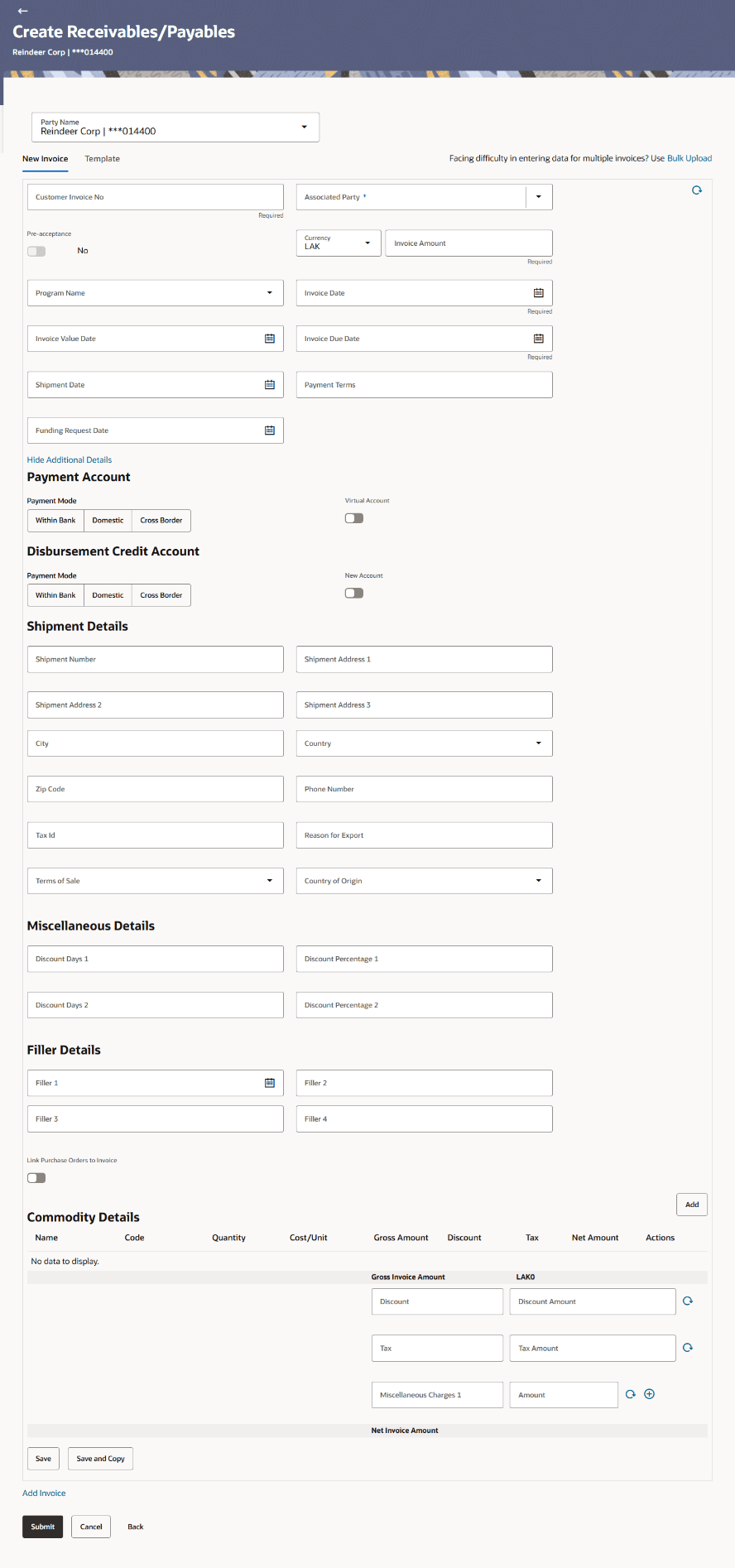
create invoice records manually.The Create Receivables/Payables screen appears starting with the New Invoice tab.
Figure 2-2 Create Receivables/Payables - New Invoice
Table 2-2 Field Description
Field Name Description Party Name & ID Displays the name and ID of the logged-in corporate party. New Invoice This section displays New Invoice details. Facing difficulty in entering data for multiple invoices? Use Bulk Upload Click the Bulk Upload link to navigate to the File Upload screen for creating invoices in bulk. Customer Invoice No Specify the customer’s own reference number of the invoice. Associated Party Select the associated party to link the invoice from all on-boarded associated parties. The list of on-boarded associated party is categorized by: - Anchor Buyer
- Anchor Supplier
- Counter Party Buyer
- Counter Party Supplier
On selecting an associated party, the role of the party as Buyer or Supplier, appears below this field.
Invoice Amount Specify the gross invoice amount. This amount is before tax and discount. It should be the gross amount of the commodities. Pre-acceptance This toggle is set to ‘No’ and is disabled if the logged-in party is the supplier. It is set to ‘Yes’ and is disabled if the logged-in party is the buyer. Name of Program Select the program to which the invoice should be linked. Programs linked to the selected associated party are listed. This field is visible only if the Oracle Banking Supply Chain Finance application is implemented by the bank. Auto Accept Displays whether the invoice will be auto accepted or not. If the invoice will be auto-accepted, then the number of days post creation to auto-acceptance, is displayed. This field appears on selecting a program. It is populated based on the auto acceptance setting in the program definition. For more information on programs, refer the Create Program section in Oracle Banking Digital Experience Corporate Supply Chain Finance User Manual. Auto Finance Displays whether the invoice will be auto financed or not. This field appears on selecting a program. It is populated based on the auto finance setting in the program definition. For more information on programs, refer the Create Program section in Oracle Banking Digital Experience Corporate Supply Chain Finance User Manual. Invoice Date Click the calendar icon and select the date of creation of the invoice. The Invoice Date should be greater than the Purchase OrderDate. You cannot enter a future date.
Invoice Value Date Click the calendar icon and select the invoice value date. This date can be earlier than the Invoice Date. Invoice Due Date Click the calendar icon and select the date on which the invoice payment is due. The Invoice Due Date should be greater than or equal to the Invoice Date.
Shipment Date Click the calendar icon and select the date when the shipment is expected to take place. The Shipment Date should be greater than the Purchase Order Date and greater than or equal to the Invoice Date.
Payment Terms Specify the terms agreed for the payment of the invoice. Funding Request Date Specify the date when the invoice should be funded or financed. This date should be greater than the current business date. This field is visible only if the Oracle Banking Supply Chain Finance application is implemented by the bank.
Show Additional Details Click Show Additional Details link to add additional details such as payment account, shipment, miscellaneous, and filler details. Payment Account User can provide the account details to receive the invoice payment. These details should be belonging to the Supplier corporate. Payment Mode Select the payment mode to create new invoice. The options are: - Within Bank
- Domestic
- Cross Border
Within Bank If the Payment Mode is selected as Within Bank. The Account Number drop-down will be displayed. The drop-down will list all the accounts belonging to the logged in corporate or the corporate selected in the party drop-down. The accounts will be listed and displayed if they have access for OBDX. Domestic If the Payment Mode is selected as Domestic. Here user can enter the account details with any other bank to receive the invoice payment. The following details are required to be entered. - Account Number
- Account Name
- Bank Name
- Branch
- Bank Code
Note: These details will be displayed only when the new account switch is OFF.
Cross Border If the Payment Mode is selected as Cross Border.
User needs to enter the Account Number or and Account Name with a bank in different country where the invoice payment is expected to receive. The bank details also required to be provided. Select the SWIFT Code or enter the Bank Address.
Transfer Via Intermediary Bank Switch this toggle ON, if the transfer is via intermediary bank.
Intermediary Bank details can be provided by giving the SWIFT Code of the bank or by entering the Bank Name and Address. To provide the SWIFT Code, click on the Lookup Link. SWIFT Code can be searched using BIC Code or Bank Name.
Note: Intermediary Bank is applicable only for cross border payment mode.
Virtual Account Switch this toggle ON, if the account is a virtual account. Disbursement Credit Account User can provide the account details to receive the disbursement proceeds in case the invoice is financed. These details should be belonging to the Supplier corporate. Payment Mode Select the payment mode to receive the finance proceeds for the invoice. The options are: - Within Bank
- Domestic
- Cross Border
Within Bank If the Payment Mode is selected as Within Bank. The Account Number drop-down will be displayed. The drop-down will list all the accounts as fetched from the internal account mapping maintenance of host system. These accounts are maintained to credit the finance proceeds. The accounts fetched and will be listed in the drop-down only if they have been mapped to OBDX. The following details will display.- Account Name
- Branch
- Currency
Note: These details will be displayed only when the New Account switch is Off.
Domestic If the Payment Mode is selected as Domestic. The drop-down will list the accounts from external account mapping maintenance of the host system. The account details belong to some other bank maintained in some other bank in the country and maintained in the host system to receive the finance proceeds when the invoice is financed. The following details will display.- Bank Name
- Branch
- Account Number
- Bank Code
- Currency
Note: These details will be displayed only when the New Account switch is Off.
Cross Border If the Payment Mode is selected as Cross Border. The drop-down will list all the corporate accounts as fetched from the external account mapping maintenance of the host system. The account details belong to the bank in another country and mapped in the host system to receive the finance proceeds when the invoice is financed. The following details will display.- Account Number
- Bank Name
- Branch
- Account Name
- Bank Code
- Currency
Note: These details will be displayed only when the New Account switch is Off.
New Account Switch this toggle On, if corporates are required to receive the finance disbursement funds into a new account which is not maintained with host SCF system.
Note: If the Payment Mode is selected as Within Bank and New Account toggle is On, then the drop-down will list all the accounts present in the Bank. This list will not be restricted to accounts maintained in SCF host only.
Note: If the Payment Mode is selected as Domestic and New Account toggle is On, the following details will display, and these are required to be entered.- Account Number
- Account Name
- Bank Name
- Branch
- Bank Code
Note: If the Payment Mode is selected as Cross Border and New Account toggle is On, user needs to enter the Account Number or IBAN as applicable as per within bank, domestic or cross border and Account Name. And select the Bank Details as SWIFT Code or Bank Address to enter the details.
Transfer Via Intermediary Bank Switch this toggle ON, if the transfer is via intermediary bank.
Intermediary Bank details can be provided by giving the SWIFT Code of the bank or by entering the Bank Name and Address. To provide the SWIFT Code, click on the Lookup Link. SWIFT Code can be searched using BIC Code or Bank Name.
Note: Intermediary Bank is applicable only for cross border payment mode.
Shipment Details This section displays Shipment details. Shipment Number Specify the shipment number. Shipment Address 1 - 3 Specify the shipment address in the fields provided. Shipment City Specify the city to ship the goods to. Shipment Country Select the country to ship the goods to. Zip Code Specify the zip code to ship the goods to. Phone Number Specify the contact number of the person who will receive the shipment. Tax Id Specify the unique tax ID if the shipment charge includes tax amount. Reason for Export Specify the relevant reason of export. Terms of Sale Specify the applicable 3-digit Info terms code. The available values are: - EXW | Ex Works
- FAS | Free Alongside Ship
- FCA | Free Carrier
- FOB | Free On Board
- CPT | Carriage Paid To
- CFR | Cost and Freight
- CIP | Carriage and Insurance Paid To
- CIF | Cost Insurance and Freight
- DAP | Delivered at Place
- DPU | Delivered at Place Unloaded
- DDP | Delivered Duty Paid
Country of Origin Specify the country from where the shipment will originate. Miscellaneous Details This section displays the Miscellaneous details. Discount Days 1 Specify the primary discount days. Discount Percentage 1 Specify the primary discount percentage. Discount Days 2 Specify the secondary discount days. Discount Percentage 2 Specify the secondary discount percentage. Filler Details This section displays the Filler details. Filler Fields 1 to 4 This section displays the Filler Label Fields. The bank can configure these fields on Day 0, based on their requirement. Link Purchase Orders to Invoice Switch the toggle ON to link the purchase orders to invoice. The Link Purchase Orders overlay screen appears.
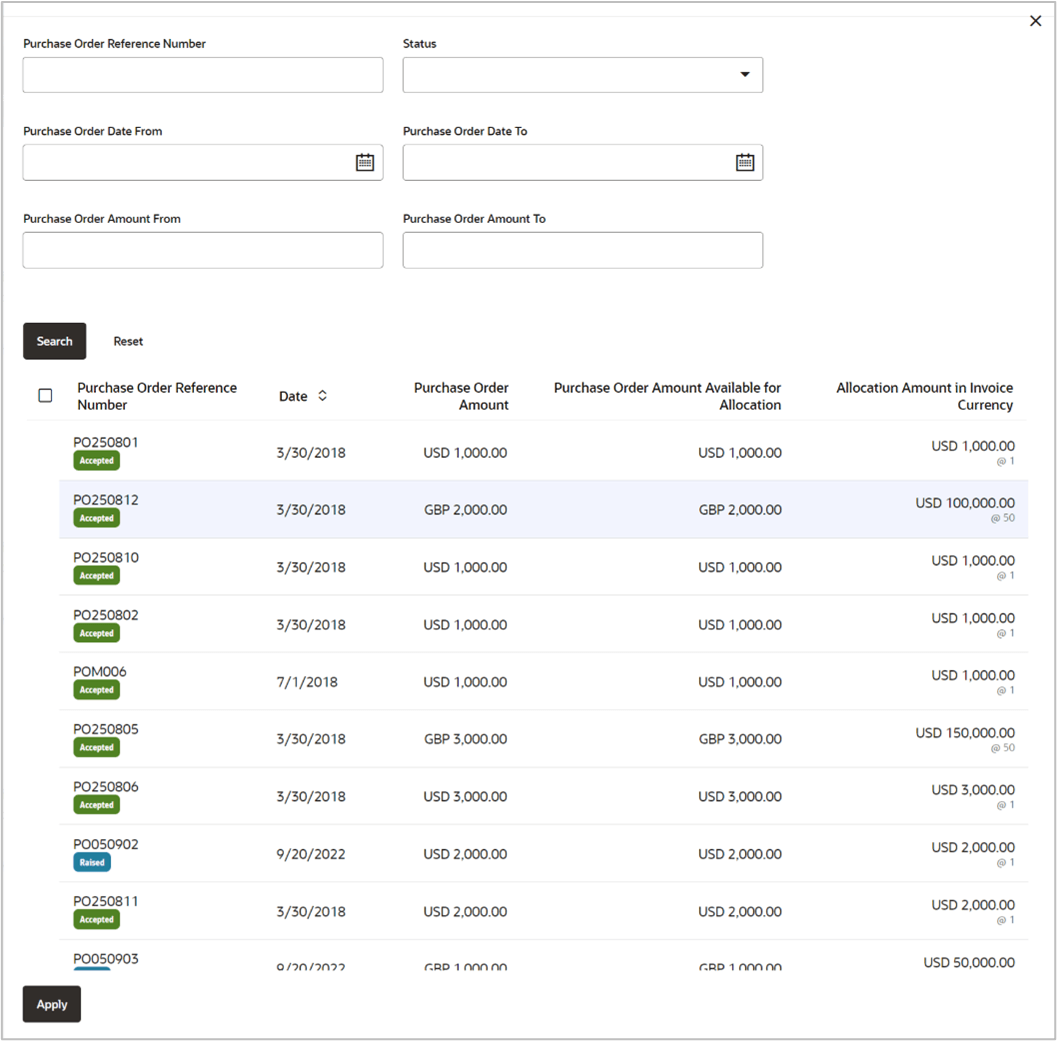
Link Purchase Orders Overlay This overlay window
appears when you switch the Link Purchase Orders to Invoice toggle ON.
Note: Figure 2-3 Link Purchase Orders Overlay Table 2-3 Field Description
Field Name
Description
Purchase Order Reference Number
Enter the reference number of the purchase order
to be searched.
Status
Select the status of the purchase order to be
searched.
Purchase Order Date From
Indicates an option to search for purchase
orders created within a specific date range. Click the calendar
icon and select the From and To dates.
Purchase Order Date To
Indicates an option to search for purchase
orders created within a specific date range. Click the calendar
icon and select the From and To dates.
Purchase Order Amount From
Indicates an option to search for purchase
orders based on an amount range. Enter the From and To
amounts.
Purchase Order Amount To
Indicates an option to search for purchase orders
based on an amount range. Enter the From and To amounts.
Search
Purchase Orders list displays for the logged-in
party and selected associated party combination for buyer and
supplier.
Search Results - List of Purchase
Order
This section displays the Search Results.
Check Box
To select all the purchase orders in the list,
select the main check box. To select purchase orders, select the
check boxes beside those purchase orders.
Purchase Order Reference Number
Status
Displays the unique reference number of the
purchase order with respect to the Supply Chain Finance
application. Also displays the status of the purchase
order.
Date
Displays the date on which the purchase order
has been created.
Purchase Order Amount
Displays the purchase order amount.
Purchase Order Amount Available for
Allocation
Displays the purchase order amount available for
allocation in purchase order currency.
Allocation Amount in Invoice CurrencyExchange
Rate
Displays the purchase order amount available for
allocation in invoice currency. It also displays the exchange
rate between invoice currency and purchase order
currency.
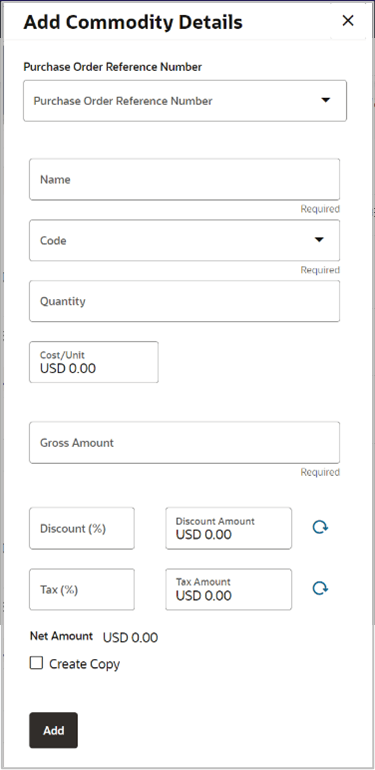
- To add a commodity, click Add in the Commodity
Details section. The Add Commodity Details overlay window appears.
Note:
- If you link the purchase orders that has the commodity details already added to the invoice, Add field for commodity details will not get displayed. Commodity details section displays the commodities applicable for the linked purchase orders. If there are no commodities added to any of the linked purchase orders, then the Add field is enabled to add the details.
- If Commodity details section displays the commodities applicable for the linked purchase orders.
Table 2-4 Field Description
Field Name Description Name Specify the name of the commodity. Code Select the code of the commodity. This value should be selected from the commodity code list. Note: This drop-down field displays the list of commodity code(s) maintained for the selected supplier party.
Quantity Specify the quantity of the commodity being purchased. Cost/Unit Specify the cost per unit of the commodity. Gross Amount Specify the gross commodity amount. It also gets auto calculated if quantity and cost per unit are entered. It is the product of the entered quantity and cost per unit. Gross Amount = Cost/Unit * Quantity
Discount Specify any discount being offered on the commodity. You can either enter the percentage of discount (in the first field) or the actual discount amount (in the second field). When you enter any one of these values, the other value is automatically calculated and displayed. Note: This field is auto populated if a discount percentage is maintained for the selected commodity code.
Click
 to reset the values.
Tax Specify any tax being charged on the commodity. You can either enter the percentage of tax (in the first field) or the actual tax amount (in the second field). When you enter any one of these values, the other value is automatically calculated and displayed. Note: This field is auto populated if a tax percentage is maintained for the selected commodity code.
Click
to reset the values.
Net Amount Displays the net commodity amount. This is automatically calculated as follows: Net Amount = Gross Amount – Discount + Tax
Create Copy Select this check box to create a copy of the commodity details entered. On clicking the Add button, a commodity record is created in the Commodity Details section.
- You can further add commodities by clicking Add, and
filling out the required details.
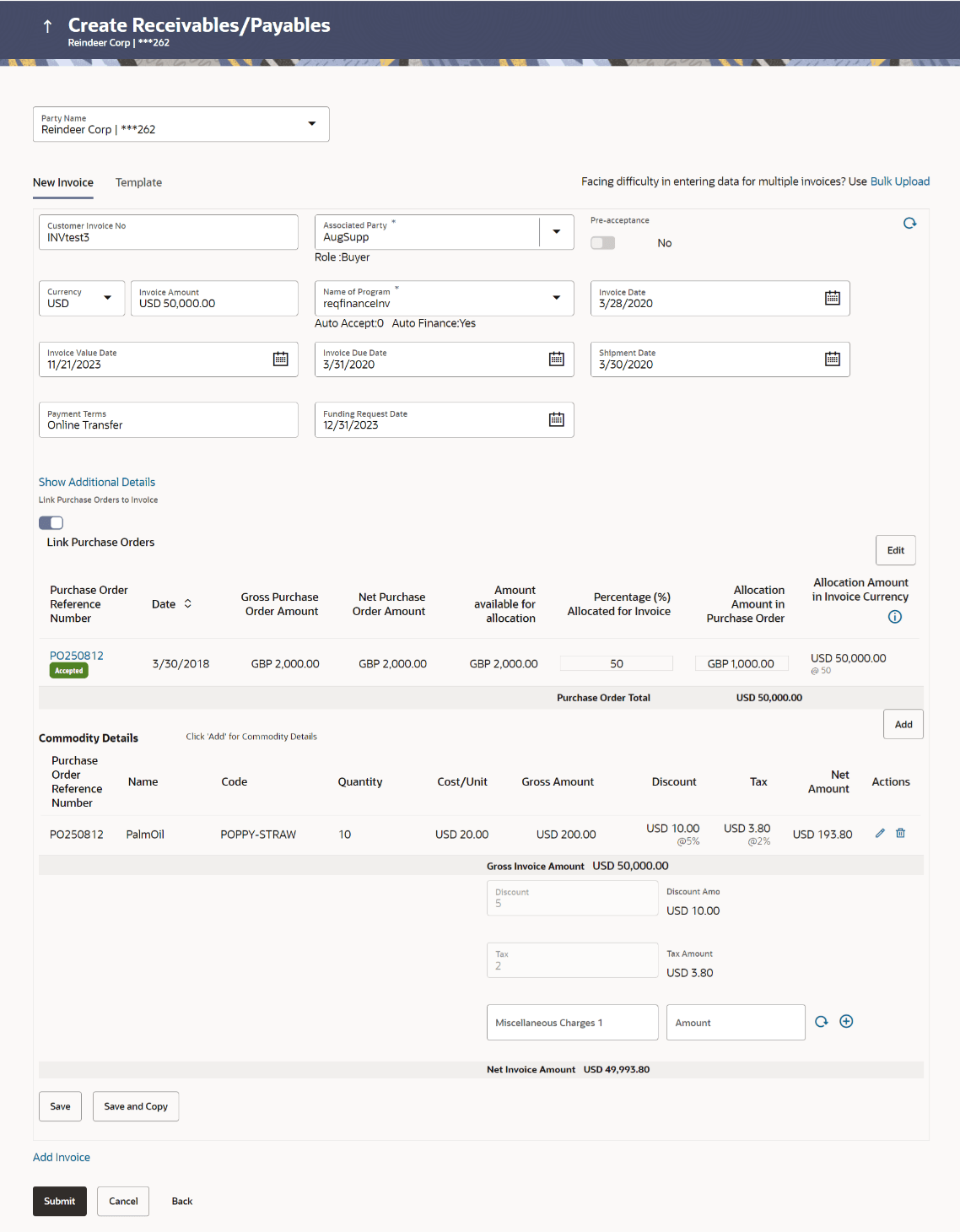
Figure 2-5 Create Receivables/Payables – Link Purchase Orders to Invoice and Commodity Details Section Updated
Table 2-5 Field Description
Field Name Description Link Purchase Order This section displays the list of purchase orders to be linked to the invoice once you add them. Purchase Order Reference Number Status Displays the unique reference number of the purchase order Also displays the status of the purchase order. Date Displays the date on which the purchase order has been created. Gross Purchase Order Amount Displays the gross purchase order amount. Net Purchase Order Amount Displays the total purchase order amount, after deducting the discount and then applying the tax. Note: The Net Purchase Order Amount gets automatically calculated as follows: Net Purchase Order Amount = Gross Purchase Order Amount - Discount Value + Tax Amount
Amount Available for Allocation Displays the purchase order amount available for allocation to Invoice. Percentage (%) Allocated for Invoice Specify the percentage of available purchase order amount to be allocated for invoice. This value is automatically calculated and displayed if you enter the amount allocated for invoice. Allocation Amount in Purchase Order Currency Displays the purchase order amount allocated for invoice in purchase order currency. This value is automatically calculated and displayed if you enter the percentage allocated for invoice. Allocation Amount in Invoice Currency Displays the purchase order amount allocated for invoice in invoice currency. This value is automatically calculated and displayed if you enter the percentage allocated for invoice. Purchase Order Total Displays the total amount allocated from purchase order to the invoice in invoice currency. This value is automatically calculated and displayed. Commodity Details This section displays the commodity detail records, once you add them. Multiple commodities can be added. Purchase Order Reference Number Displays the reference number of the purchase order against the commodity added. Name Displays the name of the commodity. Code Displays the code of the commodity. Quantity Displays the quantity of the commodity being purchased. Cost/Unit Displays the cost per unit of the commodity. Gross Amount Displays the total gross amount of the commodity being purchased. It is the product of the entered quantity and cost per unit. Gross Amount = Cost per unit * Quantity
Discount Exchange Rate Displays the discount amount and percentage being offered on the commodity. The exchange rate between invoice currency and purchase order currency is displayed if a purchase order is linked to an invoice. Tax Exchange Rate Displays the tax amount and percentage being charged on the commodity. The exchange rate between invoice currency and purchase order currency is displayed if a purchase order is linked to an invoice. Net Amount Displays the net amount of the commodity being purchased. It is automatically calculated as follows: Net Amount = Gross Amount – Discount + Tax
Actions Indicates the actions that can be performed on the commodity record. - Click
 to edit the record.
- Click
 to remove the record.
Following fields are present below the Commodity Details section, and are applicable at the invoice-level.
Gross Invoice Amount Displays the total gross amount of all the added commodities if Link Purchase Orders to Invoice toggle switch is Off. Displays the gross purchase order amount if the Link Purchase Orders to Invoice toggle switch is On.
Discount Displays the total discount amount of all the commodities added. The average discount percentage of all added commodities is also displayed. Click
to reset the values.
Total Discount % = (Total discount amount / Total invoice amount) *100
Note: When commodity records are added, the discount value of each commodity is aggregated and populated here.This value cannot then be modified. However, if commodity records are not added, then this field is editable and the discount value or percentage can be entered here.
Tax Displays the total tax amount of all the commodities added. The average tax percentage of all added commodities is also displayed. Click to reset the values.
Total Tax % = (Total tax amount / Total invoice amount) *100
Note: When commodity records are added, the tax value of each commodity is aggregated and populated here. This value cannot then be modified. However, if commodity records are not added, then this field is editable and the tax value or percentage can be entered here.
Miscellaneous Charges Add the name and amount of any other miscellaneous charge applicable. Use
 to add another charge. A maximum of 2
miscellaneous charges can be added.
to add another charge. A maximum of 2
miscellaneous charges can be added.
Click
to reset the values.
Note: If a purchase order is linked to an invoice, the miscellaneous charge amount is inherited from the purchase orders.
Net Invoice Amount Displays the total invoice amount that the buyer must pay, after deducting the discount and then applying the tax. Note: The Net Invoice Amount gets automatically calculated as follows:Net Invoice Amount = Gross Invoice Amount - Discount Value + Tax Amount
Indicates an option to reset the fields. This icon is present on the top right corner of the screen. Duplicate Invoice Indicates an option to add another invoice with the same details. Add Invoice Indicates an option to add another blank invoice. You can create multiple invoices using this link.
- Click
- Click Save to save the invoice. Or, do one of the
following:
- Click Save and Copy to save the invoice details and create a copy.
- To clear the fields, click the icon in the top right side of the screen.
Note:
- Click Submit to submit the transaction, once all
required invoices have been added. The Review screen appears. Or, do one of the
following:
- Click Cancel to cancel the transaction.
- Click Back to navigate back to the previous screen.
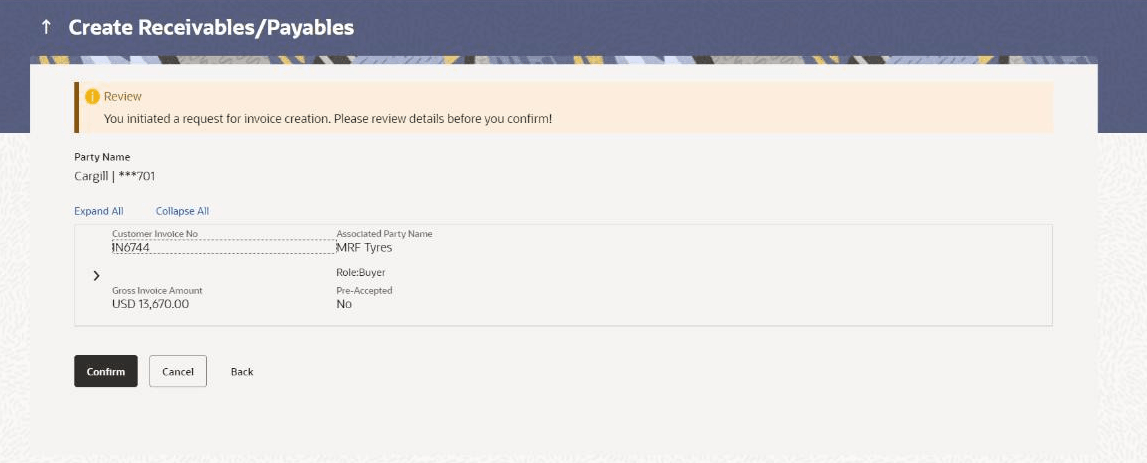
Figure 2-6 Create Receivables/Payables - Review Screen
- Perform any of the following actions:
- Click Back to navigate back to the previous screen.
- Click Cancel to cancel the transaction.
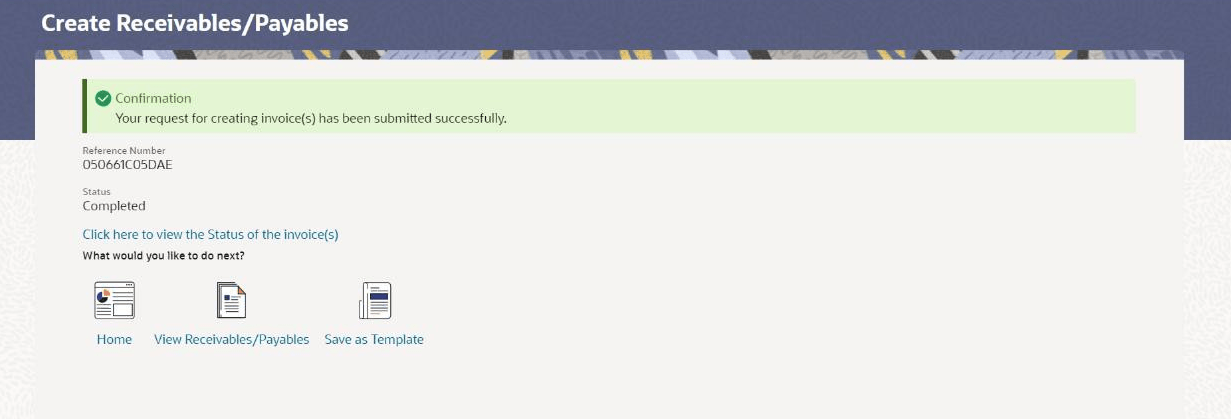
Figure 2-7 Create Receivables/Payables - Confirmation
Parent topic: Create Online Invoice