4.4 Finance Repayment
This topic provides systematic instructions to finance repayment.
Note:
The corporate user will be able to view those finances where the logged in corporate party is the borrower and the finance status is disbursed or partially settled.- To repay or settle a finance, follow the steps below:
- From the Settlement Currency list, select the required currency for repayment of finance.
- From the Account Name list, select the required debit account from which the outstanding finance will be settled.
- To filter the finances, click
 icon and enter the filter criteria. A list of finances displays
based on the search criteria.
icon and enter the filter criteria. A list of finances displays
based on the search criteria.
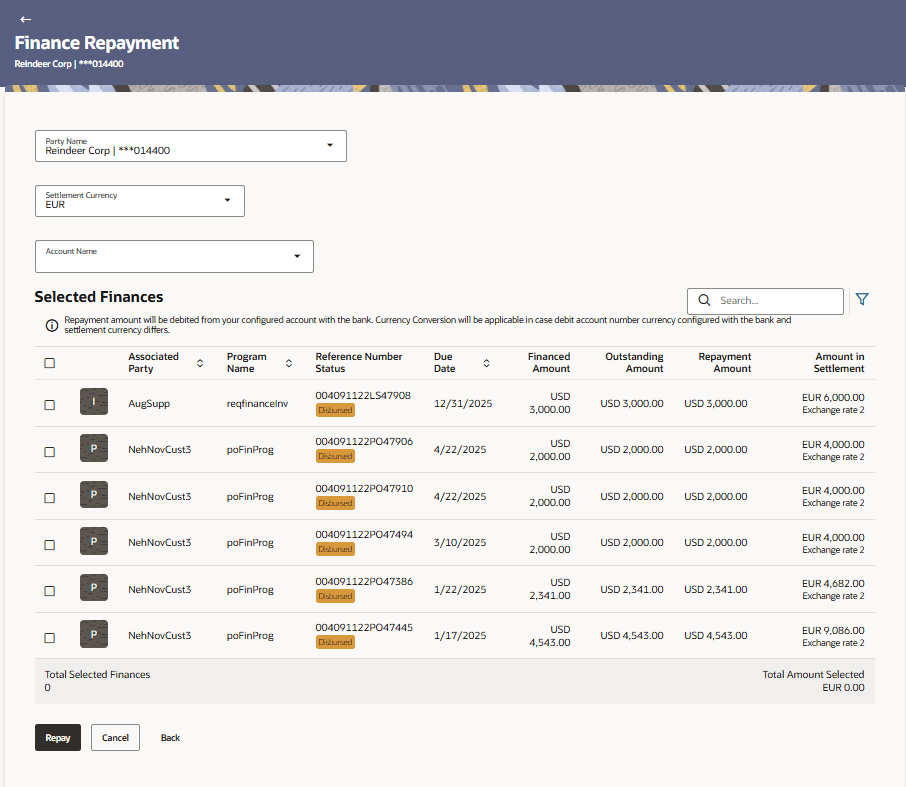
The Finance Repayment screen displays.For more information on fields, refer to field description table.
Table 4-19 Finance Repayment
Field Description Party Name and ID Select the party name and ID from the drop-down list for which the finance must be repaid. By default, the primary party of the logged-in user is selected. Note: Only accessible parties are displayed to the user.
Settlement Currency Specify the settlement currency in which settlement of finance is to be done. Account Name Select the debit account from which the outstanding finance will be settled. This field displays the account number, account name, associated product, and the settlement mode.
Note: Only the accounts to which the user has access or permission to view will be listed.
Select Finances This section displays the Select Finances details. Search Enter the partial or complete finance reference number, associated party name, program name, or amount to search for specific finance. The results appear as and when you enter the data. Click this icon to filter the finances, based on certain criteria. For more information, refer the Search (overlay window for Finance Repayment) section below. Indicator Displays 'I' for a finance against invoice(s), 'D' for a finance against debit note(s), and 'P' for a finance against purchase order(s). Associated Party Displays the name of the counter party linked with the instrument that has been financed Program Name Displays the name of the program that has been selected for requesting finance. Reference Number Status Displays the finance reference number of the outstanding finance, along with the status. Due Date Displays the due date of the finance. Financed Amount Displays the total disbursed amount of finance. Outstanding Amount Displays the amount (Interest Amount + Principal Amount) that is yet to be paid to settle the finance. Repayment Amount Displays the amount to be repaid. By default, the outstanding amount of the finance is displayed. If you select the check box beside a specific finance, then this field becomes editable. You can click  icon to change the amount to be repaid and then
click
icon to change the amount to be repaid and then
click  icon to save the changes.
Amount in Settlement Currency Displays the settlement amount or the amount to be repaid in the currency selected in the Settlement Currency field. Note: It also displays the exchange rate. The currency conversion will be applicable in case debit account currency configured with the bank and settlement currency, differ.
Total Selected Finances Displays the number of selected finances for settlement. Total Amount Selected Displays the total amount to be settled for the selected finances. - On Finance Repayment screen click

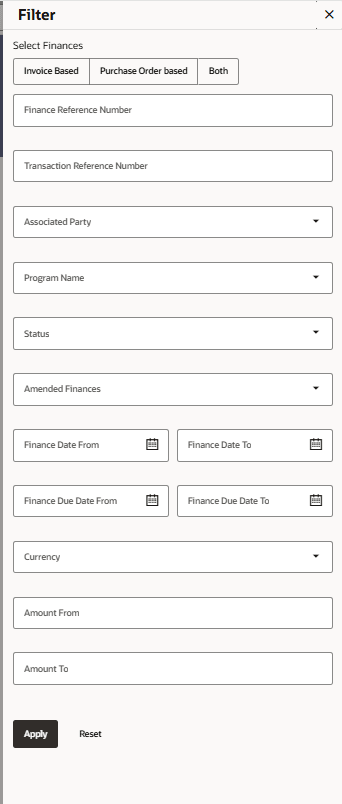
icon.The Filer Overlay window is displayed.For more information on fields, refer to field description table.
Table 4-20 Finance Repayment
Field Description Select Finances Indicated an option to search for finance records based on the instrument. The options are: - Invoice Based
- Purchase Order Based
- Both
Finance Reference Number Indicates an option to search for finance records using the finance reference number of the borrower. Transaction Reference Number Indicates an option to search for finance records using the transaction reference number. Associated Party Name Indicates an option to search for finance records that are associated with a specific counter party Program Name Indicates an option to search for finance records that are associated with a particular program. Status Indicates an option to search for finance records that are in a particular status. The options are: - Disbursed
- Disbursement In Process
- Partially Settled
- Settled
- Settlement In Process
- Disbursement Reversed
- Disbursement Reversal In Process
- Settlement Reversed
- Settlement Reversal In Process
Amended Finances Indicates an option to search for finance records that are amended. The options are:- Yes
- No
Finance Date From - To Specify the date range in the From and To fields, within which the finances are disbursed. Finance Due Date From - To Specify the date range in the From and To fields, within which the required finances are due Currency Amount Range From - To Select the currency and specify the amount range in the From and To fields to search for the required finances. - In the Repayment Amount field, click icon if you wish to modify the repayment amount.
- Enter the required amount
- Click icon to save the changes
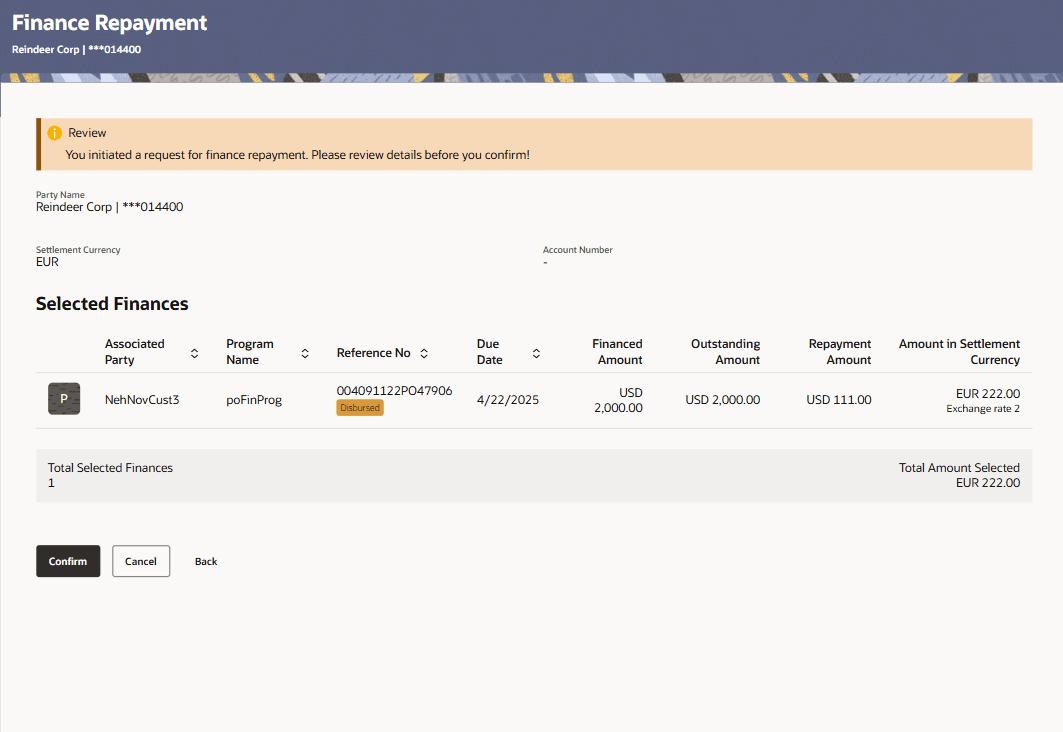
- Click Repay to settle the selected finances. The Review screen displays.
- In the Review screen, verify the details, and click
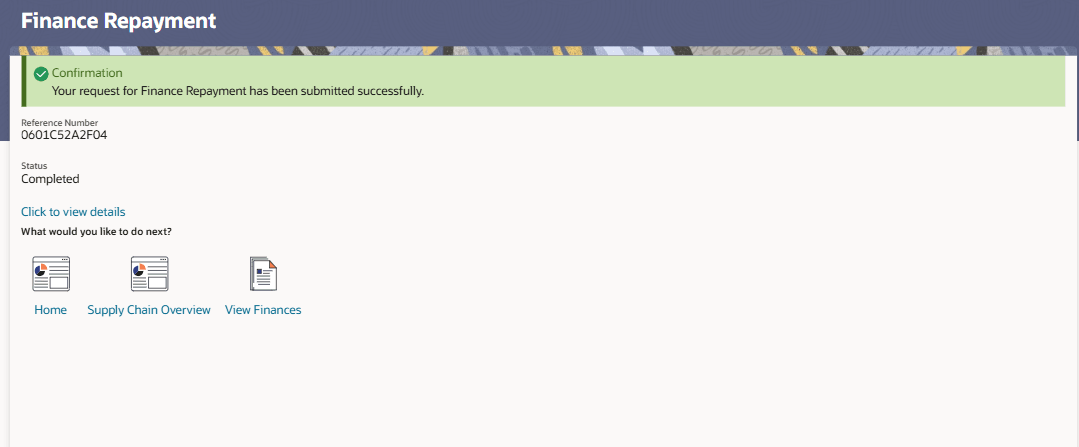
Confirm. A Confirmation message of request initiation
appears along with the reference number. Or, do one of the following:
- Click Back to navigate back to the previous screen.
- Click Cancel to cancel the transaction.
A Confirmation message regarding repayment of finance initiation appears along with the reference number.
Parent topic: Finance Management