1 Introduction
This topic describes about the introduction of supply chain finance.
Supply Chain Finance is a platform that facilitates corporate organizations to avail short-term credit that optimizes working capital. Credit can be availed by either the buyer or the seller/supplier. Suppliers sell or liquidate their invoices or receivables to banks. This enables them to make liquid money available to proceed with future orders. Similarly, Buyers avail finance for their payables from banks so that their obligations are met on time. Through SCF, the overall cost of availing credit comes down.
Using the digital platform of SCF, corporates are able to perform SCF transactions from the portal itself, thus resulting in improved business efficiency. The transactions can be executed, viewed and tracked online. No follow-ups are required with the bank for the status of the transactions.
Corporates can manage creation of single or multiple invoices and/or purchase orders directly online. Bulk entries can also be made through file upload. Corporates can also accept or reject invoices/purchase orders online. The portal facilitates corporates to introduce their business partners to the bank. The business partners, or counter parties may or may not be customers of the bank. However, each counterparty should be on-boarded by the corporate customer themselves and further be linked to the SCF programs to enable conduction of business transactions.
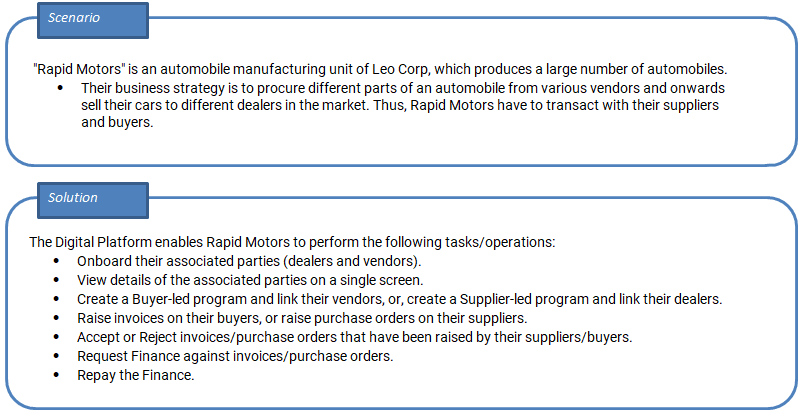
The entire chain of processes, such as onboarding counterparties, raising a purchase order/invoice, accepting the purchase order/invoice, requesting finance for the purchase order/invoice, viewing details of the finance, repayment, and so on, can be performed using the portal.
The features built for the corporate user in the Supply Chain Finance Module are as follows:
- Overview
- Program Management
- Finance Management
- Viewing Limits
Note:
- Supply Chain Finance transactions are only supported on Desktops and on Landscape mode of Tablet devices. For more information on the list of available screens for mobile view, refer Mobile Touchpoints section.
- The corporate user who performs transactions such as, creation of program, linking receivables/payables to programs, requesting finance, and so on, is referred to as ‘Maker’. The corporate user who approves the transactions is referred to as ‘Approver’ or ‘Checker’. The corporate user who eventually releases the transaction, post approval, so that it takes effect in the application, is referred to as ‘Releaser’.
- The Corporate Admin user can now assign the role of ‘Checker’ to any corporate user, for all Supply Chain Finance transactions.
- For more information on receivables and payables, refer User Manual Oracle Banking Digital Experience Receivables Payables Management