Material Currency
As per the standardized approach of IRRBB, the loss in economic value of an equity is calculated for each currency with material exposures. Material exposure is defined as those accounting for more than 5% of either banking book assets or liabilities. Utility moves data from FSI_D_ to FSI_ALM_MATERIAL_CCY.
Execution of Material Currency
To execute the Material Currency, follow these steps:
- Navigate to Operations and Processes, select Scheduler, and then select Define Batch.
- Define a new batch.
- Enter the Batch Name and Description, and then Save the batch.
- To add a task, navigate to Define Task.
- Select the Batch from the Batch drop-down list on the Define Task Window.
- Click the Add button.
- Define the task with below details:
- Task Name: Name of Task
- Task Code: Code for Task
- Task Description: This can be same a name of the Task or something else
- Task Type: REST
- Component: Transform Data
- Batch Service URL: DMT_SERVICE
- Extra Parameters: Enter following parameters:
Figure 6-144 Material Currency
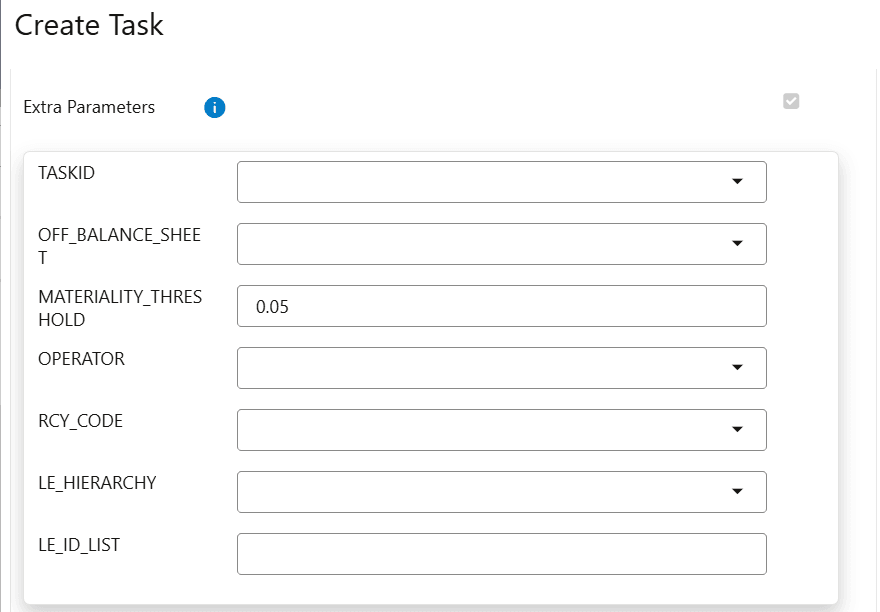
- TASKID: Select the Task ID which needs is to be executed
- OFF-BALANCE SHEET: Set the Off-balance sheet flag as ‘Yes’ to enable off-balance sheet instruments, ‘No’ to disable them.
- MATERIAL_THRESHOLD: .05 is Material Currency Threshold. 05 is the threshold defined by BASEL norms but the parameter is configurable between [0,1], limits inclusive
- OPERATOR: Select the Comparison Operator. Following options are available: Greater Than, Less Than, Greater Than Equal, Less Than Equal.
- RCY_CODE:Select the reporting currency code from drop-down. These are reporting currency ISO codes.
- LE_HIERARCHY (Optional): Select one Legal Entity hierarchy. If this parameter is provided, LE_ID_LIST must be either NULL or contain only one Legal Entity ID.
- LE_ID_LIST (Optional): If LE_HIERARCHY is not provided, LE_ID_LIST can contain either a single Legal Entity ID or multiple IDs in a comma-separated format. Example: ‘1,2,3,4’. If LE_HIERARCHY is provided, then LEID_LIST must contain only one value of either node or leaf member present in hierarchy. Example: ‘1’.