1.2 Customer Screening Workflow
The figure illustrates the Customer Screening workflow.
Figure 1-2 Customer Screening Workflow
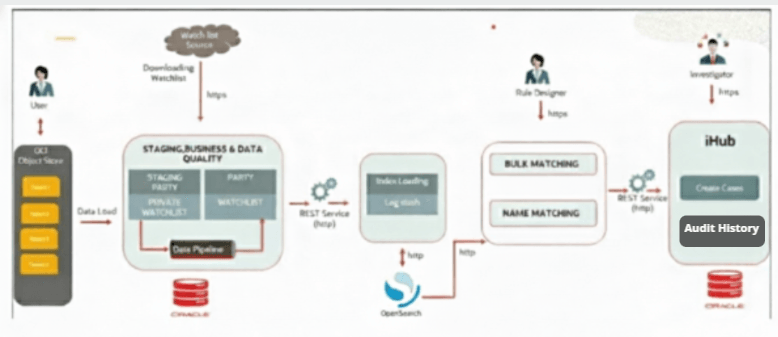
Customer screening workflow orchestrates the sanctions screening of customers against internal and external watchlists, ensuring.
This workflow ensures:
- Automated, scalable screening across multiple tenants/clients.
- Consistent data quality and processing through rigorous controls.
- Strict role separation and robust security to prevent data leakage.
- Thorough investigative and compliance traceability. .
Here’s a step-by-step explanation:
Data Ingestion
- The data ingestion process helps to collect and compartmentalize data for each tenant/client to uphold strict data separation and confidentiality.
- Data Sources:
- Customer Lists: Core customer/client records subject to scrutiny.
- Party Lists: Linked individuals/organizations of interest (e.g., beneficial owners, related vendors).
- Transactions: Counterparties in a transaction.
- Watchlists:
- External: Sanctions and PEP lists (e.g., OFAC, EU, UN, government sources) are securely downloaded via HTTPS. FinCEN names are uploaded by users in the application upon downloading the FinCEN list from a secure web-based interface.
- Internal: Proprietary/private lists managed by the organization that can be managed through UI and API.
- Ingestion Mechanism:
- Users securely upload CSV data to the Oracle Cloud Infrastructure (OCI) Object Store, partitioned by tenant to ensure data privacy and access control.
Staging, Business & Data Quality Process
This process allows users to prepare data for reliable screening while enforcing quality and business rules.
- Data Pipeline:
- Cleansing: Standardizes names, dates, and removes inconsistencies (e.g., whitespace, encoding errors).
- Validation: Ensures data is complete, accurate, and meets business rule requirements (e.g., mandatory fields, data types).
- Enrichment (optional): Additional context or identifiers can be appended.
- Categories Maintained:
- Party/Customer Data: Structured information about individuals or organizations.
- External entity data: Structured information about Transaction counterparties
- Watchlists: External and internal, consolidated for screening.
Index Loading & Search Preparation
- Data Cleaning & Validation: Verifies only high-quality, valid, and standardized data moves forward
- Index Loader & REST Service:
- Cleaned data is relayed via REST APIs to an intermediate 'Index Loader.'
- This decouples upstream processing from the search engine, allowing for asynchronous and extensible data flows.
- Logstash Integration: Leverages Logstash for advanced data transformations, enriching, and loading into OpenSearch.Pipeline: HTTP Input → Filter/Transform → Output/OpenSearch Index
- OpenSearch Index:
- Enables rapid searching, dynamic filtering, and analytics.
- Designed for scalability, privacy, and auditability.
Screening & Matching Engine
- Modes of Screening:
- Bulk (Batch) Matching: For scheduled/periodic, high-volume processing.
- Real-time (Single) Matching: For “instant” checks—via API and UI—for onboarding or transactional triggers.
- Matching Rule Management:
- Role-based secured environment for configuring matching parameters (algorithms, thresholds, fuzzy logic).
- Change management and auditing for configuration changes.
- Screening Execution:
- Matching engine queries OpenSearch for candidate matches on legal/known names, aliases, and other relevant identifiers.
- Results surfaced through both REST API and user interface.
Alerting, Case Management, and Investigation
- Alert Routing: Positive/Partial matches (potential alerts) are automatically sent through REST API to the case management system (e.g., iHub).
- Case Creation: Cases triggered for
individuals, entities, vessels, and external entities on:
- Sanction matches
- PEPs
- Inclusion on adverse media/proprietary lists
- Other exclusion/warning triggers
- Prohibited country lists
- FinCEN names.
- Investigation:
- Investigators securely access the case management environment with strict logging and access controls.
- Full audit trails maintained for all actions: assignment, escalation, investigation, and closure.
- Cases can be worked, documented, and escalated as needed according to defined procedures.
Security, Access Control & Audit
- Tenant Isolation: Logical separation of data for each client/unit to guarantee confidentiality.
- Secure Transmission/Storage: HTTPS for all data flows; encryption at rest and in transit for sensitive data.
- Role-based Access: Least-privilege principle is applied across ingestion, configuration, investigation, and administration.
- Audit Logs: Detailed logs of key activities (ingestion, rule changes, investigations) for compliance and forensic review.
Audit
Comprehensive audit history maintained for:
- Cases created in the Investigation hub, for real-time and batch screening
- Private watchlist management
- Batch execution and screening
- Real-time screening