J.1 Load Run IDs for T2Ts
You can load the data into OFSAA using the OFSAA T2Ts.
OFSAA Data Model includes Load Run Identifier as part of the primary key for staging tables. This enables data to be stored for multiple load runs for any date. OFSAA Data Model also has a table to maintain master information about Load Run and can be used for identifying or filtering Load Run during Run execution within OFSAA.
Before loading data into the staging table, generate a Load Run Identifier to stamp the records from the source. These records can be a complete snapshot or can be partial or Incremental Data too. This Load Run Identifier can be generated by calling the function in the OFSAA Atomic Schema named fn_register_load_run (Batch name: DM_REGISTER_LOAD_RUN). The function expects some input parameters (as mentoined in section Incremental T2Ts) and returns a unique Load Run Identifier to the calling program. For OFS FTP and OFS PFT applications, in the SETUP_MASTER_TABLE, the V_COMPONENT_VALUE is seeded with the EPM_LOAD_RUN_ID equals to 0 by default.
The following process flow diagram illustrates the Load Run ID for the T2T process.
Figure J-1 Load Run ID for T2T Process Flow
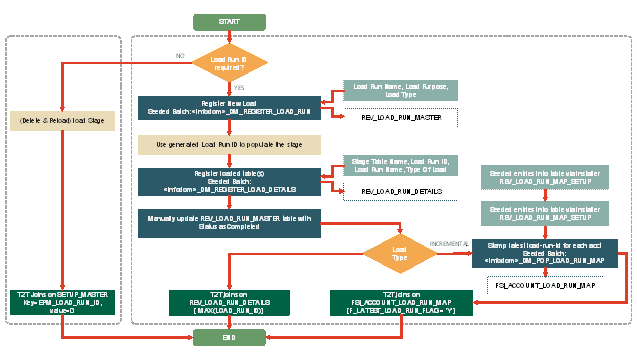
- Existing T2Ts
Existing T2Ts are modified to make a join between stage table and SETUP_PAREMATERS_MASTER table on <stage table>.load_run_id = <EPM_LOAD_RUN_ID value> and do the data load to instrument or processing table. Even though changes are made to existing T2Ts, seeded entries in the SETUP_PAREMATERS_MASTER table will make it work without any issues if the Load Run ID column value in the stage table is the default value of zero and not null. If the Load Run ID value in the stage table is any other value other than zero, then customers have to update the EPM_LOAD_RUN_ID parameter value in the SETUP_PAREMATERS_MASTER table with the used Load Run ID value for the load. - Incremental T2Ts
Incremental T2Ts are introduced to support the incremental load of data for a particular MIS date.
Parent topic: Creating and Executing T2T Processes