Accessing Reporting and Analytics
To access Reporting and Analytics from a tablet or desktop computer, use the URL that was provided by Oracle.
Note:
The following sections apply to Reporting and Analytics release 20.4 and later.
If your environment was upgraded to 20.4 from a release earlier than 20.2 and 20.3, Reporting and Analytics prompts you to change your password on the first sign-in after the upgrade to 20.4.
Signing In With a Browser
Oracle Restaurants Reporting and Analytics 20.4 contains changes that affect how you sign in to the app and some of its related apps. These changes make signing in smoother and more secure.
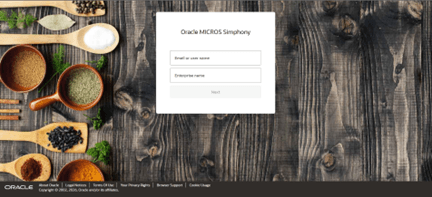
The first step of the new sign-in workflow opens to the page shown in the following image. After entering your user name and enterprise name, click Next.
-
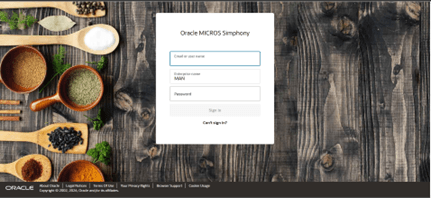
If you see the Password field as shown in the following image, enter it to finish signing in.
-
If you are re-directed to a different sign-in page as shown in the following image, enter your user name and password and then click Sign in.

After you sign in for the first time, the system retains your company information so you do not need to enter it for subsequent sign-ins.
The web browser locale setting controls the language shown on the sign-in page.
New Web Address (URL) Patterns
Starting with release 20.4, your Reporting and Analytics app web address (URL) might look different:
-
<host>/<shortname>This URL has the company’s short name and might look like this:
https://simphony-home.mtu4-demo.oraclemicros.com/ABC/portalBookmark the URL to skip the first sign-in step and to get re-directed to the sign-in page to enter your password.
-
<host>/<shortname>/SSOIf your company uses Single Sign-On, your Reporting and Analytics URL might look like this:
https://simphony-home.mtu4-demo.oraclemicros.com/ABC/SSOBookmark the URL to get re-directed to your company’s SSO server sign-in page to enter your password.
Signing In With InMotion Mobile
In the app, enter your Reporting and Analytics URL and Company name, and then click Next.
Note:
Do not add forward slashes or suffixes (for example, “portal” or your enterprise name) to the end of the URL. Make sure the URL starts withhttps:// and ends with .com.
- If you see the Username and Password fields, enter your credentials and click Login.
-
If you are re-directed to a different sign-in page, enter your user name and password and click Sign in. If your enterprise uses Single Sign-On (SSO), select the separate button in the Or sign in with section on the page to go to your company’s SSO server.
Signing In With iQuery
In the add-in, enter your Reporting and Analytics URL and Company name, and then click Next.
Note:
Do not add forward slashes or suffixes (for example, “portal” or your enterprise name) to the end of the host name. Make sure the host name does not includehttps:// and that it ends with
.com.
The system re-directs you to your browser to sign in. The sign-in workflow is the same as Signing In With a Browser.
Accessing Employee Self Service
From a mobile device or tablet, add /mobile to the end of the original
URL. For example: https://<your Reporting and Analytics URL>/mobile. See
Employee Self Service in the Oracle Restaurants Labor Management User
Guide for more information.
To switch to the tablet and desktop-optimized page, click Go To Desktop Site at the bottom of the page.