View Care Gap Closure Opportunities
View AI-generated open care gap lists.
Health system quality teams are under increasing pressure to close care gaps quickly and at scale in order to meet value-based care targets, improve patient outcomes, and secure incentive payments. The current process for closing care gaps is highly manual, with quality managers sorting through spreadsheets and reviewing patient charts to identify open care gaps, and coordinating with multiple different departments to create patient outreach campaigns. For large populations managing chronic conditions, streamlining this process has the potential to positively impact both patient care and organizational performance.
Quality Management uses real-time patient and organizational data to identify patients with open care gaps and help you create outreach campaigns to close those care gaps. The system reviews patient measure data, patient history, and future appointments for all patients eligible for a measure and recommends targeted action to help close the patient's care gaps. Currently, all measures in the following three registries are included:
- Clinical Standard v4 Comprehensive Adult Wellness
- Clinical Standard v4 Diabetes
- Clinical Standard v4 Depression
Top Opportunities on the Quality Management home page that are labeled with the Agent Insight badge contain system-generated recommendations for care gap closure and outreach efforts. Select an Agent Insight labeled opportunity to view the care gap closure insight page for that measure.
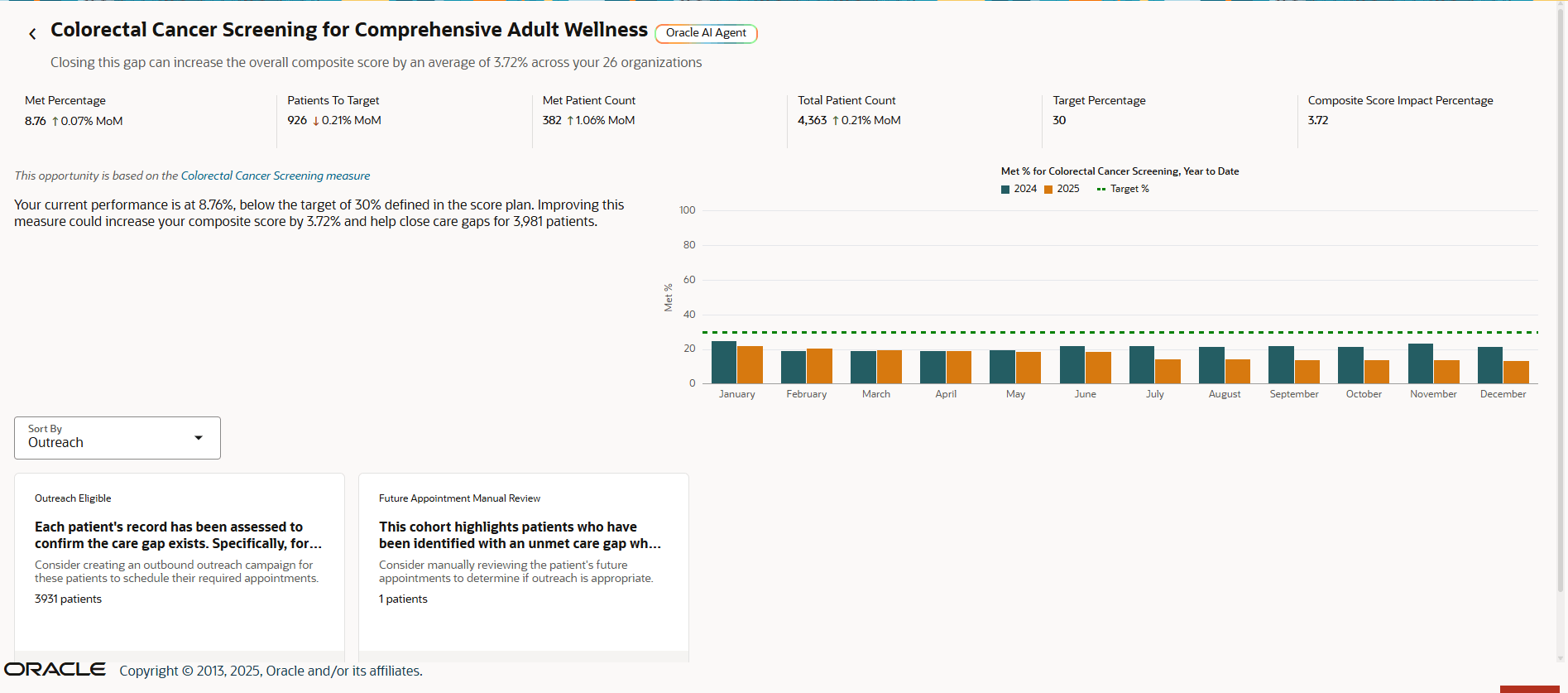
The following information is included on the care gap closure insight page:
- Key Performance Indicators (KPIs): Key targets as defined by your organization and the patient counts for the measure. KPIs displayed include the following information:
- Met Percentage
- Patients to Target
- Met Patient Count
- Total Patient Count
- Target Percentage
- Composite Score Impact Percentage
- Impact description statement: A statement describing the potential impact meeting the measure could have on your organization.
- Year over year comparison chart: A bar chart displaying monthly performance of the measure for the current year and past year.
- Patient cohorts: The system sorts all patients included in the measure into cohorts based individual health and appointment history, and recommends a primary and secondary action for each group. Patient cohorts are recommended groupings of patients based on their medical and appointment history. Patients can not be removed from a cohort. Select Send to Outreach in a cohort box to create a campaign for that subset of patients. See Patient Outreach for information about creating an outreach campaign. Select Explore to view all patients included in that cohort.
The table below describes possible cohort examples.
| Cohort Name | Cohort Description | Recommended Action | Example |
|---|---|---|---|
| Outreach Eligible | These patients have been deemed eligible for outreach based on measure recommendations, patient data, and supporting facts. Each patient's record has been assessed to confirm that the care gap exists. For patients whose records are missing data, meaning no recorded result exists in the identified measurement period and no identified scheduled appointment exists that addresses the care gap, a tailored recommendation specific to the patient and the care gap is provided to prompt appropriate follow-up and close the care gap. Each patient has an outreach message available in their profile. | Consider creating an outbound outreach campaign for these patients to schedule their required appointments. | Measure: Breast Cancer Screening (Clinical Standard)
Patient is a 48 year old female with a mammogram last documented in December 2024. She is overdue for her breast cancer screening.
Example Action: Outreach to the patient to suggest scheduling a mammogram. |
| Value-Based Care Gap | These are patients whose most recent recorded test results fall outside the recommended target range for the specific quality measure. These patients have already completed the relevant appointment or lab work, but their outcomes indicate a persisting care gap. | Consider collaborating with the attributed clinical teams for targeted intervention or specific follow-up actions to address this value-based care gap. | Measure: HbA1c < 9% from the Diabetes Registry (Clinical Standard) Patient had an hBA1c test in January of 2026. The result was 11% which does not meet the met criteria. Example Action: Work with the patient's associated clinical teams to manage their elevated A1c levels. |
| Future Appointment Manual Review | These are patients with an unmet care gap who also have an upcoming appointment that may or may not directly address the care gap. The assessment to arrive at this conclusion considers both the reason and type of appointment scheduled, as well as the provider specialty and location when available, and the specific registry. | Consider manually reviewing the patient's future appointments to determine if outreach is appropriate. | Measure: Diabetes Eye Exam (Clinical Standard) Patient is overdue for her diabetes eye exam. She has an upcoming annual office visit with her primary care provider. Example Action: Suggest a manual review to determine if the patient's upcoming appointment with her primary care provider is the right type of appointment to close the open care gap. |
| Future Appointment Scheduled | These are patients with an unmet care gap who also have an upcoming appointment that is expected to directly address the care gap. The assessment to arrive at this conclusion considers both the reason and type of appointment scheduled, as well as the provider specialty and location when available, and the specific registry. | Consider collaborating with the attributed clinical teams to ensure the care gap is closed during the relevant appointment. | Measure: Annual Office Visit (Clinical Standard) Patient's last documented office visit was in October 2024. Patient is overdue for their annual office visit but has an appointment scheduled on February 20th, 2026. Example Action: Consider collaborating with the provider to ensure there is patient follow-through and the care gap is closed. |
Additional cohorts include Oncology Patient Manual Review, Hospice Patient Manual Review, Vitals Manual Review, and Manual Review.
Parent topic: Oracle Health Quality Management Introduction