For Companies using WHO-DD B3 format
For drugs auto encoding during case processing with WHO-DD B3 format, the dictionary is set in Argus Console > System Configuration > System Management (Common Profile Switches) > Case Form Configuration > Auto Encoding section.
For MFDS E2B(R3) reporting, since it is mandatory to send the WHO Medicinal Product ID and the WHO CAS Number from C3 format, it is recommended to load the WHO-DD C3 dictionary into Oracle Argus Safety. Technically, Oracle Argus Safety supports loading multiple WHO dictionary versions and formats.
Note:
This switch shall not impact the Case processing and is used only for MFDS E2B(R3) reporting. Hence, companies can continue to code drugs with the WHO-DD B3 format as usual.WHO B3 drug code conversion to WHO C3 Record ID logic
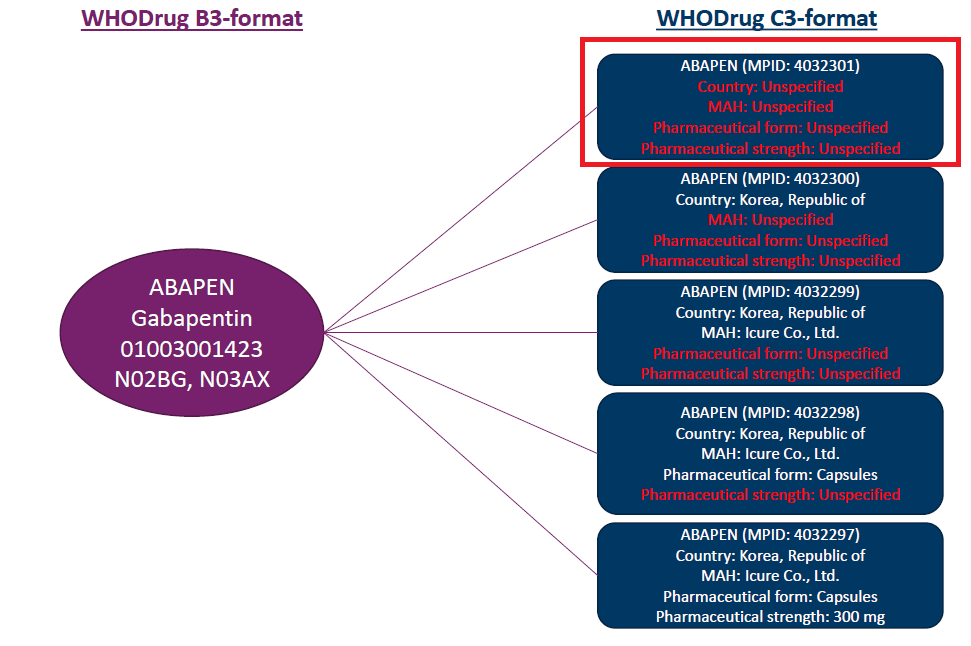
- Country = Unspecified
- MAH = Unspecified
- Formulation = Unspecified
- Strength = Unspecified
This mapping is designed in discussion with WHO-UMC to fetch the match from C3.
For example, for the ABAPEN drug coded using B3 format, Oracle Argus Safety mapping logic fetches the corresponding C3 format data, as in the image below:
From Oracle Argus Safety version 2026.1.01:
- Select the matching records from the C3 dictionary where WHO Drug Code matches with the code in the case form.
- Among the selected records, if the Drug Authorization Country value is entered in case form, then compare country A2 code in case form converted to A3 code in the selected records.
- If there are multiple matches, then consider only those records and go to the next step.
- If there are no matches, then consider the records with the Country value set as UNS or N/A and go to the next step.
- If there is a single matching record, then check if the Manufacturer and Formulation values in the case form are null, or if Manufacturer and Formulation in the single match record are not specified, then use this record for data population. In any other scenario, retrieve the C3 code by using the old logic.
- If the Drug Authorization Country value is not entered in case form, then go to the next step.
- Among the selected records, compare the Manufacturer value entered in case form.
- If there are multiple matches, then consider only those records and go to the next step.
- If there are no matches, then consider the records with manu_name = Not specified or manu_name = None and go to next step.
- If there is a single matching record, then check if the Formulation value in the case form is null, or if the Formulation in the single match is not specified/none, then use this record for data population. In other scenarios, retrieve the C3 code by using old logic.
- If the Manufacturer value is not entered in case form, then go to next step.
- Among the selected records, compare the Formulation value entered in case form.
- If there are multiple matches, then consider the first matching record.
- If there are no matches, then consider the Formulation = Unspecified. Again, if there are multiple matches, consider the first matching record.
- If there is a single matching record, then consider that record.
- If Formulation is not entered in case form, then retrieve C3 by using the old logic.
Note:
The customization of B3 to C3 mapping can be achieved by the customizing export mapping query for the below elements in Console > Interchange Mapping > MFDS profile:- PATIENTPASTDRUGTHERAPY
- PARENTPASTDRUGTHERAPY
- DRUG
- ACTIVESUBSTANCE
The pkg_mfds.sql file is unwrapped for this purpose.
WHO Medicinal Product ID and WHO CAS Number are captured and transmitted as outlined in the table below.
For details, refer to the Business Rules defined in E2B(R3) export mapping document.
| Element ID | Element description | Data capture and transmitted from |
|---|---|---|
| D.8.r.1.KR.1a | WHO-DD version | Console > Common Profile Switch > E2B > Regional Drugs Dictionary |
| D.8.r.1.KR.1b | Medicinal Product ID
(Patient Past drug Therapy) |
WHO Medicinal Product ID is retrieved from WHO-DD C3 dictionary WHO_DRUG_C_MASTER table using Drug code of the Patient past drug details |
| D.10.8.r.1.KR.1a | WHO-DD version | Console > Common Profile Switch > E2B > Regional Drugs Dictionary |
| D.10.8.r.1.KR.1b | Medicinal Product ID
(Parent Past drug Therapy) |
WHO Medicinal Product ID is retrieved from WHO-DD C3 dictionary WHO_DRUG_C_MASTER table using Drug code of the Parent past drug details |
| G.k.2.1.KR.1a | WHO-DD version | Console > Common Profile Switch > E2B > Regional Drugs Dictionary |
| G.k.2.1.KR.1b | Medicinal Product ID
(Suspect/Concomitant/Interacting Products) |
WHO Medicinal Product ID is retrieved from WHO-DD C3 dictionary WHO_DRUG_C_MASTER table using Case Form > Product > Drug Code |
| G.k.2.3.r.1.KR.1a | WHO-DD version | Console > Common Profile Switch > E2B > Regional Drugs Dictionary |
| G.k.2.3.r.1.KR.1b | Substance ID
(Ingredients of Suspect/Concomitant/Interacting Products) |
WHO CAS Number is retrieved from WHO-DD C3 dictionary WHO_DRUG_C_SUBSTANCE table using Case Form > Product > Substance Information > Substance Name |