3 Cloud
This chapter describes the RIB cloud.
The following diagram describes a sample hybrid architecture in which some of the retail applications are on-premise and some other (including RIB) are in the cloud. In this architecture, the retail applications RWMS is on-premise, while RIB is on the cloud.
Figure 3-1 Retail Integration Suite - Cloud Architecture
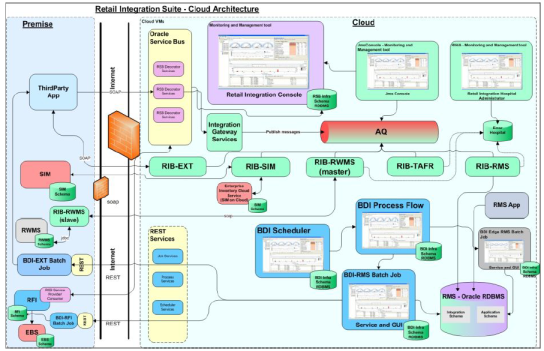
In order to support cloud deployment (including a hybrid cloud), RIB is enhanced with the addition of two Web services. These are injector and publisher Web services that allow retail applications to communicate with other applications.
Configuring RIB-RWMS for Hybrid Cloud Deployment Topology
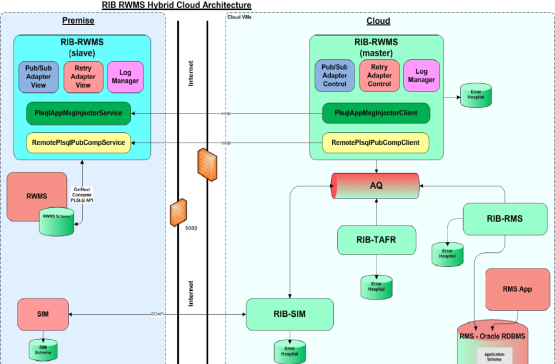
RWMS on-premise cannot communicate with RMS and other retail apps, which are all in cloud via RIB. As RIB is already supported in cloud, for enabling the integration of RWMS with all other retail applications which are in the hybrid cloud environment, RIB follows the primary/secondary approach. The secondary resides close to on-prem RWMS, while the primary is on-cloud. Communication between primary and secondary is through web service calls. The RIB-RWMS primary invokes the new web services exposed by secondary RIB-RWMS to send/receive messages to/from other applications on cloud via RIB.
For RIB-RWMS to communicate with RWMS on premise and RIB on cloud, it should be deployed in primary-secondary topology. Hybrid cloud set-up for RWMS involves a two part installation, one for each primary (cloud) and secondary components (on-premise).
Figure 3-2 RIB-RWMS Hybrid Cloud Architecture
Note:
The client-server architecture is only applicable to RIB and RWMS integration, where RIB is deployed on Next Gen SaaS Platform and the legacy RWMS is hosted on on-prem/PaaS.