Glossary of System Components
This section is intended to be a reference for clarification on terms used throughout this document.
On this page:
Batch Files
The batch files define the OPC UA client and server virtual devices, the OPC UA client and server agents, the local and remote VCCs, their properties, and their nodes/points as well as the association variables and client-side transfer sets.
Connection
This term refers to the underlying connection between a local and remote VMD or local and remote VCC.
Heartbeats
Application’s Heartbeat: Each application OPC UA server writes to a heartbeat variable in an OPC UA server within an LEC Server instance. The application’s OPC UA server updates the value of the variable every 10 seconds. The local OPC UA client monitors this heartbeat value, and if it is not updated in 30 seconds, the instance of LEC Server will go offline.
LEC’s Heartbeat: The OPC UA server in each LEC Server instance has a heartbeat variable that is updated every 10 seconds. Each external OPC UA client monitors this heartbeat variable, and if the heartbeat is not updated in 30 seconds, the client OPC UA application will failover to another instance of LEC Server instance.
ICCP Client / Local ICCP Client (LEC)
The ICCP client represents an ICCP virtual device, also known as a VCC in LEC Server. In this configuration, the VCC receives telemetry data (Block 1) from a remote VCC server. This data is processed in the LEC Processor so that it is compatible with the OPC UA data types. The VCC client also serves a role in transmitting control directives (Block 5) from the processor to the remote VCC server.
IFE (ICCP Front End)
LEC Server is configured to act as an IFE for an OEM’s application and handle associations between the application’s OPC UA clients and servers and devices of remote ICCP peers’ devices. The processing engine behind each instance of LEC IFE is LiveData LEC Server.
Inbound Association Control (VccAssocInControl)
The Inbound Association Control node enables and disables the inbound ICCP association from another VCC.
Network Manager SCADA/EMS
In this context, the OEM’s application interacts with LEC Server instances and controls which LEC Server instances are in Active or Passive mode.
- Active Mode: if the Network Manager SCADA switches an IFE to be in Active mode, the IFE is turned on and each of its virtual devices are set up to make an association with specified remote virtual devices.
- Passive Mode: if the Network Manager SCADA switches an LEC Server instance to be in Passive mode, the instance is/remains turned off, preventing any associations from being made.
OPC UA Agent
The OPC UA Agent is a node within the LEC Server instance that can enable or disable and monitor the OPC UA connection to the application’s system.
OPC UA Client / Local OPC UA Client (LEC)
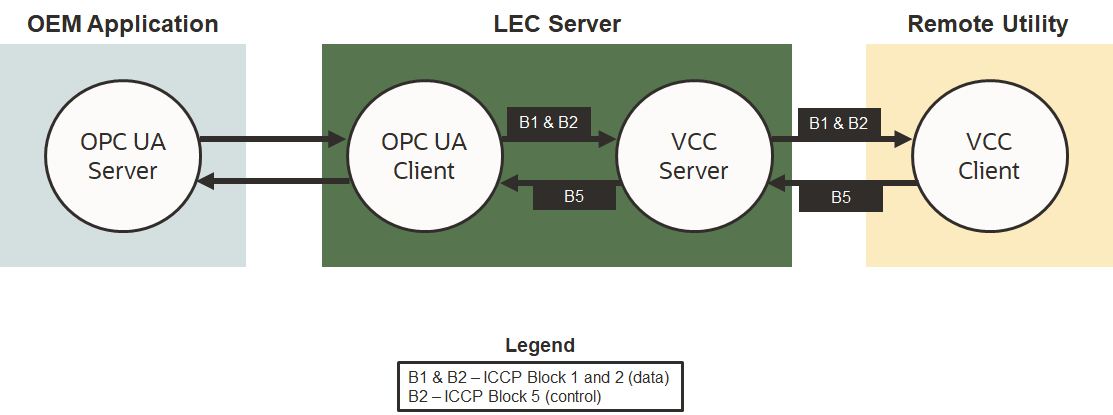
The OPC UA client is a virtual device that receives telemetry data from an application’s OPC UA server. It then transmits this data to an LEC processor virtual device, which transforms this data into ICCP Block 1 and/or Block 2 data and transmits it to the local ICCP server. The ICCP server then transfers the ICCP data to a specified remote ICCP client. In response to the transmitted data from the application’s OPC UA server, the remote ICCP device transmits control directives (Block 5) through the reverse path (VCC Server > Processor > OPC UA client virtual device > application’s OPC UA server) as outlined in the following image.
OPC UA Client (OEM Applications)
Each OPC UA client is under the control of the Network Manager SCADA. An OPC UA client will subscribe to telemetered data as well as status and statistical data from active and standby LEC Servers. For telemetered data, the OPC UA client will have an active subscription only to the active LEC Server instance.
For statistical data, the OPC UA client will have active subscriptions to all LEC Server instances, regardless of their state, active or standby. In addition to subscribing to telemetry data, an OPC UA client will subscribe to a heartbeat variable from the active LEC Server instance as shown in the following image:
The conformance block data that the application’s OPC UA client receives from the remote VCC server is outlined in this image. This data is received by the LEC VCC client, and then processed in the LEC Processor so that it is compatible with the OPC UA data types.
In response to this data, the application’s OPC UA client will send control data back to the VCC server. This data is processed into ICCP-compatible data by the LEC Processor.
OPC UA Server / Local OPC UA Server (LEC)
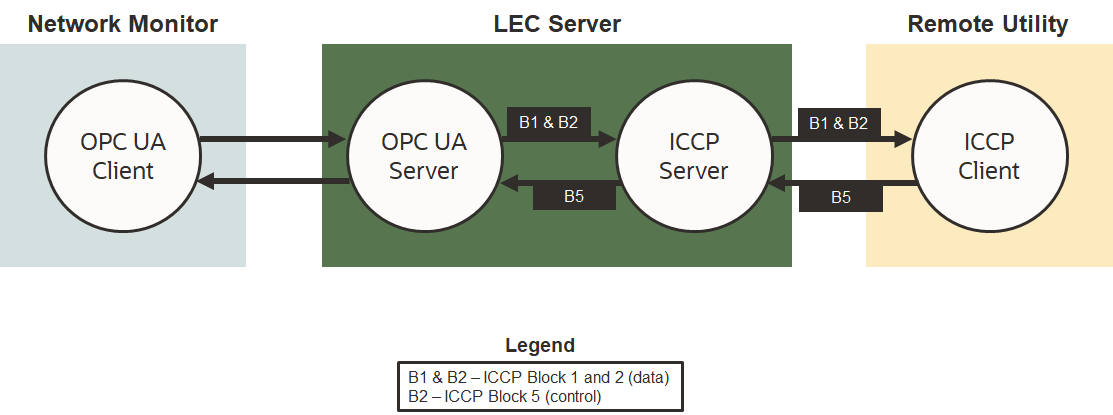
The OPC UA server is a virtual device (resource mapper) that transmits telemetry data (Block 1) from an LEC processor virtual device to an application’s OPC UA client. The processor virtual device translates ICCP data into an OPC UA compatible form, having received the data from an LEC VCC that received that data from a remote ICCP server.
The OPC UA server also serves a role in transmitting control directives from the application’s OPC UA client to the LEC Processor as shown in the following image:
OPC UA Tag
Tagging is the mechanism through which OPC UA clients can protect utilities technicians and equipment (usually during maintenance) by hanging a red tag (logically, not physically) on a device to prevent the device from running subsequent operations. OPC UA clients can set, clear, and monitor tags in remote ICCP servers. Setting, clearing, and monitoring are all Block 5 operations.
Outbound Association Control (VccAssocOutControl)
The Outbound Association Control node enables and disables the outbound ICCP association to another VCC.
Sessions
All OPC UA communications are made possible through sessions. In the IFE, the number of sessions per connection is configurable and specified in the node named AgentC of the OpcUaClient VMD and in the node named AgentS of the OpcUaServer VMD. Both AgentC and AgentS are based on the OpcUaAgent template in LEC Configuration Manager. Note that these values are set in the #IccpUaServerAgent and #IccpUaClientAgent tables in the sample header batch file AppTestAHeader.csv.
Subscription
This term describes a set of one or more points selected by the OPC UA client that the OPC UA server periodically monitors for the existence of some condition, and for which the OPC UA server sends Notifications to the client when the condition is detected. In the IFE, the number of subscriptions per connection is configurable and specified in the node AgentC of the OpcUaClient VMD and in the node AgentS of the OpcUaServer VMD. Both AgentC and AgentS are based on the OpcUaAgent template in LEC Configuration Manager. Note that these values are set in the #IccpUaServerAgent and #IccpUaClientAgent tables in the sample header batch file.
Telemetry Data
The telemetry data received by the application’s OPC UA client will provide the following statistical information:
- Number of points
- Last update time
- Number of points with bad quality as set by the remote system
- Number of points with bad quality as set by the local system
- CPU loading
- Memory consumption
- Uptime
VCC
A virtual control center (VCC) is the type of virtual device that communicates to other devices using the ICCP protocol.
VMD
A virtual manufacturing device (VMD) is a container of nodes. Each VMD is associated with a specific type of communications protocol or interface. Most VMD types are intended to handle communications in and out of LEC Server using a particular communications protocol or interface, such as ICCP, OPC UA, Modbus, database access, or others. Thus, a VMD can map a device from the outside world to Oracle Utilities LEC's internal variable model, which allows LEC Server to capture, transform, and route data to other devices, systems, or applications in a form that the other device, system, or application can understand. Each instance of a VMD has a network address.