Multicloud Universal Credits (MUC)
Oracle Multicloud Universal Credits (MUC) is a licensing option that lets you procure Oracle AI Database and Oracle Cloud Infrastructure (OCI) services in the cloud of your choice. These credits are usable across Oracle Cloud Infrastructure (OCI), Oracle AI Database@AWS, Oracle AI Database@Azure, and Oracle AI Database@Google Cloud, enabling you to streamline procurement process with a single contract across clouds, and run Oracle databases in your available preferred region. Oracle Multicloud Universal Credits are designed to help you modernize applications and databases across multiple clouds. The program removes procurement friction, reduces cost unpredictability, and provides true multicloud freedom-helping you accelerate innovation while maintaining governance and financial control.
Value Proposition
One Contract, Any Cloud
Multicloud Universal Credits provide a single licensing option reducing the overhead associated with multiple contracts and commitments.
Unified Pricing and Rate Card
MUC enables our multicloud customers to better manage their costs with unified pricing and rate cards across the entire database fleet.
True Cloud Choice
Customers can apply these credits to any available region across OCI, AWS, Azure and Google Cloud to meet their compliance requirements, attain desired performance, and to stay closer to their end users.
Scope
- Applicable to new commitments for new and existing customers.
- Conversion or migration of existing private offers or existing Oracle Universal Credit Model (UCM) commitments to MUC isn't supported.
- Intended for direct Oracle customers. Not available for resellers and indirect selling.
- MUC supports USD only.
- Not available in Non-commercial, Government, Alloy datacenters.
Who Benefits from Multicloud Universal Credits
MUC is designed for organizations that operate across multiple cloud providers and want to simplify procurement, increase cost efficiency, and gain consolidated visibility. The following customer profiles are well suited for MUC:
New Multicloud Customers
Organizations using OCI alongside one or more hyperscaler partners who want to consolidate their commitment from day one. MUC lets you start with a single contract rather than managing separate agreements per provider.
Existing OCI Universal Credit Customers
Current Oracle Universal Credit Model (UCM) subscribers interested in executing a commitment to cover multicloud partner usage.
How Multicloud Universal Credits Work
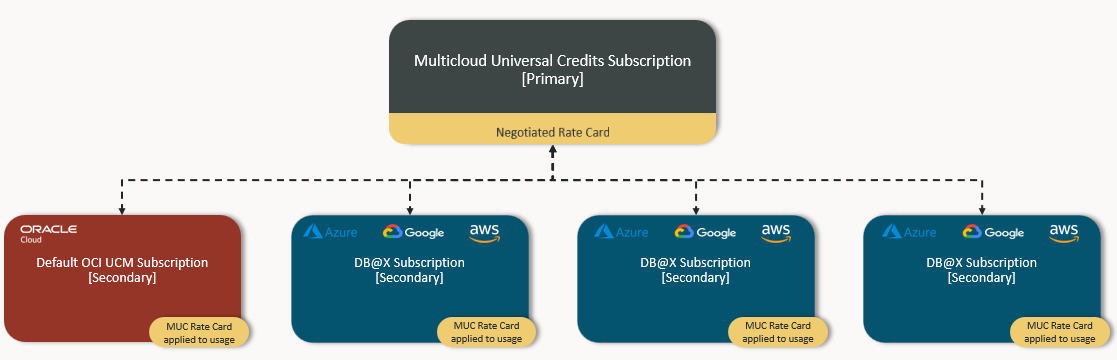
Multicloud Universal Credits uses a subscription model that has an MUC primary subscription linked to hyperscaler secondary subscriptions that aggregates usage toward the overall Multicloud Universal Credits commitment.
MUC Primary Subscription holds the total credit commitment, term length, and rate card. No direct usage occurs on the MUC subscription. The MUC subscription defines the shared credit pool that all subordinate subscriptions draw from.
Secondary subscription is the individual cloud subscription for each cloud provider (OCI, AWS, Azure, GCP). All actual usage happens on the secondary subscriptions and draws down from the MUC primary subscription associated commitment at the unified rate card. All cloud subscriptions must co-term with the MUC subscription.
Eligible Secondary Subscription Types
The following subscription types can be linked as secondary subscriptions under an MUC subscription:
- Oracle Universal Credit Model (UCM) included by default.
- Oracle Database@hypersceler private offer.
Single Rate Card
A single unified negotiated rate card that includes OCI and supported multicloud partners. Rate card pricing and term length cascade from the MUC subscription to all secondary subscriptions. All secondary subscription usage charges are calculated against this single rate card regardless of which cloud provider generated the usage.
Purchasing and Activation
The purchasing flow for MUC is designed to simplify contracting while maintaining full traceability across all subscriptions.
Contract and Commitment
Your Oracle sales representative works with you to negotiate a single commitment amount, term length, and rate card on the Multicloud Universal Credits contract. Based on the cloud providers you select during configuration, associated quotes and ordering documents are automatically generated.
Activation and Setup
On order booking, you receive welcome activation emails for both the MUC subscription and each secondary subscription. MUC subscription and secondary subscription relationships are created and stored automatically. If additional cloud provider subscriptions are needed after the initial commitment is booked, separate ordering documents are required for each new provider subscription.
Billing and Invoicing
The Multicloud Universal Credits model supports both upfront-commitment and usage-based private offers across Azure, AWS, and Google Cloud marketplaces. Work with your hyperscaler account team to choose the best option for your situation. All secondary subscription usage charges are calculated using the MUC subscription rate card and invoiced monthly in arrears. No direct usage occurs on the MUC subscription.
- Upfront-commitment private offer: Charges count against your hyperscaler commitment (including any upfront-commitment and overage charges). You might also qualify for additional incentives. Check with your hyperscaler's account team for details.
- Usage-based private offer: Usage is billed in monthly arrears. Check with your Oracle sales team to see if your workload qualifies.
- Usage-based private offers don't count against your hyperscaler commitment. You might not qualify for additional incentives. Check with your hyperscaler's account team for details.
Unused Credits
Oracle invoices you for any unused credits at the end of each annual period in accordance with the Ordering Document you signed with Oracle.
Overages
For any overage, the hyperscaler bills you monthly in arrears at your negotiated rate card (as it does today). Additionally, the overage amount counts against your Multicloud Universal Credits commitment. If you don't renew your Multicloud Universal Credits contract at the end of the term, any continued Oracle AI Database@AWS, Oracle AI Database@Azure, or Oracle AI Database@Google Cloud consumption is billed at list price. For details, see the service descriptions referenced in your Oracle Ordering Document.
Organization Management
With Multicloud Universal Credits, a Primary MUC subscription holds the total commitment, term, and unified rate card for all participating clouds. This subscription coexists with other OCI subscriptions in the tenancy but can't be remapped once activated. Use Organization Management Overview as the authoritative reference for cross-tenancy governance. The following guidance focuses on how MUC participates in that framework.
- A tenancy still needs an active OCI subscription (in addition to the Primary MUC subscription) before it can accept an invitation to join an organization.
- Existing UCM tenancies that accumulate pay-as-you-go or overage charges can be remapped to an OCI Secondary cloud subscription associated with the Primary MUC subscription so future usage decrements the shared MUC commitment. UCM tenancies with their own committed contracts remain ineligible for remapping.
- Each Secondary subscription (OCI, AWS, Azure, or GCP) draws down from the Primary MUC subscription commitment, and their Associate Sub IDs provide the subordination linkage required for reporting, compliance, and cost rollups inside Organization Management.
Considerations
- Running workloads across providers can potentially incur additional data transfer fees and latency.
- For multicloud service availability by hyperscaler, see:
- MUC simplifies procurement through a unified contract, but it can obscure per‑cloud usage unless you implement tagging, reporting, and chargeback processes.