FEATURE_ID
Syntax
feature_id::=

Description of the illustration feature_id.gif
Description of the illustration feature_id.eps
Analytic Syntax
feature_id_analytic::=

Description of the illustration feature_id_analytic.gif
Description of the illustration feature_id_analytic.eps
mining_attribute_clause::=
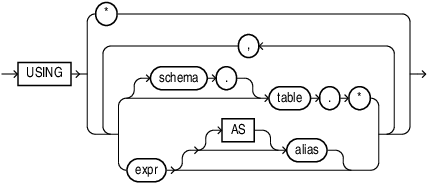
Description of the illustration mining_attribute_clause.gif
Description of the illustration mining_attribute_clause.eps
mining_analytic_clause::=

Description of the illustration mining_analytic_clause.gif
Description of the illustration mining_analytic_clause.eps
See Also: “Analytic Functions” for information on the syntax, semantics, and restrictions of mining_analytic_clause
Purpose
FEATURE_ID returns the identifier of the highest value feature for each row in the selection. The feature identifier is returned as an Oracle NUMBER.
Syntax Choice
FEATURE_ID can score the data in one of two ways: It can apply a mining model object to the data, or it can dynamically mine the data by executing an analytic clause that builds and applies one or more transient mining models. Choose Syntax or Analytic Syntax:
-
Syntax — Use the first syntax to score the data with a pre-defined model. Supply the name of a feature extraction model.
-
Analytic Syntax — Use the analytic syntax to score the data without a pre-defined model. Include
INTOn, where n is the number of features to extract, and mining_analytic_clause, which specifies if the data should be partitioned for multiple model builds. The mining_analytic_clause supports a query_partition_clause and an order_by_clause. (See “analytic_clause::=”.)
The syntax of the FEATURE_ID function can use an optional GROUPING hint when scoring a partitioned model. See GROUPING Hint.
mining_attribute_clause
mining_attribute_clause identifies the column attributes to use as predictors for scoring. When the function is invoked with the analytic syntax, these predictors are also used for building the transient models. The mining_attribute_clause behaves as described for the PREDICTION function. (See “mining_attribute_clause::=”.)
See Also:
-
Oracle Data Mining User’s Guide for information about scoring.
-
Oracle Data Mining Concepts for information about feature extraction.
Note: The following example is excerpted from the Data Mining sample programs. For more information about the sample programs, see in Oracle Data Mining User’s Guide.
Example
This example lists the features and corresponding count of customers in a data set.
SELECT FEATURE_ID(nmf_sh_sample USING *) AS feat, COUNT(*) AS cnt
  FROM nmf_sh_sample_apply_prepared
  GROUP BY FEATURE_ID(nmf_sh_sample USING *)
  ORDER BY cnt DESC, feat DESC;

      FEAT        CNT
---------- ----------
         7       1443
         2         49
         3          6
         6          1
         1          1