Graph Pattern
Purpose
A graph pattern consists of a set of vertex and edge patterns together with search conditions. A graph pattern is matched against a graph to obtain a set of solutions containing bindings for each vertex and edge variable in the pattern.
This topic has the following sub-topics:
Syntax
graph_pattern::=

Description of the illustration graph_pattern.gif
path_pattern_list::=
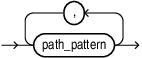
Description of the illustration path_pattern_list.gif
Semantics
A graph pattern contains the following parts:
-
MATCHkeyword. -
path_pattern_list: a list containing one or more comma-separated path patterns.
-
graph_pattern_where_clause: an optional
WHEREclause defining a search condition that may reference vertices and edges from the pattern.
Two path patterns inside the same GRAPH_TABLE may share vertex and edge variables to allow for creating more complex, non-linear patterns. Variables may also be repeated within a single path pattern to create a cyclic pattern. If multiple vertex or edge patterns share a variable then all the label expressions and element pattern WHERE clauses in those patterns must satisfy for binding to the element variable to occur.
If there are no shared variables between two path patterns, then the solution set is a cross product of the solutions of the individual path patterns.
Restrictions
A vertex variable may not have the same name as an edge variable.
Examples
Example 1
The following query finds cyclic paths from Mary via two other persons back to Mary. Only incoming edges are matched (<-[..]-).
SELECT *
FROM GRAPH_TABLE ( students_graph
  MATCH (a IS person) <-[e1 IS friends]- (b IS person)
           <-[e2 IS friends]- (c IS person)
              <-[e3 is friends]- (a IS person)
  WHERE a.name= 'Mary'
  COLUMNS (a.name AS person_a, b.name AS person_b, c.name AS person_c)
);
Here, the graph pattern consists of a single path pattern that has four vertex patterns and three edge patterns. The first vertex pattern shares a variable a with the last vertex pattern so that the pattern matches cyclic paths.
Only a single path matches the pattern:
PERSON_A   PERSON_B   PERSON_C
---------- ---------- ----------
Mary       Bob        John
Here, the output shows that a path was matched that starts in Mary with an incoming edge to Bob, followed by an incoming edge to John, followed by an incoming edge back to Mary.
The same query may also be expressed by breaking up the single path pattern into multiple path patterns as follows:
SELECT *
FROM GRAPH_TABLE ( students_graph
  MATCH (a IS person) <-[e1 IS friends]- (b IS person),
        (b) <-[e2 IS friends]- (c IS person),
        (c) <-[e3 is friends]- (a IS person)
  WHERE a.name= 'Mary'
  COLUMNS (a.name AS person_a, b.name AS person_b, c.name AS person_c)
);
Here, the first path pattern shares variable b with the second path pattern, the second path pattern shares variable c with the third path pattern, and the third path pattern shares variable a with the first path pattern.
Path Pattern
Purpose
A path pattern specifies a linear pattern that matches a string of vertices and edges. Path patterns are made up of the concatenation of one or more vertex and edge patterns. Vertex and edge patterns may be quantified as well as parenthesized.
Syntax
path_pattern::=

Description of the illustration path_pattern.gif
path_variable_declaration::=

path_variable::=

path_pattern_expression::=

Description of the illustration path_pattern_expression.gif
path_term::=
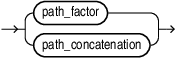
Description of the illustration path_term.gif
path_factor::=
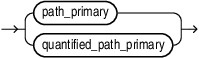
Description of the illustration path_factor.gif
path_concatenation::=

Description of the illustration path_concatenation.gif
path_primary::=
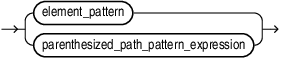
Description of the illustration path_primary.gif
Semantics
Syntactically, a path pattern starts with an optional path variable declaration followed by one or more element patterns, which are either vertex patterns or edge patterns.
The element patterns of a path pattern are not required to alternate between vertex and edge patterns; there may be two consecutive edge patterns or two consecutive vertex patterns. These topologically inconsistent patterns are understood during pattern matching as follows:
-
Two consecutive vertex patterns bind to the same vertex.
-
Two consecutive edge patterns conceptually have an implicit vertex pattern between them.
Restrictions
Path patterns have the following restrictions:
-
A path pattern may only contain two consecutive vertex patterns if one of the vertex patterns is contained in a parenthesized path pattern while the other one is not.
-
A parenthesized path pattern must be quantified.
Path variables cannot be multiply declared. This means that a path variable may not be declared with the same name as an element variable, an iterator variable, or another path variable.
Examples
Example 1
The following query counts the number of vertices in the graph:
SELECT COUNT(*)
FROM GRAPH_TABLE ( students_graph
  MATCH (v)
  COLUMNS (1 AS dummy)
);
Note that the COLUMNS clause needs to contain at least one expression, hence a dummy value is projected but it is not returned from the query.
The result is:
  COUNT(*)
----------
         6
Example 2
The following query counts the number of edges in the graph:
SELECT COUNT(*)
FROM GRAPH_TABLE ( students_graph
  MATCH -[e]->
  COLUMNS (1 AS dummy)
);
The result is:
  COUNT(*)
----------
         8
Example 3
The following query finds persons that are two friend hops away from Mary, following either incoming or outgoing friends edges:
SELECT *
FROM GRAPH_TABLE ( students_graph
  MATCH (n IS person) -[IS friends]- () -[IS friends]- (m IS person)
  WHERE n.name = 'Mary' AND m.name <> n.name
  COLUMNS (m.name AS fof)
);
In the path pattern above:
-
(
n IS person) is a vertex pattern that has a variablenand a label expressionIS person. -
-[IS friends]-is an any-directed edge pattern that has an implicit variable and a label expressionIS friends. -
()is a vertex pattern that has an implicit variable and no label expression such that it matches vertices having any label(s). -
-[IS friends]-is again an any-directed edge pattern that has an implicit variable and a label expressionIS friends. -
(
n IS person) is a vertex pattern that has a variablenand a label expressionIS person.
The result is:
FOF
----------
Bob
John
Note that the query above can also be expressed as:
SELECT *
FROM GRAPH_TABLE ( students_graph
  MATCH (n IS person) -[IS friends]- -[IS friends]- (m IS person)
  WHERE n.name = 'Mary' AND m.name <> n.name
  COLUMNS (m.name AS fof)
);
Here, the vertex pattern between the two edge patterns is implicit.
The same query can be expressed using a quantifier to avoid the repeated specification of the same edge pattern:
SELECT *
FROM GRAPH_TABLE ( students_graph
  MATCH (n IS person) -[IS friends]-{2}(m IS person)
  WHERE n.name = 'Mary' AND m.name <> n.name
  COLUMNS (m.name AS fof)
);
Quantified path patterns may be parenthesized:
SELECT *
FROM GRAPH_TABLE ( students_graph
  MATCH (n IS person) (-[IS friends]-){2}(m IS person)
  WHERE n.name = 'Mary' AND m.name <> n.name
  COLUMNS (m.name AS fof)
);
Note that each of the syntax variations above gives the same result:
FOF
----------
Bob
John
Element Pattern
Purpose
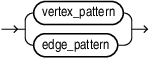
An element pattern is either a vertex pattern or an edge pattern. The result of matching an element pattern is the binding of vertices or edges to the implicitly or explicitly declared variable of the element pattern.
This section comprises the following sections:
Syntax
element_pattern::=
Description of the illustration element_pattern.gif
Vertex Pattern
Purpose
A vertex pattern is a pattern that matches vertices in a graph. The result of such matching is the binding of a set of vertices to the implicitly or explicitly declared variable of the vertex pattern.
Syntax
vertex_pattern::=

Semantics
Visually, a vertex pattern has two parentheses ( ) to mimic a circle since vertices are typically represented by circles in visualizations of graphs.
Examples
Example 1
The following query counts the number of vertices in the graph:
SELECT COUNT(*)
FROM GRAPH_TABLE ( students_graph
  MATCH (v)
  COLUMNS (1 AS dummy)
);
Note that the COLUMNS clause needs to contain at least one expression, hence a dummy value is projected but it is not returned from the query.
The result is:
  COUNT(*)
----------
      6
Example 2
The following query matches all persons with a date of birth greater than 1 January 1980:
SELECT name, birthday
FROM GRAPH_TABLE ( students_graph
  MATCH (p IS person WHERE p.dob > DATE '1980-01-01')
  COLUMNS (p.name, p.dob AS birthday)
)
ORDER BY birthday;
The result is:
NAME	   BIRTHDAY
---------- ---------
Mary	   9/25/1982, 12:00:00 AM
Alice	  2/1/1987, 12:00:00 AM
Edge Pattern
Purpose
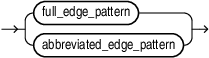
An edge pattern is a pattern that matches edges in a graph. The result of such matching is the binding of a set of edges to the implicitly or explicitly declared variable of the edge pattern.
Syntax
edge_pattern::=
Description of the illustration edge_pattern.gif
full_edge_pattern::=
Description of the illustration full_edge_pattern.gif
full_edge_pointing_right::=

Description of the illustration full_edge_pointing_right.gif
full_edge_pointing_left::=

Description of the illustration full_edge_pointing_left.gif
full_edge_any_direction::=
Description of the illustration full_edge_any_direction.gif
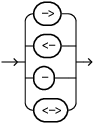
abbreviated_edge_pattern::=
Description of the illustration abbreviated_edge_pattern.gif
Semantics
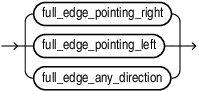
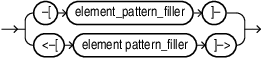
Visually, an edge pattern mimics an arrow since edges are typically represented by arrows in visualizations of graphs. For example, <-[]- or <- are incoming edge patterns because they look like incoming arrows, while -[]-> or -> are outgoing edge patterns because they look like outgoing arrows.
An edge_pattern is either a full_edge_pattern or an abbreviated_edge_pattern. The full edge pattern has an element_pattern_filler with optional element pattern variable, label expression and element pattern WHERE clause, while the abbreviated edge pattern provides syntactic sugar in case none of the three optional filler parts are needed.
The following table summarizes the options:
Table 6 Summary of Edge Patterns
| Directionality | Full Edge Pattern | Abbreviated Edge Pattern |
|---|---|---|
| Directed pointing to the right | -[ ] -> | -> |
| Directed pointing to the left | <-[ ]- | <- |
| Any-Directed: pointing to the right or the left | -[ ]- or <-[ ]-> | - |
Note that since the abbreviated syntax does not allow for providing a variable name, a label expression, or an element pattern WHERE clause, abbreviated edge patterns match with all edges in the graph that have the specified direction.
Examples
Example 1
The following query counts the number of edges in the graph:
SELECT COUNT(*)
FROM GRAPH_TABLE ( students_graph
  MATCH ->
  COLUMNS (1 AS dummy)
);
The result is:
  COUNT(*)
----------
        8
Example 2
The following query matches all friends edges that have a property meeting_date with a value greater than DATE '2000-01-01':
SELECT *
FROM GRAPH_TABLE ( students_graph
  MATCH -[e IS friends WHERE e.meeting_date > DATE '2001-01-01']->
  COLUMNS (e.meeting_date)
);
The result is:
MEETING_DATE
----------------------
7/10/2001, 12:00:00 AM
Element Pattern Filler
Purpose
Vertex patterns and full edge patterns have a filler for providing an optional variable declaration, an optional label expression, and an optional WHERE clause.
Syntax
element_pattern_filler::=

Semantics
Vertex patterns and full edge patterns and have a filler containing the following parts:
-
An optional element_variable_declaration for providing a variable name for the element pattern so that the element can be referenced elsewhere, for example in
WHEREandCOLUMNSclauses. If no variable name is specified, a variable is implicit and cannot be referenced. -
An optional is_label_expression for defining a label expression. Vertices and edges only match if they satisfy the specified label expression.
-
An optional element_pattern_where_clause for defining an in-lined search condition. Vertices and edges only match if they satisfy the specified search condition.
Examples
Example 1
The following query finds persons that are two friend hops away from Mary, following either incoming or outgoing friends edges:
SELECT *
FROM GRAPH_TABLE ( students_graph
  MATCH (n IS person WHERE n.name = 'Mary')
          -[e IS friends WHERE e.meeting_date > DATE '2001-01-01']-
            () -[IS friends]- (m IS person)
  WHERE m.name <> n.name
  COLUMNS (m.name, e.meeting_date)
);
In the path pattern above:
-
(
n IS person WHERE n.name = 'Mary') is a vertex pattern that has a variablen, a label expressionIS personand an element patternWHEREclauseWHERE n.name = 'Mary'. -
-[e IS friends WHERE e.meeting_date > DATE '2001-01-01']-is an any-directed edge pattern that has a variablee, a label expressionIS friendsand an element patternWHEREclauseWHERE e.meeting_date > DATE '2001-01-01'. -
()is a vertex pattern that has an implicit variable and neither has a label expression nor an element patternWHEREclause. -
-[IS friends]-is an any-directed edge pattern that has an implicit variable, a label expressionIS friendsbut no element patternWHEREclause. -
(
n IS person) is a vertex pattern that has a variablen, a label expressionIS personbut no element patternWHEREclause.
The result is:
NAME       MEETING_DATE
---------- ----------------------
John       7/10/2001, 12:00:00 AM
Element Variable
Purpose
Element variables are either vertex or edge variables. During pattern matching, the variables will bind to sets of vertices or edges in the graph. Element variables can be referenced from other places in the query to access data of vertices and edges, such as their property values.
Syntax
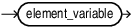
element_variable_declaration::=
element_variable::=

Semantics
Syntactically, an element_variable_declaration is an identifier and can thus be either double quoted or unquoted. Declaring an element variable is optional and if no element variable is declared then the element pattern has an implicit variable with an (implicit) unique name. Implicit variables cannot be referenced elsewhere in the query.
Multiple vertex patterns may declare the same element variable and multiple edge patterns may also declare the same element variable. In such cases, there are not multiple variables but there is a single variable that is shared by the different vertex or edge patterns.
Declared variables are visible within the GRAPH_TABLE in which they are declared. They may be referenced in WHERE and COLUMNS clauses defined in the same GRAPH_TABLE.
If an element variable is declared in a quantified path pattern, then it may bind to more than one vertex or edge within a single solution to the pattern. References are interpreted contextually: if the reference occurs outside the quantified path pattern, then the reference is to the complete list of graph elements that are bound to the element variable. In this circumstance, the element variable is said to have group degree of reference. However, if the reference does not cross a quantifier, then the reference has singleton degree of reference.
For example, in (X) -[E WHERE E.P > 1]->{1,10} (Y) WHERE SUM(E.P) < 100 the edge variable E is referenced twice: once in the edge pattern and once outside the edge pattern. Within the edge pattern, E has singleton degree of reference and the property reference E.P references a property of a single edge. On the other hand, the reference within the SUM aggregate has group degree of reference (because of the quantifier {1,10}) and references the list of edges that are bound to E.
Restrictions
-
A vertex pattern may not declare a variable with the same name as an edge pattern.
-
A quantified path pattern may not declare a variable with the same name as an element variable declared outside of the quantified path pattern.
Examples
Example 1
The following query finds friends of friends of John following incoming or outgoing edges that have a property meeting_date with a value greater than DATE '2000-09-015':
SELECT DISTINCT name
FROM GRAPH_TABLE ( students_graph
  MATCH (a IS person) -[e IS friends WHERE e.meeting_date > DATE '2000-09-15']-{2} ("b" IS person)
  WHERE a.name = 'John' AND a.name <> "b".name
  COLUMNS ("b".name)
);
In the query above, a and "b" are vertex variables, e is an edge variable and e.meeting_date, a.name and "b".name are property references that access a property value of the referenced vertex or edge.
The result shows that John has two such friends of friends:
NAME
----------
Alice
Bob
Example 2
The following query finds friends of Mary and the universities that Mary and her friends went to:
SELECT *
FROM GRAPH_TABLE ( students_graph
  MATCH (p1 IS person) -[e1 IS friends]- (p2 IS person)
      , (p1) -[IS student_of]-> (u1 IS university)
      , (p2) -[IS student_of]-> (u2 IS university)
  WHERE p1.name = 'Mary'
  COLUMNS (p1.name, p2.name AS friend, e1.meeting_date, u1.name AS univ_1, u2.name AS univ_2)
);
In the query above, p1, p2, u1 and u2 are vertex variables, while e1 is an edge variable. The pattern -[IS student_of]-> appears twice and implicitly declares two unique variables that cannot be referenced. Furthermore, there are two vertex patterns that share variable p1 and there are two vertex patterns that share variable p2. Vertices will only bind to such variable if both vertex patterns match.
The result shows that Mary has three friends, one of which goes to the same university XYZ, while two other friends go to a different university ABC:
NAME       FRIEND     MEETING_D UNIV_1     UNIV_2
---------- ---------- --------- ---------- ----------
Mary       John       19-SEP-00 XYZ        ABC
Mary       Bob        10-JUL-01 XYZ        ABC
Mary       Alice      19-SEP-00 XYZ        XYZ
Example 3
The following query finds all paths that have a length between 2 and 5 edges ({2,5}), starting from a person named Alice and following both incoming and outgoing edges labeled friends. Edges along paths should not be traversed twice (COUNT(e.friendship_id) = COUNT(DISTINCT e.friendship_id)). The query returns all friendship IDs along paths as well as the length of each path.
SELECT *
FROM GRAPH_TABLE ( students_graph
       MATCH (p IS person) -[e IS friends]-{2,5} (friend IS person)
       WHERE p.name = 'Alice' AND
             COUNT(e.friendship_id) = COUNT(DISTINCT e.friendship_id)
       COLUMNS (LISTAGG(e.friendship_id, ', ') AS friendship_ids,
                COUNT(e.friendship_id) AS path_length));
Note that in the element pattern WHERE clause of the query above, p.name references a property of a single edge, while e.friendship_id within the COUNT aggregate accesses a list of property values since the edge variable e is enclosed by the quantifier {2,5}. Similarly, the two property references in the COLUMNS clause both access a list of property values.
The result is:
FRIENDSHIP_IDS    PATH_LENGTH
----------------- -----------
2, 3              2
2, 4              2
2, 3, 1           3
2, 4, 1           3
2, 3, 1, 4        4
2, 4, 1, 3        4
Label Expression
Purpose
Label expressions are used to limit the search to only vertices or edges of a specific type.
Syntax
is_label_declaration::=

Description of the illustration is_label_expression.gif
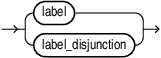
label_expression::=
Description of the illustration label_expression.gif
label_disjunction::=

Description of the illustration label_disjunction.gif
label::=

Description of the illustration label.gif
Semantics
Syntactically, an is_label_declaration starts with the keyword IS followed by a label_expression, which is either a label or a label_disjunction denoted by a vertical bar |. A label itself is an identifier and can thus be double quoted or unquoted.
An element pattern matches only vertices and edges that satisfy the label expression. If the label expression is omitted, then all vertices and edges are matched irrespective of their labels.
Examples
Example 1
The following query matches all vertices labeled person or university and retrieves their name and date of birth properties:
SELECT *
FROM GRAPH_TABLE ( students_graph
  MATCH (x IS person|university)
  COLUMNS (x.name, x.dob)
)
ORDER BY name;
The result is:
NAME       DOB
---------- ---------
ABC
Alice      01-FEB-87
Bob        11-MAR-66
John       13-JUN-63
Mary       25-SEP-82
XYZ
Above, since universities do not have a date of birth, a null value is returned and shows up as empty string in the DOB column.
Example 2
The following query matches outgoing edges labeled student_of or friends from a person named Mary to a vertex m that is labeled university or "PERSON":
SELECT *
FROM GRAPH_TABLE ( students_graph
  MATCH (n IS person) -[e IS student_of|friends]-> (m IS university|"PERSON")
  WHERE n.name = 'Mary'
  COLUMNS (e.subject, e.meeting_date, m.name)
)
ORDER BY subject, meeting_date, name;
The result is:
SUBJECT    MEETING_D NAME
---------- --------- ----------
Math                 XYZ
           19-SEP-00 Alice
           19-SEP-00 John
Element Pattern WHERE Clause
Purpose
The element pattern WHERE clause specifies a search condition that is syntactically placed inside a vertex or an edge pattern and that needs to be satisfied by the vertex or edge for the pattern to match.
Syntax
element_pattern_where_clause::=

Description of the illustration element_pattern_where_clause.gif
Semantics
Syntactically, the element_pattern_where_clause starts with the keyword WHERE and is followed by a search_condition, which is an arbitrary boolean value expression.
The element pattern WHERE clause may reference any graph element variable in the graph pattern. If the variable has group degree of reference, then the reference must be inside the arguments of an aggregate function. See Aggregation in GRAPH_TABLE. There is no requirement that the search condition must reference the variable of the element pattern itself, but for improved query readability it is generally recommended that it always does such that any search condition that does not reference the element variable is placed in the graph pattern WHERE clause instead.
Examples
Example 1
The following query finds all friends of John whom he met after 15 September 2000:
SELECT Gt.name
FROM GRAPH_TABLE ( students_graph
  MATCH (a IS person WHERE a.name = 'John')
          -[e IS friends WHERE e.meeting_date > DATE '2000-09-15']-
            (b IS person)
  COLUMNS (b.name)
) GT;
The example above contains two element pattern WHERE clauses:
-
WHERE a.name='John' -
WHERE e.meeting_date > DATE '2000-09-15'.
The result is:
NAME
----------
Mary
Quantified Path Pattern
Purpose
Quantified path patterns allow for repeated matching of a path pattern, typically for the purpose of matching variable-length paths. The specified quantifier determines a minimum and maximum for the number of times to match the path pattern.
Syntax
quantified_path_primary::=

Description of the illustration quantifier_path_primary.gif
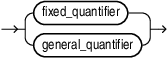
graph_pattern_quantifier::=
Description of the illustration graph_pattern_quantifier.gif
fixed_quantifier::=

general_quantifier::=

lower_bound::=
Description of the illustration lower_bound.gif
upper_bound::=
Description of the illustration upper_bound.gif
Semantics
A quantified_path_primary is a path_primary together with a quantifier. Here, the path primary must be either an edge pattern or a parenthesized path pattern.
A graph_pattern_quantifier is either:
-
A fixed_quantifier, which is an unsigned integer placed between curly braces. The integer value specifies an exact number of times the pattern should be matched. In other words, the lower bound on the number of times to match the pattern is the same as the upper bound.
-
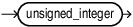
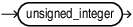
A general_quantifier, which has an optional lower_bound, a comma (,) and a mandatory upper_bound, all of which are placed between curly braces. Lower and upper bound are unsigned integers and specify a minimum and a maximum number of times to match the path pattern. If no lower bound is specified, then the lower bound is zero (0).
The following table summarizes the options:
Table 7 Quantifier Table
| Quantifier | Meaning |
|---|---|
{ n } |
Exactly n |
{ n, m } |
Between n and m (inclusive) |
{ , m } |
Between zero (0) and m (inclusive) |
Restrictions
The following restrictions apply to quantified path patterns:
-
The path primary that is quantified must be either an edge pattern or a parenthesized path pattern. For example, vertex patterns cannot be quantified unless they appear together with at least one edge pattern inside a parenthesized path pattern.
The lower bound should be 0 or greater, while the upper bound should be 1 or greater and should also be greater than or equal to the lower bound.
- Nested quantifiers are not allowed.
Examples
Example 1
The following query finds friends of friends of John following incoming or outgoing edges that have a property meeting_date with a value greater than DATE '2000-09-15':
SELECT DISTINCT name
FROM GRAPH_TABLE ( students_graph
  MATCH (a IS person)
          -[e IS friends WHERE e.meeting_date > DATE '2000-09-15']-{2}
            (b IS person)
  WHERE a.name = 'John' AND a.name <> b.name
  COLUMNS (b.name)
);
In the query above, the path pattern -[e IS friends WHERE e.meeting_date > DATE '2000-09-15']- is quantified with the fixed quantifier {2} to indicate that the edge pattern should match exactly twice.
The result is:
NAME
----------
Bob
Alice
The same query may be written using a parenthesized path pattern too. The following are all syntactic alternatives, the latter two use a parenthesized path pattern:
-
-[e IS friends WHERE e.meeting_date > DATE '2000-09-15']-{2} -
(-[e IS friends WHERE e.meeting_date > DATE '2000-09-15']-){2} -
(-[e IS friends]- WHERE e.meeting_date > DATE '2000-09-15'){2}
Example 2
The following query finds persons that can be reached from Mary within three hops, following only persons that are taller than Mary.
SELECT DISTINCT name, height
FROM GRAPH_TABLE ( students_graph
  MATCH (a IS person|person_ht)
           (-[e IS friends]- (x IS person_ht) WHERE x.height > a.height) {,3}
             (b IS person|person_ht)
  WHERE a.name = 'Mary'
  COLUMNS (b.name, b.height)
)
ORDER BY height;
The result is:
NAME           HEIGHT
---------- ----------
Mary             1.65
Alice             1.7
Bob              1.75
John              1.8
Note that the reason Mary is included in the result is because the specified quantifier {,3} has a lower bound of zero such that the quantified pattern is allowed to match zero times in which case variables a and b bind to the same vertex corresponding to Mary.
Example 3
The following query finds all paths between university ABC and university XYZ such that paths have a length of up to 3 edges ({,3}). For each path, a JSON array is returned such that the array contains the friendship_id value for edges labeled friends, and the subject value for edges labeled student_of. Note that the friendship_id property is cast to VARCHAR(100) to make it type-compatible with the subject property.
SELECT *
FROM GRAPH_TABLE ( students_graph
       MATCH (u1 IS university) -[e]-{,3} (u2 IS university)
       WHERE u1.name = 'ABC' AND u2.name = 'XYZ'
       COLUMNS (JSON_ARRAYAGG(CASE WHEN e.subject IS NOT NULL THEN e.subject
                              ELSE CAST(e.friendship_id AS VARCHAR(100)) END) AS path));
The result is:
PATH
----------------------- ["Arts","3","Math"]
["Music","4","Math"]
Parenthesized Path Pattern
Purpose
Parenthesized path patterns allow for defining more complex quantified path pattern expressions.
Syntax
parenthesized_path_pattern_expression::=

Description of the illustration parenthesized_path_pattern_expression.gif
parenthesized_path_pattern_where_clause::=

Description of the illustration parenthesized_path_pattern_where_clause.gif
Semantics
A parenthesized_path_pattern_expression is a path_pattern_expression together with an optional parenthesized_path_pattern_where_clause, placed in between parentheses.
Parenthesized path patterns allow for the quantification of any path pattern expression that contains at least one edge pattern. Without parentheses, only a single edge pattern can be quantified.
The parenthesized path pattern WHERE clause may reference vertex and edge variables declared in the parenthesized path pattern itself as well as vertex and edge variables declared outside of the parenthesized path pattern. If the variable has group degree of reference, then the reference must be inside the arguments of an aggregate function. See Aggregation in GRAPH_TABLE.
Restrictions
The following restrictions apply to parenthesized path pattern expressions:
-
Each parenthesized path pattern needs to be quantified.
-
There can only be a single level of parentheses. Nesting of parenthesized path patterns is not allowed.
Examples
Example 1
The following query finds persons that can be reached from Bob within one to three hops ({1,3}) such that for each consecutive pair of persons along the path, the first person has a date of birth that is smaller than the date of birth of the second person.
SELECT DISTINCT name, birthday
FROM GRAPH_TABLE ( students_graph
  MATCH
   (a IS person)
     ( (x) -[e IS friends]- (y IS person)
       WHERE x.dob < y.dob ){1,3}
         (b IS person)
  WHERE a.name = 'Bob'
  COLUMNS (b.name, b.dob AS birthday)
)
ORDER BY birthday;
The result is:
NAME       BIRTHDAY
---------- ---------
Mary       25-SEP-82
Alice      01-FEB-87
Example 2
The following query finds all paths that have a length between 2 and 3 edges ({2,3}), starting from a person named John and following only outgoing edges labeled friends and vertices labeled person. Vertices along paths should not have the same person_id as John (WHERE p.person_id <> friend.person_id).
SELECT *
FROM GRAPH_TABLE ( students_graph
       MATCH (p IS person) ( -[e IS friends]-> (friend IS person)
                             WHERE p.person_id <> friend.person_id){2,3}
       WHERE p.name = 'John'
       COLUMNS (COUNT(e.friendship_id) AS path_length,
                LISTAGG(friend.name, ', ') AS names,
                LISTAGG(e.meeting_date, ', ') AS meeting_dates ));
Above, the COLUMNS clause contains three aggregates, the first to compute the length of each path, the second to create a comma-separated list of person names along paths, and the third to create a comma-separate list of meeting dates along paths.
The result of the query is:
PATH_LENGTH NAMES               MEETING_DATES
----------- ------------------- -----------------------------------
          2 Bob, Mary           01-SEP-00, 10-JUL-01
          3 Bob, Mary, Alice    01-SEP-00, 10-JUL-01, 19-SEP-00
Graph Pattern WHERE Clause
Purpose
The graph pattern WHERE clause specifies a search condition that is syntactically placed at the end of the graph pattern and that needs to be satisfied by the complete graph pattern in order for the graph pattern to match.
Syntax
graph_pattern_where_clause::=

Description of the illustration graph_pattern_where_clause.gif
Semantics
Syntactically, the graph pattern WHERE clause starts with the keyword WHERE and is followed by a search_condition, which is an arbitrary boolean value expression.
The graph pattern WHERE clause may reference any element variables in the graph pattern. If the variable has group degree of reference, then the reference must be inside the arguments of an aggregate function. See Aggregation in GRAPH_TABLE .
Examples
Example 1
The following query finds all friends of John whom he met after 15 September 2000:
SELECT Gt.name
FROM GRAPH_TABLE ( students_graph
  MATCH (a IS person) -[e IS friends]- (b IS person)
  WHERE a.name = 'John' AND e.meeting_date > DATE '2000-09-15'
  COLUMNS (b.name)
) GT;
Note that the two conditions are placed together in the graph pattern WHERE clause to form a single search that needs to be satisfied by the pattern: WHERE a.name = 'John' AND e.meeting_date > DATE '2000-09-15'.
The result is:
NAME
----------
Mary