- Is the message that was just received (or about to be sent) a potential Topology Hiding and Restoral candidate?
- If the message is a potential candidate, is this a message between a Protected Network and an Untrusted Network?
To facilitate potential candidates, the Peer Node configuration element called Topology Hiding Status must be set to Enabled on any Peer Node that is associated with at least one Untrusted Network.
- Protected Networks: Defines, for each Protected Network, the Protected Realm Name and an optional reference to a Trusted Network List. The assumption is that all networks are Untrusted to a Protected Network unless they appear in a Trusted Network List that is assigned to that Protected Network. In essence, the Trusted Network List is a white list; any Network Realm Name that is not in that list is an Untrusted Network. If a Protected Network is not assigned a Trusted Network List, then it is assumed that all networks (except itself) are Untrusted.
- Trusted Network List: A list of Trusted Network Realm Names. A Trusted Network List can be assigned to any Protected Network.
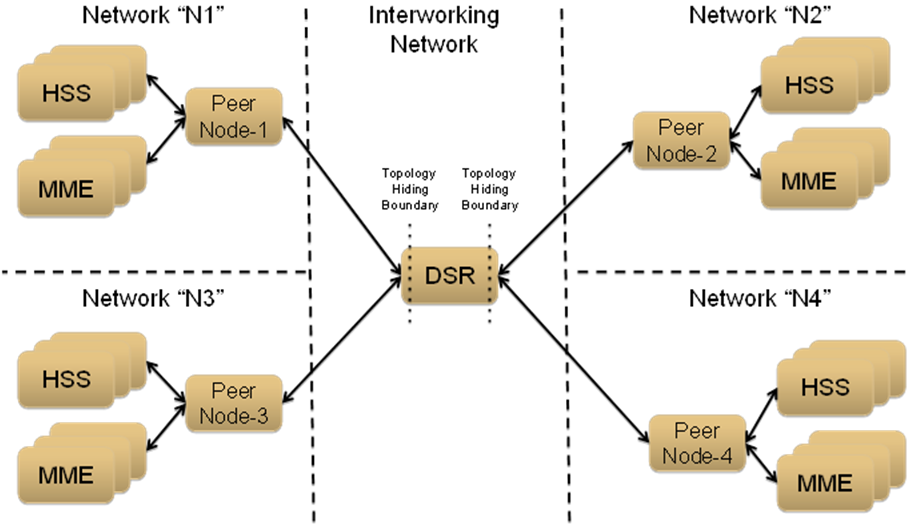
For the sake of discussion, assume that all of the networks are Protected Networks and the Protected Networks and Trusted Network Lists shown in Table 1 and Table 2 are configured:
| Protected Network Name | Protected Network Realm Name | Trusted Network List Name |
|---|---|---|
| N1 | n1.com | Trusted Networks-1 |
| N2 | n2.com | Trusted Networks-2 |
| N3 | n3.com | Trusted Networks-3 |
| N4 | n4.com | Trusted Networks-4 |
| Protected Network Name | Network Realm List |
|---|---|
| Trusted Networks-1 | n3.com |
| Trusted Networks-2 | n3.com n4.com |
| Trusted Networks-3 | n2.com |
| Trusted Networks-4 | n1.com n2.com n3.com |
Based on the example Protected Networks and Trusted Network Lists, the trust relationship matrix among the four networks in this example configuration is shown in Table 3.
| Protected Network | Relationship with Peer Network | |||
|---|---|---|---|---|
| N1 | N2 | N3 | N4 | |
| N1 | Trusted | Not Trusted | Trusted | Not Trusted |
| N2 | N2 | Not Trusted | Trusted | Trusted |
| N3 | Not Trusted | Trusted | Trusted | Not Trusted |
| N4 | Trusted | Trusted | Trusted | Trusted |
| Is this network Untrusted by at least one other network? | Yes | Yes | No | Yes |
Based on the Network Trust Relationship Matrix, the Peer Node element settings for the network shown in Table 4 would be used:
| Peer Node | Topology Hiding Status Element Setting |
|---|---|
| Peer Node-1 | Enabled |
| Peer Node-2 | Enabled |
| Peer Node-3 | Disabled |
| Peer Node-4 | Enabled |
With the information in Table 5, the TH type-independent criteria for determining whether a message is a potential candidate for Topology Hiding/Restoral are defined in Table 5.
| TH Trigger | Message | Message Path | General Topology Hiding/Restoral Candidate Criteria |
|---|---|---|---|
| RTH | Request | Protected-to-Untrusted | Egress Peer Node Topology Hiding Status is Enabled, AND Origin-Realm is a Protected Network X, AND Destination-Realm is an Untrusted Network to Protected Network X |
| RTR | Request | Untrusted-to-Protected | Ingress Peer Node Topology Hiding Status is Enabled, AND Destination-Realm is a Protected Network X, AND Origin-Realm is an Untrusted Network to Protected Network X |
| ATH | Answer | Protected-to-Untrusted | Egress Peer Node Topology Hiding Status is Enabled, AND Origin-Realm is a Protected Network X, AND Realm of the Diameter Node that originated the transaction is an Untrusted Network to Protected Network X TH Trigger point ATH occurs after the Diameter Routing Function deallocates the PTR for the transaction. Therefore, the Origin-Realm value that was received in the Request message must be stored in the Application-Data stack event just before deallocating the PTR in order for the Diameter Routing Function to make an evaluation at ATH of whether the Answer response is being sent to an Untrusted Network. |
| ATR | Answer | Untrusted-to-Protected | PTR contains one or more indications that topology information restoral is required For Untrusted-to-Protected Answer messages, any information that was hidden in the egress Request is a candidate for restoral regardless of which "Network" sends the Answer message response. Topology information restoral at ATR is always performed regardless of the egress Peer Node's Topology Hiding Status if Topology Hiding was performed on the egress Request message for this Diameter transaction. |
If the TH Trigger Point criteria defined in Table 5 are met, then the Diameter Routing Function must determine which TH types are enabled for the associated Protected Network. Each TH type might have additional criteria that must be met in order to determine whether topology-related information hiding or restoral is required.
The Protected Networks configuration component defines which TH types are enabled for the Protected Network. If a Configuration Set for the TH type is assigned to the Protected Network, then that TH type is enabled for that Protected Network and the rules for that TH type are applied. The Path, S6a/S6d HSS, MME/SGSN, S0 PCRF, and S9 AF/pCSCF TH types are supported. An example Protected Network component for the use case network defined in this section could look like the configuration in Table 6:
| Protected Network Name | Protected Network Realm Name | Trusted Network List Name | Path TH | S6a/S6d HSS TH | MME/SGSN TH | S9 PCRF TH | S9 AF/pCSCF TH |
|---|---|---|---|---|---|---|---|
| N1 | n1.com | Trusted Networks-1 | Path Config Set-1 | S6a/S6d HSS Config Set-1 | MME/SGSN Config Set-1 | NULL | NULL |
| N2 | n2.com | Trusted Networks-2 | Path Config Set-2 | S6a/S6d HSS Config Set-1 | MME/SGSN Config Set-1 | NULL | NULL |
| N3 | n3.com | Trusted Networks-3 | Path Config Set-3 | NULL | NULL | S9 PCRF Config Set-1 | S9 AF/pCSCF onfig Set-1 |
| N4 | n4.com | Trusted Networks-4 | Path Config Set-4 | NULL | NULL | S9 PCRF Config Set-2 | S9 AF/pCSCF onfig Set-2 |
In the example, if a message associated with Protected Network N3 is a candidate for topology hiding/restoral, then the Diameter Routing Function invokes only the Path Topology Hiding Configuration Set rules for that message.
The TH type-specific Hiding/Restoral rules are defined in Topology Hiding Types.