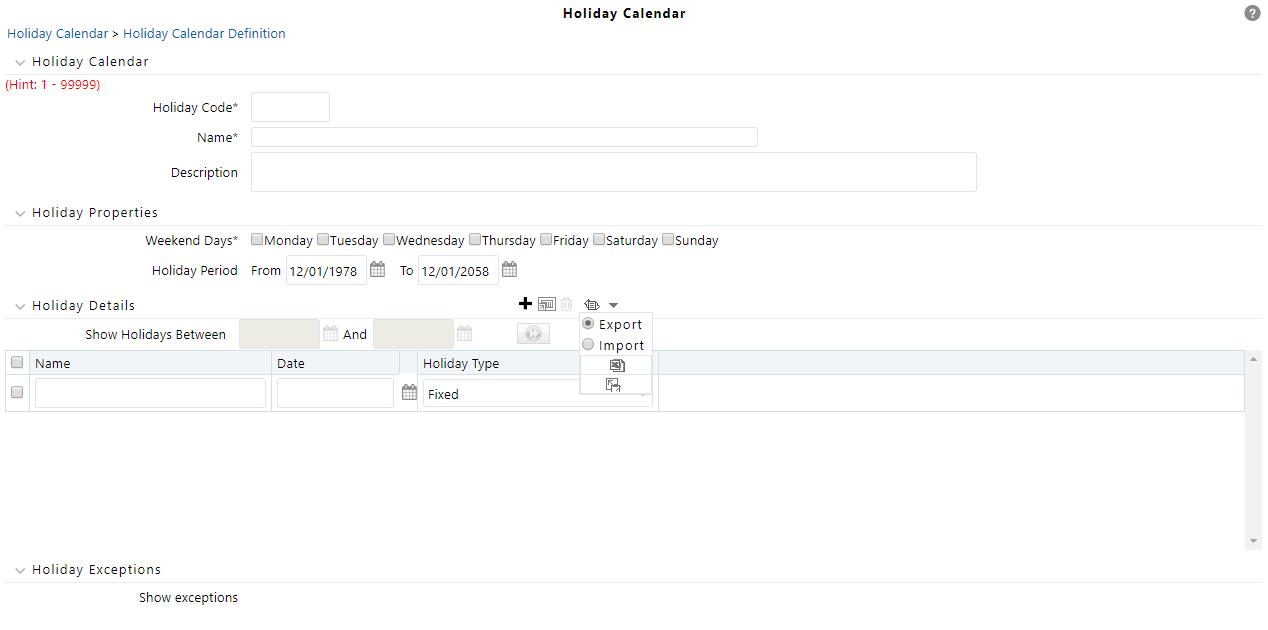
This chapter discusses the procedure for creating a Holiday Calendar and generating a list of the weekend and holiday dates.
NOTE:
Every SKU in the Liquidity Risk Solution (LRS) pack leverages this common user interface.
A Holiday is a day designated as having special significance for which individuals, a government, or some religious groups have deemed that observance is warranted and thus no business is carried on this day. The Holiday Calendar code can range from 1 to 99999.
The procedure for working with and managing a Holiday Calendar is similar to that of other OFSAA business rules. It includes the following functionalities:
· Searching for a Holiday Calendar.
· Viewing and Updating a Holiday Calendar.
· Copying a Holiday Calendar.
· Deleting a Holiday Calendar.
· Check Dependencies in the Holiday Calendar definitions.
· Refresh the Holiday Calendar summary page.
Topics:
· Searching for a Holiday Calendar
Search for a Holiday Calendar to perform any of the following tasks:
· View
· Edit
· Copy
· Delete
· Check Dependencies
· Refresh
· Predefined Holiday Calendar
1. In the Oracle Financial Services Analytical Applications Infrastructure home screen, select Financial Services Liquidity Risk Management.
2. To open the Holiday Calendar window, select Liquidity Risk Management, then select Holiday Calendar on the Left-Hand Side (LHS) menu. This page is the gateway to all Holiday Calendars and related functionality. You can navigate to other pages relating to Holiday Calendar from this page.
3. Enter the search criteria.
4. Enter the name of the Holiday Calendar.
5. Click Search. Only holiday calendars that match the search criteria are displayed.
NOTE:
You can control the number of rows to display on-screen by selecting the Pagination Options icon from the action bar.
Holiday calendars are created to capture holidays for a given date range for any organization. It is possible to create and use multiple holiday calendars.
1. In the Oracle Financial Services Analytical Applications Infrastructure home screen, select Financial Services Liquidity Risk Management.
2. To open the Holiday Calendar window, select Liquidity Risk Management, then select Holiday Calendar on the Left-Hand Side (LHS) menu.
3. Click Add Holiday Calendar. The Holiday Calendar Definition page is displayed.
4. Enter a code value for the new holiday calendar.
NOTE:
The code is a numeric identifier for the holiday calendar. The code value must be a number between 1 and 99999. The code value you assign to the new holiday calendar must be unique.
5. In the Name and Description fields enter a name and brief description of the holiday calendar.
NOTE:
The name you assign to the holiday calendar must be unique. The Name field can hold a maximum of 30 characters.
6. In the Holiday Properties table, select not more than two weekend days. Then select the Holiday Period. The Holiday Period can be defined for a range of up to 40 years less than the current date, and 40 years greater than the current date, totally spanning a maximum of 80 years.
7. In the Holiday Details table, define the Holiday details for any period within the holiday range defined in step 6. There are two types of holidays that can be defined, Fixed and Moving.
A fixed holiday is one which is deemed as a holiday for every year in the holiday period, for that particular day.
Example: 25th December - Christmas, is a fixed holiday.
To define a fixed holiday, input the holiday date for the first occurrence in the date range. For example, if your Date Range runs from 01-JAN-2000 to 31-DEC-2050, you should input the fixed holiday, Christmas, as 25-DEC-2000. The holiday calendar procedure populates all the subsequent 25-DEC entries in the holiday list table (FSI Holiday List).
The holiday calendar procedure ensures that holiday and weekend entries are not duplicated. For example, if weekends are defined as Saturday/Sunday and Christmas falls on a weekend day, there will be only one entry in the FSI Holiday List table.
A moving holiday is one which is deemed as a holiday only for that particular date and year, and not for every year in the holiday period. All occurrences of a moving holiday must be input manually.
Example, 20th August 2012 is a moving holiday on account of the festival, Ramzan
8. Once the holiday calendar definition is saved, its status in the summary page is marked as Defined.
9. A holiday calendar created can also be deleted. Select one or more rows of holiday calendar definitions and click Delete.
Excel import/export functionality is used for adding and editing defined holiday calendars.
Figure 13 Holiday Calendar Definitions - Excel Import or Export
Execute a holiday calendar definition to generate calendar dates listing the various types of holidays for a given holiday period.
· Predefined Rules
1. In the Oracle Financial Services Analytical Applications Infrastructure home screen, select Financial Services Liquidity Risk Management.
2. To open the Holiday Calendar window, select Liquidity Risk Management, then select Holiday Calendar on the Left-Hand Side (LHS) menu.
3. Search for a rule.
4. Select a Holiday Calendar and click Generate Calendar Dates to execute the selected holiday calendar. The Holiday list for holiday ID #1 generated successfully message appears (where #1 is the holiday calendar code). The holiday list can be confirmed by querying the FSI Holiday List table.
The status of a holiday calendar where holiday dates have been generated displays as Processed in the Status column of the summary page.
Important: If you do not want to Generate Calendar dates immediately, you can select that particular holiday calendar anytime later from the summary page with its status defined, and then click Generate Calendar Dates to execute the selected holiday calendar.
5. The generated holiday list is no longer valid if the following is true:
a. There is a change in the definition of the holiday calendar.
b. There is any update or modification to the Holiday Exceptions defined for that holiday calendar.
In such a case, you will get a message This holiday calendar has been modified. Please generate the holiday list again and the holiday calendar state will be changed to "Defined" until the holiday list is regenerated with a new definition.
You can specify exceptions to the holidays. As a prerequisite, a holiday calendar should be properly defined and the status of the holiday calendar should be Processed in the summary page. Generating the holiday list will populate the holidays (weekends, fixed and moving) along with the working days. The Show Exceptions button is enabled in the detail page. Any changes in the holiday definition will disable the Show Exceptions button. You must generate the holiday list again to define or view the exceptions.
1. Click Show Exceptions in the Holiday Exceptions grid. The Holiday Exceptions window opens.
2. The search block in the Exceptions page has the following:
a. From (Year), To (Year): Denotes the range of years which is a subset out of the holiday list generated, for which exceptions are required to be defined.
b. Fixed Holidays: You can filter the list of holidays by the type of Fixed Holidays.
c. Moving Holidays: You can filter the list of holidays by the type of Moving Holidays.
d. Holiday Date: For a particular known holiday date, exceptions can be defined.
e. All Exceptions: This check box lists all the exceptions when selected, if already defined, for the holidays within the From, To Date range.
The search result gives the list of all holidays based on the selection of the search criteria fields.
3. In the Holiday Exceptions block, there are two types of exceptions that can be defined: Not a holiday and Shift to.
Any holiday can be marked as not a holiday, in which case that day is removed from the Holiday List. If the drop-down list in the Exception type is selected as "Not a Holiday", then the "Shift To" date picker field is disabled.
Example
Spring earlier considered as a holiday in the holiday calendar can be marked as Not a Holiday in the Exceptions Window. Further, the user can write his comments or remarks in the Notes Text Box next to the Exception Type dropdown. Any holiday can be shifted to another day, in which case the declared holiday is removed from the Holiday List, while the Shifted To day is included as a holiday.
Excel import/export functionality is used for adding and editing holiday exceptions.
Figure 14 Holiday Calendar Exceptions - Excel Import or Export

To use the holiday code configurations for LRS processing, refer to the Create/Execute LRM Batch from Command Line section.