
US Federal Reserve issued a notice of final rule, Liquidity Coverage Ratio: Liquidity Risk Measurement, Standards, and Monitoring, in November 2013 covering the requirements for the computation of Liquidity Coverage Ratio for US covered companies. These guidelines are similar to those issued by Bank for International Settlements (BIS), with some deviations based on the conditions under which the US banks operate. US Federal Reserve has prescribed two approaches for computing the Liquidity Coverage Ratio, each of which applies to banks of different sizes.
OFS Liquidity Coverage Ratio complies with the WW, Final Rule, and Liquidity Coverage Ratio: Liquidity Risk Measurement Standards, Sep 2014.
· Liquidity Coverage Ratio
The Liquidity Coverage Ratio applies to larger banks and requires the stock of Hiqh Quality Liquid Assets (HQLA) to be sufficient to cover the add-on approach over a liquidity horizon of 30 days. The regulator provides specific guidelines including assets into the stock of HQLA and provides the relevant haircuts. The computation of the denominator is based on an add-on approach using inflow and outflow rates specified by the regulator.
· Modified Liquidity Coverage Ratio
A new approach, the modified LCR calculation, is prescribed by US Federal Reserve for smaller banks, which requires the stock of HQLA to be sufficient to cover net cash outflows over a liquidity horizon of 30 days. These banks are required to compute a less stringent LCR, due to their relatively small size and lower complexity. The inflow and outflow rates for such banks are 70% of those prescribed under the LCR approach.
OFS LRCUSFR supports both these approaches for computing Liquidity Coverage Ratio as prescribed by the US Federal Reserve in its final rule; Regulation WW, Liquidity Coverage Ratio: Liquidity Risk Measurement, Standards, and Monitoring.
Topics:
· Inputs
· Preconfigured Regulatory LCR Scenario
· Modified Liquidity Coverage Ratio Calculation
· FR2052a and FR2052b Related Calculations
· Regulation YY Liquidity Risk Calculation
The LRRCUSFR application requires the following inputs for LCR calculation:
· Liquidity haircut, inflow percentage, and outflow percentage of the respective business assumption are preconfigured. However, you can change them, if required.
· Liquidity Horizon is specified as the Runtime parameter.
This section explains the process of calculating the Liquidity Coverage Ratio (LCR).
Topics:
· Determining the Maturity of Cash Flows
· Deposit Stability Identification
· Classifying Operational Account
· Calculating Contractually Required Collateral
· Calculating Excess Collateral
· Calculating Downgrade Impact Amount
· Calculating Net Derivative Cash Inflows and Outflows
· Calculating Twenty Four Month Look-back Amount
· Calculating Operational Amount
· Calculating HQLA Transferability Restriction
· Calculating Cash Inflows and Outflows
· Calculating Net Cash Outflows (NCOF)
· Consolidation as Per LCR Approach
The application supports an out-of-the-box Run for computing LCR as per the final Rule issued by the US Federal Reserve. This Run includes the regulatory scenario with associated HQLA haircuts, inflow and outflow rates preconfigured in the form of business assumptions.
Assets classified as available-for-sale or held-to-maturity are included in the stock of HQLA if they fulfill the following HQLA criteria:
· Are unencumbered.
· Meet the operational HQLA requirements.
· Are not client pool securities that are held in segregated accounts or cash received from a repurchase agreement on client pool securities held in a segregated account.
· If consolidated, then the portion of assets required to cover the consolidated subsidiary’s net cash outflow and an excess amount of assets having unrestricted transferability.
· An asset received under a re-hypothecation right where the owner has a right to withdraw the asset anytime during the liquidity horizon without remuneration.
· Assets which are held not to cover operational costs.
NOTE:
Available-for-Sale Security is a security that is purchased with the intent of selling it before its maturity or selling it within a short period if the security does not have a known maturity.
Held-to-Maturity Securities are securities that a bank intends to hold until maturity.
All assets, whether owned by the bank or received from counterparties as collateral, are classified as follows:
· Level 1 Assets
· Level 2A Assets
· Level 2B Assets
· Other Assets
Level 1, 2A, and 2B assets are considered high-quality liquid assets and are included as part of the stock of HQLA provided they meet the HQLA eligibility criteria set out by the US Federal Reserve. Assets are classified as HQLA based on the qualifying criteria set by the US Federal Reserve. The following steps are involved in identifying the asset level:
Topics:
· Identification of Assets as Liquid and Readily Marketable
· Treatment of Assets Issued by Financial Sector Entities
The application identifies liquid and readily marketable assets that meet the following criteria:
· It is traded in an active secondary market with more than two committed market makers.
· It has a large number of committed non-market maker participants on both the buying and selling sides of transactions.
· It has timely and observable market prices.
· It has high trading volumes.
An asset that is not liquid and readily marketable is not considered a high quality liquid asset.
Any asset whose issuer is either a financial sector entity or a consolidated subsidiary of a financial sector entity is classified as a non-HQLA asset and excluded from the stock of high-quality liquid assets. These attributes are captured at the standard party level.
1. Identification and Treatment of Level 1 Assets
The following criteria qualifies assets to be classified as Level 1 assets.
Level 1 assets are fully included as part of the stock of high-quality liquid assets provided, they meet the HQLA eligibility criteria. The application identifies the following as HQLA Level 1 assets:
a. Federal Reserve Bank Balances: Balances held by the Federal Reserve banks include reserve balance requirements, excess balances, and term deposits. Only excess balances and certain term deposits are included in the stock of Level 1 assets. To be included in the stock, term deposits should be held according to the terms and conditions that:
— explicitly and contractually permit such term deposits to be withdrawn upon demand before the expiration of the term
Or that,
— permit such term deposits to be pledged as collateral for the term or automatically-renewing overnight advances from a Federal Reserve Bank.
§ Reserve balance requirements are excluded from the stock as they must be maintained with the Federal Reserve Bank at all times.
§ Federal Reserve Bank balances include the central bank reserves held at a US Federal Reserve Bank directly by the bank or through a correspondent bank less any reserve balance requirement.
§ Additionally, central bank term deposits held by a bank directly or through a correspondent bank are included provided they fulfill the following criteria:
— It is withdrawn on-demand before maturity
— Or
— It is pledged as collateral for the term or automatically-renewing overnight advances from a Federal Reserve Bank.
§ The value of eligible term deposits that are included in the amount net of any withdrawal penalty.
b. Foreign Withdrawable Reserves: Reserves held in foreign central banks that have no transferability restrictions are included. Any reserves held by the bank in a foreign central bank that do not have restrictions on use and are freely withdrawable and denominated in the local currency of that foreign country, are included as Level 1 assets. The reserves include term deposits held at the central bank.
c. United States Government Securities: Securities issued by, or unconditionally guaranteed by the U.S Department of the Treasury for the timely payment of principal and interest are included. Additionally, securities issued by any other US government agency and explicitly guaranteed by the full faith and credit of the U.S. government, provided that they are liquid and readily-marketable.
d. Certain Sovereign and Multilateral Organization Securities: Securities issued or guaranteed by a sovereign entity, a central bank, the Bank for International Settlements, the International Monetary Fund, the European Central Bank and European Community, or a multilateral development bank are included in the securities if they fulfill the following conditions:
— Are assigned a 0% risk weight.
— Are liquid and readily marketable.
— Issued by an entity whose obligations have a proven record as a reliable source of liquidity in the repurchase or sales markets during stressed market conditions.
— Are not an obligation of a financial entity or its consolidated subsidiary.
e. Certain Foreign Sovereign Debt Securities: Debt securities issued by a foreign sovereign entity with a non 0% risk weight if they fulfill the following conditions:
— Are liquid and readily marketable.
— Are issued in the local currency of the foreign sovereign.
The legal entity holds the securities to cover its cash outflows in that jurisdiction.
2. Identification and Treatment of Level 2A Assets
The application identifies HQLA Level 2A Assets in the following manner:
a. U.S. GSE Securities: A security issued or guaranteed by a U.S. government-sponsored enterprise as to the timely payment of principal and interest, that is investment grade under 12 CFR part 1 as of the calculation date, provided the claim is senior to preferred stock.
b. Securities issued by or guaranteed by a US government-sponsored entity (GSE) as they have been assigned a 20% risk weight.
c. Securities issued by or guaranteed by a sovereign or multi-lateral development bank that are:
— Not included in Level 1 assets.
— Assigned a risk weight between 0% and 20%.
— Price has not decreased, or haircut increased by greater than 10% during a 30-calendar day period of significant stress.
— Not an obligation of a financial entity or its consolidated subsidiary.
NOTE:
The rule excludes covered bonds and securities issued by other Public Sector Enterprises (PSE’s) to be included in the stock even if they are assigned a 20% risk weight.
3. Identification and Treatment of Level 2B Assets
The application identifies the following as HQLA Level 2B Assets:
a. Publicly traded corporate debt securities that meet the following criteria:
— Considered investment-grade per the definition provided in 12 CFR part 1.
— Issued or guaranteed by an entity whose obligations have a proven record as a reliable source of liquidity in repurchase or sales markets during stressed market conditions. Reliability is proven if the price has not decreased or haircut increased by 20% over a 30-day stress period.
— Not an obligation of a financial sector entity and not an obligation of a consolidated subsidiary of a financial sector entity.
b. Publicly traded common equities that meet the following criteria:
— Included in Russell 100 Index or an index that the bank’s supervisor in a foreign jurisdiction recognizes for inclusion in Level 2B assets if the share is held in that jurisdiction.
— Issued in US Dollars or in the currency of the jurisdiction in which the bank operates and holds the common equity share to cover net cash outflows in that jurisdiction.
— Issued by an entity whose publicly traded common equity shares have a proven record as a reliable source of liquidity in repurchase or sales markets during stressed market conditions. Reliability is proven if the price has not decreased or haircut increased by 40% over a 30-day stress period.
— Not issued by a financial sector entity and not issued by a consolidated subsidiary of a financial sector entity.
— If held by a depository institution, is not acquired in satisfaction of a debt previously contracted (DPC).
— If held by a consolidated subsidiary of the bank, it includes the publicly traded common equity share in its Level 2B liquid assets only if the share is held to cover net cash outflows of its consolidated subsidiary in which the publicly traded common equity share is held.
c. U.S. general obligation municipal securities that meet the following criteria:
i. Is issued by, or guaranteed as to the timely payment of principal and interest by, a public sector entity.
ii. It is liquid and readily marketable.
iii. Considered investment-grade per the definition provided in 12 CFR part 1.
iv. Is issued or guaranteed by an entity whose obligations have a proven record as a reliable source of liquidity in repurchase or sales markets during stressed market conditions. Reliability is proven if the price has not decreased or haircut increased by 20% over a 30-day stress period.
v. It is not an obligation of a financial sector entity and not an obligation of a consolidated subsidiary of a financial sector entity.
NOTE:
A public sector entity is defined as any state, local authority, or other governmental subdivision below the U.S. sovereign entity level.
The maximum value of such securities issued by a single public sector entity than can be included in the stock of HQLA is the fair value up to two times the average daily trading volume during the previous four quarters of all general obligation securities issued by that public sector entity.
The U.S. Municipal Securities can be included as Level 2B Asset only to the extent of 5% of the total stock of HQLA.
The application identifies whether a bank’s asset or a mitigant received under re-hypothecation rights meets all the operational requirements and generally applicable criteria. If both conditions are met, then such an HQLA is marked as eligible HQLA and is included in the stock of HQLA.
Topics:
· Generally Applicable Criteria for Eligible HQLA
The application checks for the following operational criteria:
a. Operational Capability to Monetize HQLA
An asset can be considered HQLA only if the bank has demonstrated the operational capability to monetize such an asset. The application captures this information for each asset as a flag.
b. HQLA Under the Control of the Liquidity Management Function
To be considered eligible HQLA the asset is under the control of the management function of the bank that manages liquidity. The application captures this information for each asset as a flag.
c. Termination of Transaction Hedging HQLA
If an HQLA is hedged by a specific transaction, then the application considers the impact of closing out the hedge to liquidate the asset that is, the cost of terminating the hedge while computing the stock of HQLA. The hedge termination cost is deducted from the fair value of the asset and the difference is included in the stock of HQLA.
d. Policies and Procedures to Determine Eligible HQLA Composition
The banks that have established policies and procedures determine the composition of their eligible HQLA periodically. This is a qualitative criterion which banks have to ensure compliance with.
The application checks for the following criteria:
a. Unencumbered
The application looks at the encumbrance status and includes only those assets in the stock which are unencumbered. If partially encumbered, then the portion of the asset that is unencumbered is considered as HQLA and included in the stock.
b. Segregated Client Pool Securities
A segregated client pool security held by the bank or the cash received as part of a repo transaction where the underlying is a client pool security are not considered eligible HQLA and therefore excluded from the stock.
c. Maintenance of Eligible HQLA in the United States
A bank is generally expected to maintain an amount and type of eligible HQLA in the United States that is sufficient to meet its total net cash outflow amount in the United States.
d. Exclusion of Certain Re-hypothecated Assets
Any asset that a bank receives under a re-hypothecation right is not considered eligible HQLA if the counterparty or beneficial owner of the asset has a contractual right to withdraw the asset without an obligation to pay more than the minimum remuneration at any time within 30 calendar days. This exclusion also applies to any asset generated from another asset obtained under such a re-hypothecation right.
e. Exclusion of Assets Designated to Cover Operational Costs
Bank’s assets such as deposits held at other depository institutions to meet its operational costs such as wages, facility maintenance, and so on are excluded from HQLA as such assets are not available to cover the liquidity needs that arise during stress situations. The application assesses the operational deposit criteria for such assets and excludes them from the stock of HQLA.
All unencumbered assets classified as Level 1, Level 2A, or Level 2B, which meet the HQLA eligibility criteria, are included in the stock of high-quality liquid assets (SHQLA). The formula for calculating SHQLA is as follows:
NOTE:
All calculations are based on the market value of assets.
Topics:
· Calculating Liquid Asset Amount
· Calculating Unadjusted Excess HQLA
· Identifying Eligible HQLA on Unwind:
· Unwinding of Transactions Involving Eligible HQLA
· Calculating Adjusted Liquid Asset Amount
The application applies the relevant liquidity haircuts to the fair value of each eligible HQLA based on the haircuts specified as part of the business assumption. The sum of haircut adjusted fair value of all assets which are not ‘other assets’ and which are classified as ‘eligible HQLA’ comprises of the stock of unadjusted HQLA. The stock includes the bank’s assets which are unencumbered, meaning not placed as collateral; as well as assets received from counterparties where the bank has a re-hypothecation right and where such assets are not re-hypothecated.
1. Level 1 liquid asset amount
The Level 1 liquid asset amount equals the fair value of all Level 1 liquid assets held by the bank as of the eligible calculation date HQLA, less the amount of the reserve balance requirement less hedge termination costs (if any), less withdrawal penalty on time deposits (if any).
2. Level 2A liquid asset amount
The Level 2A liquid asset amount equals 85 percent of the fair value of all Level 2A liquid assets held by the bank as of the calculation date that are eligible HQLA, less hedge termination costs (if any).
3. Level 2B liquid asset amount
The Level 2B liquid asset amount equals 50 percent of the fair value of all Level 2B liquid assets held by the bank as of the calculation date that is eligible HQLA, less hedge termination costs (if any).
4. Level 2B PSE security liquid asset amount
The Level 2B liquid asset amount equals 50 percent of the fair value of all Level 2B PSE securities, to the extent of 2 times the average daily trading volumes of all US general obligation municipal bonds issued by each issuer, held by the bank as of the calculation date that is eligible HQLA, less hedge termination costs (if any).
The unadjusted excess HQLA is calculated based on the following formula:

The formula for computing the cap excess amounts is as follows:
1. Calculation of Level 2 Cap Excess Amount

2. Calculation of Level 2B Cap Excess Amount

3. Calculation of Level 2B PSE Security Cap Excess Amount

The application identifies the assets that are placed as collateral which are eligible HQLA if they are not encumbered. Placed collateral is marked as eligible HQLA on unwinding if it fulfills all of the following criteria:
· Asset Level is a Level 1, 2A or 2B asset
· Meets HQLA Operational Requirements
· Meets Generally Applicable HQLA Criteria on Unwind
The application identifies all transactions maturing within the LCR horizon where HQLA is placed or received. These transactions include repos, reverse repos, secured lending transactions, collateral swaps, and so on. Such transactions are to be unwound that is, the original position is to be reversed and the cash or stock of HQLA has adjusted accordingly. This is done to avoid including any asset in the stock that should be returned to its owner before the end of the LCR horizon.
The formula for this calculation is as follows:
1. Adjusted Level 1 liquid asset amount
The formula for calculating the adjusted Level 1 liquid asset amount is as follows:

NOTE:
Adjustments relate to the cash received or paid and the eligible Level 1 asset posted or received as collateral or underlying assets as part of a secured funding transaction, secured lending transaction, asset exchanges, or collateralized derivatives transaction.
2. Adjusted Level 2A liquid asset amount
The formula for calculating the adjusted Level 2A liquid asset amount is as follows:

NOTE:
Adjustments relate to eligible Level 2A assets posted or received as collateral or underlying assets as part of a secured funding transaction, secured lending transaction, asset exchanges, or collateralized derivatives transaction.
3. Adjusted Level 2B liquid asset amount
The formula for calculating the adjusted Level 2B liquid asset amount is as follows:

NOTE:
Adjustments relate to eligible Level 2B assets posted or received as collateral or underlying assets as part of a secured funding transaction, secured lending transaction, asset exchanges, or collateralized derivatives transaction.
4. Adjusted Level 2B PSE security liquid asset amount
The formula for calculating the adjusted Level 2B PSE security liquid asset amount is as follows:

NOTE:
Adjustments relate to eligible Level 2B PSE securities posted or received as collateral or underlying assets as part of a secured funding transaction, secured lending transaction, asset exchanges, or collateralized derivatives transaction.
5. Calculation of Adjusted Excess HQLA
The adjusted excess HQLA is calculated based on the following formula:

The formula for computing the adjusted cap excess amounts is as follows:
a. Calculation of Adjusted Level 2 Cap Excess Amount

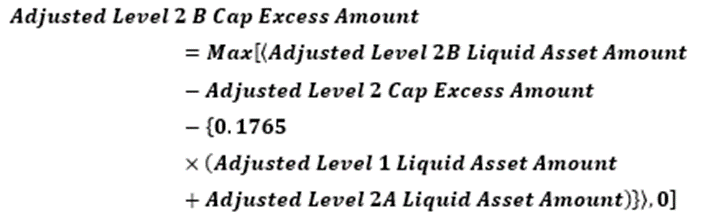
b. Calculation of Adjusted Level 2B Cap Excess Amount
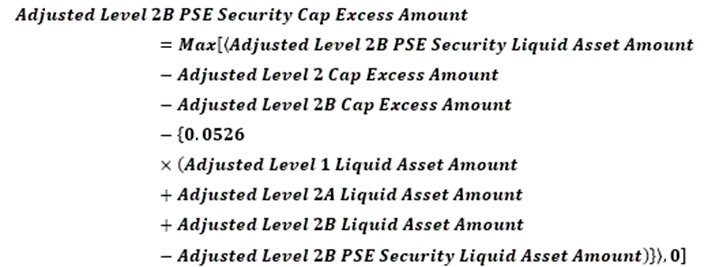
c. Calculation of Adjusted Level 2B PSE Security Cap Excess Amount
To calculate the Liquidity Coverage Ratio and the components thereof, a bank assumes an asset or transaction’s maturity is based on the following assumptions:
1. If an instrument or transaction is subject to outflow, then the earliest possible contractual maturity date or the earliest possible date the transaction occurs is considered. The application checks if the counterparty has an option to reduce maturity. The following options must be considered which results either in reducing or extending the maturity date:
a. If an investor or funds provider has an option that reduces the maturity, then the application considers the earliest date as the maturity date. If the option is exercised, then it means that the maturity date is equal to the earliest date or latest date.
b. If an investor or funds provider has an option that extends the maturity, then the application assumes that the investor or funds provider does not exercise the option to extend the maturity. This means that the maturity date equals to the original maturity date if the option is not exercised.
c. If a covered company holds an option to reduce the maturity of the transaction, the application assumes that the option is exercised. If the option is exercised, then it means that the maturity date is equal to the earliest date or latest date.
d. If a covered company holds an option to extend the maturity of the transaction, the application assumes that the option is not exercised by the covered company and calculates the maturity of the transaction. This means the existing maturity date continues.
The application considers the following exceptions to the rule in Step (d):
§ If a long term callable bond which is issued by a covered company has an original maturity greater than one year and the call option held by the covered company does not go into effect until at least six months after the issuance, the original maturity of the bond is considered for purposes of the LCR.
Or,
§ If the covered company holds an option permitting it to repurchase any of its obligation from a sovereign entity, a U.S. government-sponsored enterprise, or a public sector entity, then the original maturity of the obligation is considered for calculation of LCR.
e. If the covered company has an option that extends the maturity of an obligation it has issued, then the application does not exercise this option to extend the maturity. This means the extended maturity date is considered for computing LCR.
f. If an option is subject to a contractually defined notice period, then the application determines the earliest possible contractual maturity date regardless of the notice period. This means that the application considers the earliest date as the maturity date.
2. If an instrument or transaction is subject to inflows, then the application considers the latest possible contractual maturity date or the latest possible date the transaction occurs. The following options are considered, which results in increasing the maturity date:
a. If the borrower has an option which results in extending the maturity, then application assumes that the borrower exercises the option and consider to extend the maturity date to the latest possible date. This means that the maturity date is equal to the earliest date or latest date.
b. If the borrower has an option that reduces the maturity, then the application assumes that the borrower will not exercise the option to reduce the maturity. This means that the existing maturity date is continued.
c. If the covered company has an option that reduces the maturity, then the application assumes that it will not exercise the option to reduce the maturity. This means that the existing maturity date is continued.
d. If the covered company has an option that extends the maturity of an instrument or transaction, the application assumes that it will exercise the option to extend the maturity to the latest possible date. If the option is exercised, then it means that the maturity date is equal to the earliest date or latest date.
e. If any option is subject to a contractually defined notice period, then the application considers it while calculating maturity for Inflows.
3. The maturity date of secured lending transactions or inflow-generating asset exchanges is the later of the contractual maturity date of the secured lending transaction or inflow-generating asset exchange and the maturity date of the secured funding transaction or outflow-generating asset exchange for which the received collateral was used.
4. The maturity date for a transaction with financial sector entities and which is not an operational deposit is considered by the application to be the first calendar day after the calculation date for LCR.
5. Maturity for transactions related to broker-dealer segregated account inflow amount is considered by the application to be based on calculation performed by the broker-dealer for the release of assets to its customers. If a broker-dealer performs this calculation daily, then the inflow is considered by the application to be on the first day of the 30 calendar-day periods if a broker-dealer performs the calculation every week, then the inflow is considered on the date of the next regularly scheduled calculation.
NOTE:
The revised maturity is considered for the computation of LCR. The maturity computation for cash flows is calculated as part of the LRM application. However, an assumption is defined to move the cash flows of financial sector entities, which are not an operational deposit, for LCR calculation.
A stable deposit is a deposit whose entire outstanding balance is fully covered by deposit insurance provided by Federal Deposit Insurance Corporation (FDIC) of the USA and which satisfies one of the following conditions:
a. It is held in a transactional account by the depositor
Or
b. The depositor has an established relationship with the reporting legal entity.
The FDIC covers all deposit accounts, including checking and savings accounts, money market deposit accounts, and certificates of deposit. The standard insurance amount is $250,000 per depositor, per insured bank, for an ownership category. The application expects the limit to be provided at a customer-ownership category combination. This limit is allocated to the insurance eligible accounts based on a waterfall approach such that it maximizes insurance coverage from the perspective of deposit stability identification. Once the insurance limit is allocated, deposit stability is identified based on insurance coverage and other conditions. Only the fully covered accounts meeting the other stability criteria are considered stable deposits.
NOTE:
· Deposit Insurance Calculations are done following FDIC Part 370 guidelines. See the Deposit Insurance Calculations as per FDIC 370 section for details.
· An insurance eligible account means an account that is covered by the deposit insurance scheme.
· In the context of the US Federal Reserve on LCR, fully covered means that the entire outstanding balance of the deposit account must be covered by insurance.
The insurance limit captured at each customer-ownership category combination is allocated to multiple accounts in the decreasing order of the outstanding amount (including interest) of the accounts, provided it fully covers the outstanding amount of the account. The insurance coverage status is updated for each deposit account as follows:
· Fully Insured: Insured Amount = Outstanding Amount
· Partially Insured: Insured Amount greater than 0 and less than Outstanding amount
· Uninsured: Insured Amount = 0
Operational deposit means unsecured wholesale funding or a collateralized deposit that is necessary for the covered company to provide operational services as an independent third-party intermediary, agent, or administrator to the wholesale customer or counterparty providing the unsecured wholesale funding or collateralized deposit.
The deposits are classified as an operational deposit if designated as an operational deposit by the covered company and the deposit is used or either cash management, custody management, or clearing management and not used of prime brokerage or correspondent banking. The customer must hold the deposit at the covered company for the primary purpose of obtaining the operational services provided by the covered company. The related operational services must be performed according to a legally binding written agreement, and meet the following criteria:
a. The termination of the agreement must be subject to a minimum 30 calendar-day notice period.
or
b. As a result of the termination of the agreement or transfer of services to a third-party provider, the customer providing the deposit would incur significant contractual termination costs or switching costs (switching costs include significant technology, administrative, and legal service costs incurred in connection with the transfer of the operational services to a third-party provider).
Contractually required collateral is the amount of collateral that is contractually due from one party to the other based on the current exposure and collateral position. This amount must be paid to the party soon and results in outflow for the party owing the collateral and inflow to the party to whom the collateral is due. It can be of two types based on the direction of the exposure, Excess Collateral Due or Excess Collateral Receivable.
Topics:
· Calculating Contractually Due Collateral
· Calculating Contractually Receivable Collateral
The application computes the value of the collateral that a bank is required to post contractually to its derivative counterparty, if one of the following conditions are met.
1. If the Secured Indicator is No, then the contractually due collateral is 0.
2. If the Secured Indicator is Yes and the CSA Type is One way, then the contractually due collateral is 0.
3. If the Secured Indicator is Yes, the CSA Type is Two way and Gross Exposure is greater than or equal to 0, then the contractually due collateral is 0.
4. If the Secured Indicator is Yes, the CSA Type is Two way and Gross Exposure is less than 0, the application computes the contractually due collateral as follows:

Where,
Threshold is the unsecured exposure that a party to a netting agreement is willing to assume before making collateral calls.
The contractually due collateral is assumed to be posted and therefore receives the relevant outflow rate specified by the regulator as part of the preconfigured business assumptions for LCR calculations.
The application computes the value of the collateral that a derivative counterparty is required contractually to post to the bank, if one of the following conditions are met.
1. If the Secured Indicator is No, then the contractually receivable collateral is 0.
2. If the Secured Indicator is Yes and the Gross Exposure is less than or equal to 0, then the contractually receivable collateral is 0.
3. If the Secured Indicator is Yes and the Gross Exposure is greater than 0, then the application computes the contractually receivable collateral as follows:

The contractually receivable collateral does not receive a pre-specified inflow rate from the regulator and is, therefore, excluded from the LCR calculations. However, the application computes this to generate reports.
Excess collateral is the value of collateral posted or received that is more than the collateral required based on the current levels of exposure and collateral position. This amount can be withdrawn by the party which has provided the collateral over its exposure and results in outflow to the party holding the excess collateral and an inflow to the party who has provided the excess collateral. It can be of two types, Excess Collateral Due or Excess Collateral Receivable.
Topics:
· Calculating Excess Collateral Due
· Calculating Excess Collateral Receivable
The application computes the value of the collateral that a derivative counterparty has posted to the bank, over the contractually required collateral, and therefore can be withdrawn by the counterparty, as follows:
1. If the Secured Indicator is No, then the excess collateral due is 0.
2. If the Secured Indicator is Y and the Gross Exposure are less than or equal to 0, the application computes the excess collateral due as follows:

Where,
Adjusted collateral received: Collateral received from the counterparty less customer withdrawable collateral
Customer withdrawable collateral: Collateral received under re-hypothecation rights that can be contractually withdrawn by the customer within the LCR horizon without a significant penalty associated with such a withdrawal.
3. If the Secured Indicator is Y and the Gross Exposure are greater than 0, the application computes the excess collateral due as follows:

The excess collateral due is assumed to be recalled by the counterparty and therefore receives the relevant outflow rate specified by the regulator as part of the preconfigured business assumptions for LCR calculations.
The application computes the value of the collateral that the bank has posted to its derivative counterparty, over the contractually required collateral, and therefore can be withdrawn by the bank, as follows:
1. If the Secured Indicator is No, then the excess collateral receivable is 0.
2. If the Secured Indicator is Y and the Gross Exposure are greater than or equal to 0, the application computes the excess collateral receivable as follows:

Where,
Adjusted collateral posted: Collateral posted by the bank less firm withdrawable collateral.
Firm withdrawable collateral: Collateral provided under re-hypothecation rights that can be contractually withdrawn by the bank within the LCR horizon without a significant penalty associated with such a withdrawal.
3. If the Secured Indicator is Y and the Gross Exposure are less than 0, the application computes the excess collateral receivable as follows:

The excess collateral receivable does not receive a pre-specified inflow rate from the regulator and is, therefore, excluded from the LCR calculations. However, the application computes this to a report.
This section details the calculation of downgrade impact amount for derivatives and for other liabilities.
Topics:
· Calculating Downgrade Impact Amount for Derivatives
· Calculating Downgrade Impact Amount for Other Liabilities
The application calculates the downgrade impact amount for derivatives if one of the following conditions are met.
1. If a downgrade trigger does not exist for the derivatives contract or netting agreement, the downgrade impact amount is 0.
2. If the Net Exposure is greater than 0, the downgrade impact amount is 0.
3. If the Net Exposure is less than or equal to 0, the downgrade impact amount is calculated as follows:

The application calculates the downgrade impact amount for other liabilities, including annuities, that have an associated downgrade, derivatives, if one of the following conditions are met.
1. If a downgrade trigger does not exist for the liability account, the downgrade impact amount is 0.
2. The downgrade impact amount for liabilities other than derivatives and securitizations is calculated as follows:

NOTE:
Any liability account that is triggered due to a particular level of rating downgrade has an outflow corresponding to a pre-specified percentage of the downgrade impact amount. For example, if a 3-notch downgrade is specified, then the downgrade impact amount will outflow only for those accounts that have a trigger of 1-notch, 2-notches, and 3-notches. If a 2-notch downgrade is specified, then the downgrade impact amount will outflow only for those accounts that have a trigger of 1-notch and 2-notches. The rating downgrade and the outflow percentage as specified by the regulator are part of the preconfigured business assumptions for LCR calculations.
This section details the cash flow netting calculations at the derivative contract level and netting agreement level.
Topics:
· Cash Flow Netting at Derivative Contract Level
· Cash Flow Netting at Netting Agreement Level
Cash flows from each derivative contract are netted as follows:
1. When cash inflows and outflows are denominated in the same currency and occur at the same time bucket, they are netted as follows:
a. The cash inflows and outflows are summed up and the net value is computed as follows:

b. If the net cash flow is positive and there is no netting agreement associated with the derivative contract, the value is treated as net derivative cash outflow.
c. If the net cash flow is negative and there is no netting agreement associated with the derivative contract, the value is treated as net derivative cash inflow.
2. When cash inflows and outflows are denominated in different currencies but settle within the same day, they are netted as follows:
a. The cash inflows and outflows are summed up after being converted to the reporting currency and the net value is computed.
b. If the net cash flow is positive and there is no netting agreement associated with the derivative contract, the value is treated as net derivative cash outflow.
c. If the net cash flow is negative and there is no netting agreement associated with the derivative contract, the value is treated as net derivative cash inflow.
3. When cash inflows and outflows are denominated in different currencies and do not settle within the same day, they are netted as follows:
a. The cash outflows from each derivative contract without an associated netting agreement are summed up and treated as net derivative cash outflows.
b. The cash inflows from each derivative contract without an associated netting agreement are summed up and treated as net derivative cash inflow.
NOTE:
If a derivative contract has a netting agreement associated with it, the cash flow is further netted across contracts at the netting agreement level.
For derivative contracts which have a netting agreement associated with them, the net cash flows computed at the derivative contract level are further netted across multiple contracts under the same netting agreement as follows:
1. For derivative contracts that belong to a single netting agreement, whose payment netting agreement flag is Yes, they are netted across multiple contracts under the same netting agreement as follows:
a. The cash inflows and outflows occurring in each time bucket, denominated in each currency, are summed up across all contracts whose payment netting agreement flag is Yes, and the net value is computed.
b. If the net cash flow is positive, the value is treated as net derivative cash outflow.
c. If the net cash flow is negative, the value is treated as net derivative cash inflow.
2. For derivative contracts that belong to a single netting agreement, whose payment netting agreement flag is No, they are netted across multiple contracts under the same netting agreement as follows:
a. The cash outflows occurring in each time bucket, denominated in each currency, are summed up separately for each derivative contract whose payment netting agreement flag is No and treated as net derivative cash outflow.
b. The cash inflows occurring in each time bucket, denominated in each currency, are summed up separately for each derivative contract whose payment netting agreement flag is No and treated as net derivative cash inflow.
NOTE:
Cash flow netting for netting agreements is done separately for each currency. Cash flows are not netted across currencies. Instead, the inflows and outflows converted into the reporting currency are summed up separately to report the net derivatives cash inflow and net derivatives cash outflow at an entity level.
The application computes the 24-month look-back amount to define outflows due to increased liquidity needs, related to market valuation changes on derivatives, as follows:
· The Mark-to-Market (MTM) value of collateral outflows and inflows due to valuation changes on derivative transactions are captured at a legal entity level. The values over a 24-month historical time window from the “As of Date” are identified.
· The application computes the largest 30-day absolute net collateral flow occurring within each rolling 30-day historical time window as follows:
a. The net Mark-to-Market collateral change is computed for each day within a particular 30-day historical time window as follows:

b. The cumulative net Mark-to-Market collateral change is computed for each day within a particular 30-day historical time window as follows:

Where,
i: Each day within a particular 30-day historical time window
n: Each 30-day historical time window
c. The absolute net Mark-to-Market collateral change is computed for each day within the rolling 30-day historical time window as follows:

d. The largest 30-day absolute net collateral flow occurring within the rolling 30-day historical time window is identified as follows:

NOTE:
Steps (a) to (d) are repeated for each rolling 30-day historical time window.
e. The 24-month look-back amount is calculated as follows:

NOTE:
1. This calculation is done for each legal entity separately.
2. The largest 30-day absolute net collateral flow is computed in 30-day blocks on a rolling basis. For example, the first 30-day block is As of Date to As of Date - 29; the second 30-day block is As of Date - 1 to As of Date - 30 and so on.
3. The 24-month look-back amount is computed as the maximum of the largest absolute net collateral flow during all rolling 30-day periods in every 24 months.
The 24-month look-back calculations are illustrated in the following table considering a 34-day historical time window rather than 24-months. This results in five rolling 30-day windows.
Rolling 30-Day Period |
Day |
Mark-To-Market Collateral Outflows Due To Derivative Transaction Valuation Changes (a) |
Mark-To-Market Collateral Inflows Due To Derivative Transaction Valuation Changes (b) |
Net Mark-To-Market Collateral Change (c = a - b) |
Cumulative Net Mark-To-Market Collateral Change (d = Cumulative c) |
Absolute Net Mark-To-Market Collateral Change [e = Abs (d)] |
|---|---|---|---|---|---|---|
As of Date to As of Date - 29 |
As of Date |
65 |
14 |
51 |
51 |
51 |
As of Date - 1 |
65 |
9 |
56 |
107 |
107 |
|
As of Date - 2 |
74 |
83 |
-9 |
98 |
98 |
|
As of Date - 3 |
71 |
97 |
-26 |
72 |
72 |
|
As of Date - 4 |
84 |
89 |
-5 |
67 |
67 |
|
As of Date - 5 |
8 |
57 |
-49 |
18 |
18 |
|
As of Date - 6 |
40 |
59 |
-19 |
-1 |
1 |
|
As of Date - 7 |
42 |
87 |
-45 |
-46 |
46 |
|
As of Date - 8 |
100 |
6 |
94 |
48 |
48 |
|
As of Date - 9 |
41 |
30 |
11 |
59 |
59 |
|
As of Date - 10 |
45 |
9 |
36 |
95 |
95 |
|
As of Date - 11 |
9 |
32 |
-23 |
72 |
72 |
|
As of Date - 12 |
59 |
67 |
-8 |
64 |
64 |
|
As of Date - 13 |
61 |
10 |
51 |
115 |
115 |
|
As of Date - 14 |
22 |
36 |
-14 |
101 |
101 |
|
As of Date - 15 |
63 |
81 |
-18 |
83 |
83 |
|
As of Date - 16 |
36 |
3 |
33 |
116 |
116 |
|
As of Date - 17 |
61 |
22 |
39 |
155 |
155 |
|
As of Date - 18 |
94 |
37 |
57 |
212 |
212 |
|
As of Date - 19 |
3 |
18 |
-15 |
197 |
197 |
|
As of Date - 20 |
13 |
27 |
-14 |
183 |
183 |
|
As of Date - 21 |
24 |
56 |
-32 |
151 |
151 |
|
As of Date - 22 |
57 |
75 |
-18 |
133 |
133 |
|
As of Date - 23 |
66 |
87 |
-21 |
112 |
112 |
|
As of Date - 24 |
33 |
71 |
-38 |
74 |
74 |
|
As of Date - 25 |
29 |
30 |
-1 |
73 |
73 |
|
As of Date - 26 |
64 |
25 |
39 |
112 |
112 |
|
As of Date - 27 |
54 |
39 |
15 |
127 |
127 |
|
As of Date - 28 |
51 |
6 |
45 |
172 |
172 |
|
As of Date - 29 |
35 |
31 |
4 |
176 |
176 |
|
As of Date - 1 to As of Date - 30 |
As of Date - 1 |
65 |
9 |
56 |
56 |
56 |
As of Date - 2 |
74 |
83 |
-9 |
47 |
47 |
|
As of Date - 3 |
71 |
97 |
-26 |
21 |
21 |
|
As of Date - 4 |
84 |
89 |
-5 |
16 |
16 |
|
As of Date - 5 |
8 |
57 |
-49 |
-33 |
33 |
|
As of Date - 6 |
40 |
59 |
-19 |
-52 |
52 |
|
As of Date - 7 |
42 |
87 |
-45 |
-97 |
97 |
|
As of Date - 8 |
100 |
6 |
94 |
-3 |
3 |
|
As of Date - 9 |
41 |
30 |
11 |
8 |
8 |
|
As of Date - 10 |
45 |
9 |
36 |
44 |
44 |
|
As of Date - 11 |
9 |
32 |
-23 |
21 |
21 |
|
As of Date - 12 |
59 |
67 |
-8 |
13 |
13 |
|
As of Date - 13 |
61 |
10 |
51 |
64 |
64 |
|
As of Date - 14 |
22 |
36 |
-14 |
50 |
50 |
|
As of Date - 15 |
63 |
81 |
-18 |
32 |
32 |
|
As of Date - 16 |
36 |
3 |
33 |
65 |
65 |
|
As of Date - 17 |
61 |
22 |
39 |
104 |
104 |
|
As of Date - 18 |
94 |
37 |
57 |
161 |
161 |
|
As of Date - 19 |
3 |
18 |
-15 |
146 |
146 |
|
As of Date - 20 |
13 |
27 |
-14 |
132 |
132 |
|
As of Date - 21 |
24 |
56 |
-32 |
100 |
100 |
|
As of Date - 22 |
57 |
75 |
-18 |
82 |
82 |
|
As of Date - 23 |
66 |
87 |
-21 |
61 |
61 |
|
As of Date - 24 |
33 |
71 |
-38 |
23 |
23 |
|
As of Date - 25 |
29 |
30 |
-1 |
22 |
22 |
|
As of Date - 26 |
64 |
25 |
39 |
61 |
61 |
|
As of Date - 27 |
54 |
39 |
15 |
76 |
76 |
|
As of Date - 28 |
51 |
6 |
45 |
121 |
121 |
|
As of Date - 29 |
35 |
31 |
4 |
125 |
125 |
|
As of Date - 30 |
93 |
68 |
25 |
150 |
150 |
|
As of Date - 2 to As of Date - 31 |
As of Date - 2 |
74 |
83 |
-9 |
-9 |
9 |
As of Date - 3 |
71 |
97 |
-26 |
-35 |
35 |
|
As of Date - 4 |
84 |
89 |
-5 |
-40 |
40 |
|
As of Date - 5 |
8 |
57 |
-49 |
-89 |
89 |
|
As of Date - 6 |
40 |
59 |
-19 |
-108 |
108 |
|
As of Date - 7 |
42 |
87 |
-45 |
-153 |
153 |
|
As of Date - 8 |
100 |
6 |
94 |
-59 |
59 |
|
As of Date - 9 |
41 |
30 |
11 |
-48 |
48 |
|
As of Date - 10 |
45 |
9 |
36 |
-12 |
12 |
|
As of Date - 11 |
9 |
32 |
-23 |
-35 |
35 |
|
As of Date - 12 |
59 |
67 |
-8 |
-43 |
43 |
|
As of Date - 13 |
61 |
10 |
51 |
8 |
8 |
|
As of Date - 14 |
22 |
36 |
-14 |
-6 |
6 |
|
As of Date - 15 |
63 |
81 |
-18 |
-24 |
24 |
|
As of Date - 16 |
36 |
3 |
33 |
9 |
9 |
|
As of Date - 17 |
61 |
22 |
39 |
48 |
48 |
|
As of Date - 18 |
94 |
37 |
57 |
105 |
105 |
|
As of Date - 19 |
3 |
18 |
-15 |
90 |
90 |
|
As of Date - 20 |
13 |
27 |
-14 |
76 |
76 |
|
As of Date - 21 |
24 |
56 |
-32 |
44 |
44 |
|
As of Date - 22 |
57 |
75 |
-18 |
26 |
26 |
|
As of Date - 23 |
66 |
87 |
-21 |
5 |
5 |
|
As of Date - 24 |
33 |
71 |
-38 |
-33 |
33 |
|
As of Date - 25 |
29 |
30 |
-1 |
-34 |
34 |
|
As of Date - 26 |
64 |
25 |
39 |
5 |
5 |
|
As of Date - 27 |
54 |
39 |
15 |
20 |
20 |
|
As of Date - 28 |
51 |
6 |
45 |
65 |
65 |
|
As of Date - 29 |
35 |
31 |
4 |
69 |
69 |
|
As of Date - 30 |
93 |
68 |
25 |
94 |
94 |
|
As of Date - 31 |
51 |
97 |
-46 |
48 |
48 |
|
As of Date - 3 to As of Date - 32 |
As of Date - 3 |
71 |
97 |
-26 |
-26 |
26 |
As of Date - 4 |
84 |
89 |
-5 |
-31 |
31 |
|
As of Date - 5 |
8 |
57 |
-49 |
-80 |
80 |
|
As of Date - 6 |
40 |
59 |
-19 |
-99 |
99 |
|
As of Date - 7 |
42 |
87 |
-45 |
-144 |
144 |
|
As of Date - 8 |
100 |
6 |
94 |
-50 |
50 |
|
As of Date - 9 |
41 |
30 |
11 |
-39 |
39 |
|
As of Date - 10 |
45 |
9 |
36 |
-3 |
3 |
|
As of Date - 11 |
9 |
32 |
-23 |
-26 |
26 |
|
As of Date - 12 |
59 |
67 |
-8 |
-34 |
34 |
|
As of Date - 13 |
61 |
10 |
51 |
17 |
17 |
|
As of Date - 14 |
22 |
36 |
-14 |
3 |
3 |
|
As of Date - 15 |
63 |
81 |
-18 |
-15 |
15 |
|
As of Date - 16 |
36 |
3 |
33 |
18 |
18 |
|
As of Date - 17 |
61 |
22 |
39 |
57 |
57 |
|
As of Date - 18 |
94 |
37 |
57 |
114 |
114 |
|
As of Date - 19 |
3 |
18 |
-15 |
99 |
99 |
|
As of Date - 20 |
13 |
27 |
-14 |
85 |
85 |
|
As of Date - 21 |
24 |
56 |
-32 |
53 |
53 |
|
As of Date - 22 |
57 |
75 |
-18 |
35 |
35 |
|
As of Date - 23 |
66 |
87 |
-21 |
14 |
14 |
|
As of Date - 24 |
33 |
71 |
-38 |
-24 |
24 |
|
As of Date - 25 |
29 |
30 |
-1 |
-25 |
25 |
|
As of Date - 26 |
64 |
25 |
39 |
14 |
14 |
|
As of Date - 27 |
54 |
39 |
15 |
29 |
29 |
|
As of Date - 28 |
51 |
6 |
45 |
74 |
74 |
|
As of Date - 29 |
35 |
31 |
4 |
78 |
78 |
|
As of Date - 30 |
93 |
68 |
25 |
103 |
103 |
|
As of Date - 31 |
51 |
97 |
-46 |
57 |
57 |
|
As of Date - 32 |
12 |
31 |
-19 |
38 |
38 |
|
As of Date - 4 to As of Date - 33 |
As of Date - 4 |
84 |
89 |
-5 |
-5 |
5 |
As of Date - 5 |
8 |
57 |
-49 |
-54 |
54 |
|
As of Date - 6 |
40 |
59 |
-19 |
-73 |
73 |
|
As of Date - 7 |
42 |
87 |
-45 |
-118 |
118 |
|
As of Date - 8 |
100 |
6 |
94 |
-24 |
24 |
|
As of Date - 9 |
41 |
30 |
11 |
-13 |
13 |
|
As of Date - 10 |
45 |
9 |
36 |
23 |
23 |
|
As of Date - 11 |
9 |
32 |
-23 |
0 |
0 |
|
As of Date - 12 |
59 |
67 |
-8 |
-8 |
8 |
|
As of Date - 13 |
61 |
10 |
51 |
43 |
43 |
|
As of Date - 14 |
22 |
36 |
-14 |
29 |
29 |
|
As of Date - 15 |
63 |
81 |
-18 |
11 |
11 |
|
As of Date - 16 |
36 |
3 |
33 |
44 |
44 |
|
As of Date - 17 |
61 |
22 |
39 |
83 |
83 |
|
As of Date - 18 |
94 |
37 |
57 |
140 |
140 |
|
As of Date - 19 |
3 |
18 |
-15 |
125 |
125 |
|
As of Date - 20 |
13 |
27 |
-14 |
111 |
111 |
|
As of Date - 21 |
24 |
56 |
-32 |
79 |
79 |
|
As of Date - 22 |
57 |
75 |
-18 |
61 |
61 |
|
As of Date - 23 |
66 |
87 |
-21 |
40 |
40 |
|
As of Date - 24 |
33 |
71 |
-38 |
2 |
2 |
|
As of Date - 25 |
29 |
30 |
-1 |
1 |
1 |
|
As of Date - 26 |
64 |
25 |
39 |
40 |
40 |
|
As of Date - 27 |
54 |
39 |
15 |
55 |
55 |
|
As of Date - 28 |
51 |
6 |
45 |
100 |
100 |
|
As of Date - 29 |
35 |
31 |
4 |
104 |
104 |
|
As of Date - 30 |
93 |
68 |
25 |
129 |
129 |
|
As of Date - 31 |
51 |
97 |
-46 |
83 |
83 |
|
As of Date - 32 |
12 |
31 |
-19 |
64 |
64 |
|
As of Date - 33 |
34 |
36 |
-2 |
62 |
62 |
The largest 30-day absolute net collateral flow for each rolling 30-day period and the 24-month look-back value (in this example, the 34-day look-back value) is computed as follows:
Rolling 30-Day Period |
Largest 30-Day Absolute Net Collateral Flow [f = Max (e)] |
24 Month Look-back Value [Max (f)] |
|---|---|---|
As of Date to As of Date - 29 |
212 |
212 |
As of Date - 1 to As of Date - 30 |
161 |
|
As of Date - 2 to As of Date - 31 |
153 |
|
As of Date - 3 to As of Date - 32 |
144 |
|
As of Date - 4 to As of Date - 33 |
140 |
The regulator prescribed lower outflow rate for operational deposits should be applied only to the portion of the EOP balance that is truly held to meet operational needs. The application supports a new methodology to compute the operational portion of the EOP balance of operational deposits. The following steps are involved in computing the operational balance:
1. All deposits classified as operational as per regulatory guidelines are identified. This is a separate process in LRM.
2. The EOP balances of eligible operational accounts are obtained over a 90-day historical window including the As of Date , for example As of Date - 89 days. To identify historical observations, the f_reporting_flag must be updated as ‘Y’ for one execution of the Run per day in the LRM Run Management Execution Summary UI. The application looks up the balance for such accounts against the Run execution for which the Reporting Flag is updated as “Y” for each day in the past.
NOTE:
The historical time window is captured as a parameter in the SETUP_MASTER table. The default value is 90 days which can be modified by the user. To modify this value, update the value under the component code DAYS_HIST_OPER_BAL_CALC_UPD
3. A rolling 5-day average is calculated for each account over the historical window.
4. The average of the 5-day rolling averages computed in Step 3 is calculated.
5. The operational balance is calculated as follows:
NOTE:
The calculation of the operational balance can be either a direct download from the staging tables or through the historical balance approach.

NOTE:
The operational balance calculation based on historical lookback is optional. You can choose to compute the operational balances using this method or provide the value as a download. To provide the value as a download, update the value in the SETUP_MASTER table under the component code HIST_OPERATIONAL_BAL_CALC_UPD as N. If the value is ‘Y’ then the value would be calculated through historical balance approach.
6. The non-operational balance is calculated as follows:

7. The operational insured balance is calculated as follows:

The insured and uninsured balances are calculated as part of a separate process , for example the insurance allocation process which is explained in detail in the relevant section under each jurisdiction.
8. The operational uninsured balance is calculated as follows:

9. The non-operational insured balance is calculated as follows:

10. The non-operational uninsured balance is calculated as follows:

The operational deposit computation process is illustrated in the following table, assuming a 15-day historical window instead of 90-days and for the “As of Date” 28th February 2017. The historical balances for 15-days including the “As of Date” are provided as follows.
Clients With Operational Accounts |
Eligible Operational Accounts |
Historical Time Window |
As of Date |
|||||||||||||
|---|---|---|---|---|---|---|---|---|---|---|---|---|---|---|---|---|
2/14/2017 |
2/15/2017 |
2/16/2017 |
2/17/2017 |
2/18/2017 |
2/19/2017 |
2/20/2017 |
2/21/2017 |
2/22/2017 |
2/23/2017 |
2/24/2017 |
2/25/2017 |
2/26/2017 |
2/27/2017 |
2/28/2017 |
||
A |
10001 |
102,000 |
102,125 |
102,250 |
102,375 |
102,500 |
102,625 |
102,750 |
102,875 |
103,000 |
103,125 |
103,250 |
103,375 |
103,500 |
103,625 |
103,750 |
10296 |
23,500 |
23,550 |
23,600 |
23,650 |
23,700 |
23,750 |
23,800 |
23,850 |
23,900 |
23,950 |
24,000 |
24,050 |
24,100 |
24,150 |
24,200 |
|
B |
31652 |
65,877 |
59,259 |
59,234 |
59,209 |
59,184 |
59,159 |
59,134 |
59,109 |
59,084 |
59,059 |
59,034 |
59,009 |
58,984 |
58,959 |
58,934 |
11. The rolling averages and cumulative average are computed as follows:
Clients with Operational Accounts |
Eligible Operational Accounts |
5-day Rolling Average |
Cumulative Average (a) |
||||||||||
|---|---|---|---|---|---|---|---|---|---|---|---|---|---|
2/18/2017 |
2/19/2017 |
2/20/2017 |
2/21/2017 |
2/22/2017 |
2/23/2017 |
2/24/2017 |
2/25/2017 |
2/26/2017 |
2/27/2017 |
2/28/2017 |
|||
A |
10001 |
102,250 |
102,375 |
102,500 |
102,625 |
102,750 |
102,875 |
103,000 |
103,125 |
103,250 |
103,375 |
103,500 |
95136 |
|
10296 |
23,600 |
23,650 |
23,700 |
23,750 |
23,800 |
23,850 |
23,900 |
23,950 |
24,000 |
24,050 |
24,100 |
22721 |
B |
31652 |
60,553 |
59,209 |
59,184 |
59,159 |
59,134 |
59,109 |
59,084 |
59,059 |
59,034 |
59,009 |
58,984 |
56931 |
12. The operational and non-operational balances are computed as follows:
Clients with Operational Accounts |
Eligible Operational Accounts |
Current Balance (b) |
Operational Balance (c = a - b) |
Non-Operational Balance |
Insured Balance |
Uninsured Balance |
Insured Operational Balance |
Uninsured Operational Balance |
Insured Non-Operational Balance |
Uninsured Non-Operational Balance |
|---|---|---|---|---|---|---|---|---|---|---|
A |
10001 |
103,750 |
95,136 |
8,615 |
100,000 |
3,750 |
95,136 |
|
4,865 |
3,750 |
10296 |
24,200 |
22,721 |
1,480 |
|
24,200 |
|
22,721 |
|
1,480 |
|
B |
31652 |
58,934 |
56,931 |
2,003 |
58,934 |
|
56,931 |
|
2,003 |
|
NOTE:
· Negative historical balances are replaced by zero for this computation.
· For operational accounts that have an account start date greater than or equal to historical days including the “As of Date”, missing balances are replaced by previously available balance.
· For operational accounts that have an account start date less than the historical days including the “As of Date”, the following occurs:
1. Missing balances between the account start date and “As of Date” are replaced by the previously available balance.
2. The rolling average is calculated only for the period from the account start date to the “As of Date”
· The methodology to compute operational balance is optional. This can be turned On or Off using the SETUP_MASTER table, where component code = HIST_OPERATIONAL_BAL_CALC_UPD. The option to provide the operational balance as a download is supported by the application.
Regulators across jurisdictions recognize the existence of liquidity transfer restrictions, for banks that operate in multiple jurisdictions. Such transfer restrictions have implications for the group-wide consolidated LCR calculations and hence must be treated appropriately. In the LCR consolidation process, LRRCUSFR includes the restricted HQLA from a subsidiary in the consolidated stock of HQLA only to the extent of that subsidiary’s liquidity needs such as its net cash outflow, per the regulatory requirements. The treatment of transferability restriction during consolidation is as follows:
1. The net cash outflows are computed for a subsidiary, on a consolidated basis. The consolidation entity is the subsidiary itself in this case. If the subsidiary is a leaf level entity, then the net cash outflow is calculated on a standalone basis.
2. The restricted and unrestricted stock of Level 1, Level 2A and Level 2B is computed for the subsidiary on a consolidated basis. The application captures the HQLA transferability restriction at an account level through the flag F_TRANSFERABILITY_RESTRICTION.
3. The application checks whether the stock of restricted Level 1 assets is greater than the net cash outflows. If yes, it includes the stock of restricted Level 1 assets in the calculation of its immediate parent entity’s stock of HQLA up to the extent of its net cash outflows computed as part of step 1. If no, the entire stock of restricted Level 1 assets is included in the consolidated calculations.
4. The application checks whether the stock of restricted Level 1 + Level 2A assets is greater than the net cash outflows. If yes, it includes the stock of restricted Level 2A assets in the calculation of its immediate parent entity’s stock of HQLA up to the extent of its net cash outflows computed as part of step 1 less stock of restricted Level 1 asset. If no, the entire stock of restricted Level 2A assets is included in the consolidated calculations.
5. The application checks whether the stock of restricted Level 1 + Level 2A + Level 2B assets is greater than the net cash outflows. If yes, it includes the stock of restricted Level 2B assets in the calculation of its immediate parent entity’s stock of HQLA up to the extent of its net cash outflows computed as part of step 1 less stock of restricted Level 1 + Level 2A assets. If no, the entire stock of restricted Level 2B assets is included in the consolidated calculations.
6. The unrestricted Level 1, 2A, and 2B assets are included fully in the calculation of its immediate parent entity’s stock of HQLA.
7. Steps 1 to 6 are repeated for each sub-consolidation level within the organization structure of the consolidation entity until the consolidation entity itself.
NOTE:
1. The allocation of restricted assets is done in the descending order of asset quality to maximize the stock of HQLA.
2. This calculation is part of the LCR consolidation process. For a complete view of the process, see the Consolidation section.
Net cash outflow is derived from cash inflow and cash outflow.
NOTE:
· This section details the cash inflows and outflows that are included as part of the regulatory LCR computation as per US Federal Reserve requirements. The associated regulatory inflow and outflow rates to determine the cash flows are included in the denominator.
· The inflow and outflow rates are specified as part of the business assumption definition UI. You can define and maintain multiple business assumptions with different rates and can apply them to compute the LCR and other liquidity metrics under various scenarios.
This section includes information about cash flow exclusions.
Topics:
The following steps describe the cash flow computation.
1. Cash Inflow Exclusions
The US Federal Reserve explicitly excludes the following cash flows from the denominator of LCR/modified LCR:
a. The deposits held by the bank, at other banks, for its operational purposes, that is, the bank’s operational deposits.
b. Amounts that the bank would receive from derivative transactions due to forward sale of mortgage loans or any derivatives that are mortgage commitments or pipeline.
c. Undrawn amount of funding credit and liquidity lines received by the bank.
d. The fair value of any asset included in the bank’s stock of HQLA as well as any inflows received from or concerning such assets. For example, inflows received from HQLA assets maturing within 30 days.
e. Any cash flows from a non-performing asset or any asset that is expected to be non-performing within the LCR horizon.
f. Cash flows from any account that does not have a contractual maturity or from an account whose maturity date is beyond the liquidity horizon.
g. Any inflows or outflows from intragroup transactions are excluded. These include transactions between the following:
— The legal entity at the level of which consolidation is being carried out that is, consolidation level and its subsidiaries.
— Any two subsidiaries in the immediate organization structure of the consolidation level entity.
2. Net Derivative Cash Inflow
Net derivative cash flows refer to the cash inflows and outflows obtained from derivative contracts and their underlying collateral. These cash inflows include all payments that the bank is expected to receive from its counterparty as well as any collateral that is due to be received from the counterparty within the LCR horizon. If an ISDA master netting agreement is in place, then the payments and collateral due to the counterparty during the LCR horizon are off-set against the cash inflows. If the net exposure value is positive, it is considered a derivatives cash outflow and included in the outflow part of the denominator.
Such inflows and outflows are offset against each other at a netting agreement level provided the payment netting indicator is Yes.
The process of computing the derivative cash inflows and outflows is provided as follows:
a. The application checks if the payment netting indicator is Yes for a given netting agreement. If Yes, sum all cash outflows (negative cash flows) and inflows (positive cash flows) denominated in a particular currency, occurring on each date from the instruments which are part of a particular netting agreement and the underlying collateral.
— If the sum of cash flows is negative, then it is considered net derivative cash outflows.
— If the sum of cash flows is positive, then it is considered net derivative cash inflows.
b. The application checks if the payment netting indicator is No for a given netting agreement. If No, then
— Sum all cash outflows denominated in a particular currency, occurring on each date from the instruments which are part of a particular netting agreement and the underlying collateral. This is considered net derivative cash outflow.
— Sum all cash inflows denominated in a particular currency, occurring on each date from the instruments which are part of a particular netting agreement and the underlying collateral. This is considered net derivative cash inflow.
— The net derivative cash outflow at a legal entity level equals the sum of all derivative cash outflows computed in step 1(a) and 2(a).
— The net derivative cash outflow at a legal entity level equals the sum of all derivative cash outflows computed in step 1(b) and 2(b).
3. Retail Cash Inflow Amount
The cash inflows from retail customers or counterparties include contractually payable amounts multiplied by the regulator-specified inflow rate.
4. Unsecured Wholesale Cash Inflow Amount
Unsecured wholesale cash inflows include amounts contractually due from wholesale customers or counterparties, regulated and non-regulated financial companies, investment companies, non-regulated funds, pension funds, investment advisers, or identified companies, or from a consolidated subsidiary of any of the foregoing, or central banks.
5. Securities Cash Inflow Amount
The contractual payments due to the bank from non-HQLA securities that it owns are included as part of cash inflows.
6. Secured Lending and Asset Exchange Cash Flows
Inflows from secured lending transactions maturing within the LCR horizon are based on the collateral securing such transactions. The inflow rates increase in inverse proportion to the quality of the collateral and are related to the liquidity haircuts specified for such assets.
Inflows from asset exchanges are determined based on the difference between the quality of the assets received and posted. If the assets to be posted by the bank to the counterparty at the maturity of the transaction are of lower quality than the assets that will be received from the counterparty, such asset exchanges result in cash inflows to the bank.
The inflow and outflow rates are specified as part of the business assumptions UI.
7. Segregated Account Inflow Amount
A Covered Company’s broker-dealer segregated account inflow amount is the fair value of all assets released from broker-dealer segregated accounts maintained per statutory or regulatory requirements for the protection of customer trading assets, provided that the calculation of the broker-dealer segregated account inflow amount, for any transaction affecting the calculation of the segregated balance (as required by applicable law), is consistent with the following:
§ In calculating the broker-dealer segregated account inflow amount, the covered company must calculate the fair value of the required balance of the customer reserve account as of 30 calendar days from the calculation date by assuming that customer cash and collateral positions is changed consistent with the outflow and inflow calculations.
§ If the fair value of the required balance of the customer reserve account as of 30 calendar days from the calculation date, as calculated consistent with the outflow and inflow calculations, is less than the fair value of the required balance as of the calculation date, the difference is the segregated account inflow amount.
§ If the fair value of the required balance of the customer reserve account as of 30 calendar days from the calculation date, as calculated consistent with the outflow and inflow.
8. Other Cash Inflow Amounts
A Covered Company’s inflow amount as of the calculation date includes zero percent of other cash inflow amounts which are other than the inflows included in the following: Excluded Amount for Intragroup Transactions
The inflow amounts mentioned do not include amounts arising out of transactions between the following:
§ The Bank and a consolidated subsidiary of the bank; or
§ A consolidated subsidiary of the bank and another consolidated subsidiary of the bank.
All intragroup transactions mentioned above are eliminated to compute the Inflow Amount.
The cash outflow calculation process is explained as follows:
1. Retail Funding Outflow
The retail funding outflow amount includes outflows concerning deposits and other unsecured funding from retail customers, regardless of the maturity of the transaction. These exclude brokered deposits. Retail funding is further classified as stable and less stable based on the regulatory guidelines and receives run-off rates based on this classification. See the Deposit Stability Identification section for details.
· Classifying small business customers as retail customers
A business customer is treated as a retail customer if the following conditions are met:
§ The banks manage its transactions with the business customer, including deposits, unsecured funding, and credit facility and liquidity facility transactions, in the same way, it manages its transactions with individuals;
§ Transactions with the business customer have liquidity risk characteristics that are similar to comparable transactions with individuals; and
§ The total aggregate funding raised from the business customer is less than $1.5 million.
· Classifying Trust customers as retail customers
The agencies have concluded that certain trusts pose liquidity risks substantially similar to those posed by individuals, and the agencies are modifying the final rule to clarify that living or testamentary trusts can be treated as retail customers or counterparties if the following conditions are met:
§ Is solely for the benefit of natural persons;
§ Does not have a corporate trustee; and
§ Terminates within 21 years and 10 months after the death of grantors or beneficiaries of the trust living on the effective date of the trustor within 25 years, if applicable under state law (in states that have a rule against perpetuities).
· Classifying established relationship
The retail deposits that are entirely covered by deposit insurance and:
§ Is held by the depositor in a transactional account; or
§ The depositor that holds the account has another established relationship with the bank such as another deposit account, a loan, bill payment services, or any similar service or product provided to the depositor that the bank demonstrates to the satisfaction of the agency would make deposit withdrawal highly unlikely during a liquidity stress event.
2. Structured Transaction Outflow
The outflow amount from structured transaction either issued or sponsored by the bank is calculated as the maximum of one of the following values:
§ 100% of the structured transactions, issued by the bank, that mature during the LCR horizon and all commitments made by the bank to purchase assets during the LCR horizon.
Or
§ The maximum contractual amount that the bank may be required to provide to its sponsored entity that issues the structured instrument, through a liquidity facility, a return or repurchase of assets from that entity or other funding agreement.
3. Derivative Cash Outflow
Net derivative cash outflows include all payments that the bank has to make to its counterparty as well as any collateral that is due to be paid by the bank within the LCR horizon. If an ISDA master netting agreement is in place, then the payments and collateral to be received from the counterparty during the LCR horizon are off-set against the cash outflows. If the net exposure value is negative, it is considered a derivatives cash inflow and included in the inflow part of the denominator.
NOTE:
Any cash flows from forwarding sales of mortgages and mortgage commitments are excluded from derivative cash flows as they are assigned a different outflow rate.
4. Mortgage Commitments or Pipelines
A mortgage commitment is a written agreement that the bank is willing to provide a mortgage loan to the buyer to complete the purchase formalities. This is not an actual loan but only a commitment to provide the loan. Once the buyer has purchased a property per the terms of commitment and availed the loan, it gets converted to a mortgage.
As per US Federal Reserve, outflow is captured for retail mortgage commitments.
5. Commitment Outflow Amount
The commitment outflow amount includes the undrawn portion of committed credit and liquidity facilities provided by various counterparties. The application deducts the value of any Level 1 or Level 2A asset which is securing the facility from the portion of the undrawn amount of that facility that is drawn down within the LCR horizon, provided the underlying asset is not included in the stock of HQLA. The outflow amount is determined by multiplying the adjusted undrawn amount with the outflow rates specified by the user. These rates vary based on the facility type and customer type.
6. Collateral Outflow
§ Changes in financial condition: Derivatives and other transactions may include certain clauses that result in collateral outflows due to changes in the financial condition of an institution due to a downgrade. The application supports the ability to capture downgrade triggers for derivatives and other transactions. It also supports the ability to activate these triggers through the Rating Downgrade assumption. See Chapter 6 Business Assumptions in the Oracle Financial Services Liquidity Risk Measurement and Management User Guide for details on this assumption. The collateral outflow due to change in financial condition is supported through calculation and outflow of downgrade impact amount.
a. Downgrade Impact Amount for Derivatives
The downgrade impact amount for derivatives is calculated at the netting agreement level as follows:
i. The application checks if a downgrade trigger exists for a particular derivative transaction. If there is no downgrade trigger, the downgrade impact amount is 0.
ii. If a downgrade trigger exists, the application checks for the signage of the net exposure. If the net exposure is positive, that is greater than 0, the downgrade impact amount is 0.
iii. If a downgrade trigger exists and the net exposure is negative, the downgrade impact amount is calculated as follows:

NOTE:
The ratings downgrade business assumption is defined at the netting agreement level for all accounts that have a netting agreement ID associated with them. The outflow of downgrade impact amount depends on the downgrade specified. For example, if a 3-notch downgrade is specified, then the downgrade impact amount outflows only for those accounts that have a trigger of 1-notch, 2-notches, and 3-notches. If a 2-notch downgrade is specified, then the downgrade impact amount outflows only for those accounts that have a trigger of 1-notch and 2-notches. See Chapter 6 Business Assumptions in the Oracle Financial Services Liquidity Risk Measurement and Management User Guide, for details on the ratings downgrade business assumption.
b. Downgrade Impact Amount for Securitizations
The downgrade impact amount for securitizations is calculated as follows:
i. The application checks the commingling indicator value. If the commingling indicator is ‘No’, the downgrade impact amount is 0.
ii. If the commingling indicator is ‘Yes’, the application checks if the downgrade trigger exists for such a securitization. If there is no downgrade trigger, the downgrade impact amount is 0.
iii. If a downgrade trigger exists the application compares the start date of the collections from the underlying assets with the As of Date. If the collection start date greater than As of Date, the downgrade impact amount is 0.
iv. If the collection start date is less than or equal to the As of Date, the downgrade impact amount is calculated as follows:

Where,
c: Collection start date is less than or equal to the As of Date
f: As of Date
NOTE:
The ratings downgrade business assumption is defined for securitizations for the outflow of downgrade impact amount.
c. Downgrade Impact Amount for Other Liabilities
For other liabilities, including annuities, that have a downgrade trigger associated with them, the downgrade impact amount is calculated as follows:
i. The application checks if a downgrade trigger exists for liabilities other than derivatives and securitizations. If there is no downgrade trigger, the downgrade impact amount is 0. Otherwise,
ii. If a downgrade trigger exists, the application checks if the product is derivative or securitization. If it is not a derivative or securitization, the downgrade impact amount is calculated as follows:

NOTE:
The ratings downgrade business assumption is defined for other liabilities for the outflow of downgrade impact amount.
7. Potential Valuation Changes
Collateral outflows may result due to the fall in the fair value of non-Level 1 assets securing a transaction. The application provides the ability to specify outflow rates on the fair value of collateral posted.
8. Excess Collateral
Any unsegregated collateral over the amount contractually required to be provided by the counterparty to the bank is assumed to be withdrawn during stress conditions. The application calculates the value of excess collateral and provides the ability to specify outflows on such excess collateral.
The procedure of calculating excess collateral posted by the counterparty is as follows:
§ The application checks for signage of net exposure. If net exposure is negative, that is less than 0, then the excess collateral is 0. Otherwise,
§ If net exposure is positive, the excess collateral is calculated as follows:

NOTE:
· Excess collateral mentioned above is computed only for derivatives and not for any other assets.
· The business assumption of the outflow of excess collateral is defined at the netting agreement level for all accounts that have a netting agreement ID associated with them.
9. For non-derivative transactions, applications compute excess collateral as follows:

10. Contractually Required Collateral
Any collateral that is contractually due from the bank to the counterparty, but has not yet been posted, is assumed to be demanded by the counterparty during times of stress. The application calculates the value of contractually due collateral and provides the ability to specify outflows on such collateral.
The procedure of calculating the collateral that a bank is required to post contractually is as follows, if one of the following conditions are met.
§ The application checks for the CSA type of transaction. If the CSA Type is One way then the contractually due collateral is 0.
§ If the CSA Type is Two way, it checks for signage of net exposure. If net exposure is positive which is greater than 0, then the contractually due collateral is 0.
§ If the net exposure is negative, the contractually due collateral is calculated as follows:

Where,
Threshold: Minimum exposure amount required to call for additional collateral.
NOTE:
· Contractually due collateral is computed only for derivatives and not for any other liabilities.
· The business assumption of the outflow of required collateral is defined at the netting agreement level for all accounts that have a netting agreement ID associated with them.
§ For non-derivative transactions, the application computes the contractually collateral as:

11. Outflow Related to Collateral Substitution
In a stress scenario, any collateral that is substituted by collateral, is assumed to be substituted by the lowest quality of collateral allowed under the substitution clause of the contract. The application provides the ability to capture the substitution details identifies the asset level of each substitutable collateral based on the attributes of the substitutable collateral and determines the lowest quality of substitutable collateral permissible under the terms of the contract. The outflow rates due to collateral substitution are captures through the business assumptions UI.
12. Derivative Collateral Change
The absolute value of the largest LCR horizon cumulative net mark-to-market collateral outflow or inflow resulting from derivative transactions realized during the preceding 24 months.
13. Brokered Deposit Outflow
As per US Federal Reserve, brokered deposits are assigned higher Run-offs. A brokered deposit is a deposit that a bank obtains whether directly or indirectly from or through the mediation or assistance of a deposit broker or brokerage house. For example, a bank may offer a large denomination deposit to a brokerage house which then sells in smaller chunks to its ultimate customers.
Brokered deposits are further sub-divided into the following categories:
§ Reciprocal Brokered Deposits
§ Brokered Sweep Deposit
§ Other Brokered Deposits
Each of these brokered deposit categories are assigned a different Run-off rate.
14. Debt Security Outflow
The application defines the debt security outflow amount from retail customers through business assumptions. Separate outflow rates are assigned based on the securities issued are structured or not.
15. Unsecured Wholesale Funding Outflow Amount
Any unsecured funding from wholesale customers, including operational deposits that mature within the LCR horizon is identified by the application. The application identifies the operational deposits as those arising from clearing, custody, and cash management relationship based on the regulatory guidelines. Separate outflow rates are assigned to such funding based on regulatory or user-specified parameters.
16. Secured Funding and Asset Exchange Outflow Amount
Outflows from secured funding transactions maturing within the LCR horizon are based on the collateral securing such transactions. The outflow rates increase in inverse proportion to the quality of the collateral and are related to the liquidity haircuts specified for such assets.
Outflows from asset exchanges are determined based on the difference between the quality of the assets received and posted. If the assets to be posted by the bank to the counterparty at the maturity of the transaction are of higher quality than the assets that will be received from the counterparty, such asset exchanges result in cash outflows to the bank.
The inflow and outflow rates are specified as part of the business assumptions UI.
17. Central Bank Borrowings
If a bank has borrowed from a foreign central bank, then such borrowings will get an outflow rate equal to the rate specified by that jurisdiction under its minimum liquidity standard. In the absence of a specific outflow rate from the foreign jurisdiction, the outflow rate is equal to the rates specified for secured funding transactions under the US Federal Reserve's regulation, Liquidity Coverage Ratio: Liquidity Risk Measurement, Standards, and Monitoring.
The application provides banks the ability to specify multiple outflow rates for borrowings from each foreign central bank.
Under the US Liquidity Coverage Ratio requirements, a peak cumulative net cash outflow day is identified, and an add-on is computed and added to the previous Net cash outflow computation. The agencies elected to employ peak day approach to take into account potential maturity mismatches between a covered company’s outflows and inflows during the 30 calendar-day period; that is, the risk that a covered company could have a substantial amount of contractual inflows that occur late in a 30 calendar-day period while also having substantial outflows that occur early in the same period. Such mismatches have the potential to threaten the liquidity position of the organization during a time of stress and would not be apparent under the Basel III Revised Liquidity Framework denominator calculation.
Cumulative cash inflows have been capped at 75 percent of aggregate cash outflows in the calculation of total net cash outflows. This limit would have prevented a covered company from relying exclusively on cash inflows, which may not materialize in a period of stress, to cover its liquidity needs and ensure that covered companies maintain a minimum HQLA amount to meet unexpected liquidity demands during the 30 calendar-day period
The formula for computing the Total Net Cash Outflows is as follows:

Where,
· Aggregated Outflows is the sum of:
§ Cash Outflows from Open Maturity Products and
§ Cash outflows occurring over 30 days.
· Aggregated Inflows is the sum of:
§ Cash Inflows from Open Maturity Products and
§ Cash Inflows occurring over 30 days
· Add -On is calculated as:
§ The greater of:
— 0; and
— The largest net cumulative maturity outflow amount as calculated for any of the 30 calendar days following the calculation date; minus
§ The greater of:
— 0; and
— The net day 30 cumulative maturity outflow amount as calculated.
Topics:
· Calculating Net Cumulative Peak Day amount using Add-on Approach
· A numerical example for Net Cash Outflow Calculation - LCR
The proposed net cumulative add - on approach is calculated in the two-step process as follows:
1. Cash outflows and inflows over the 30 calendar-day periods are aggregated and netted against one another, with the aggregated inflows capped at 75 percent of the aggregated outflows.
2. Calculation of add-on, which requires a covered company to identify the largest single-day maturity mismatch within the 30 calendar day periods by calculating the daily difference in cumulative outflows and inflows that have set maturity dates, as specified by section 31 of the final rule, within the 30 calendar day periods. The day with the largest difference reflects the net cumulative peak day. The covered company must calculate the difference between that peak day amount and the net cumulative outflow amount on the last day of the 30 calendar-day periods for those same outflow and inflow categories that have maturity dates within the 30 calendar-day periods. This difference equals the add-on. The amounts calculated in Steps 1 and 2 are added together to determine the total net cash outflow.
NOTE:
· In calculating the add-on, both the net cumulative peak day amount and the net cumulative outflow amount on the last day of the 30 calendar-day periods cannot be less than zero.
· The categories of inflows and outflows included in the add-on calculation comprise those categories that are the most likely to expose covered companies to maturity mismatches within the 30 calendar day periods, such as repurchase agreements and reverse repurchase agreements with financial sector entities, whereas outflows such as non-maturity retail deposits are not a part of the add-on calculation.
· Transactions that have no maturity date are not included in the calculation of the maturity mismatch add-on.
A covered company’s total cash inflow amount is capped at 75 percent of its total cash outflows. This is to ensure that covered companies hold a minimum HQLA amount equal to at least 25 percent of total cash outflows.
However, certain foreign currency exchange derivative cash flows are to be treated on a net basis and have therefore effectively been removed from the gross inflow cap calculation. The inflow leg of a foreign currency exchange derivative transaction in effect is not subject to the 75 percent inflow cap as long as it settles on the same date as the corresponding outflow payment of that derivative transaction.
NOTE:
The inflow cap does not apply to the calculation of the maturity mismatch add-on.
As per the US Federal Reserve, the peak cumulative net cash outflow approach is used for calculation of the denominator of the Liquidity Coverage Ratio. This applies to all large banks that are required to calculate the LCR on an unmodified basis. The liquidity horizon prescribed by the US Federal Reserve for the calculation of the LCR is 30 calendar days.
The following table illustrates this approach to Liquidity Coverage Ratio calculation. For computational convenience, we have taken the liquidity horizon as 10 days instead of 30 days.
Day |
Non-Maturing Outflows |
Outflows with Maturity Date as specified in section 31 |
Cumulative Outflows with Maturity Date as specified in section 31 |
Non-Maturing Inflows |
Inflows with Maturity Date as specified in section 31 |
Cumulative Inflows with Maturity Date as specified in section 31 |
Net Cumulative Maturity Outflows |
|---|---|---|---|---|---|---|---|
Day 1 |
|
100 |
100 |
|
90 |
90 |
10 |
Day 2 |
|
20 |
120 |
|
5 |
95 |
25 |
Day 3 |
|
10 |
130 |
|
5 |
100 |
30 |
Day 4 |
|
15 |
145 |
|
20 |
120 |
25 |
Day 5 |
|
20 |
165 |
|
15 |
135 |
30 |
Day 6 |
|
0 |
165 |
|
0 |
135 |
30 |
Day 7 |
|
0 |
165 |
|
0 |
135 |
30 |
Day 8 |
|
10 |
175 |
|
8 |
143 |
32 |
Day 9 |
|
15 |
190 |
|
7 |
150 |
40 |
Day 10 |
|
25 |
215 |
|
20 |
170 |
45 |
Day 11 |
|
35 |
250 |
|
5 |
175 |
75 |
Day 12 |
|
10 |
260 |
|
15 |
190 |
70 |
Day 13 |
|
0 |
260 |
|
0 |
190 |
70 |
Day 14 |
|
0 |
260 |
|
0 |
190 |
70 |
Day 15 |
|
5 |
265 |
|
5 |
195 |
70 |
Day 16 |
|
15 |
280 |
|
5 |
200 |
80 |
Day 17 |
|
5 |
285 |
|
5 |
205 |
80 |
Day 18 |
|
10 |
295 |
|
5 |
210 |
85 |
Day 19 |
|
15 |
310 |
|
20 |
230 |
80 |
Day 20 |
|
0 |
310 |
|
0 |
230 |
80 |
Day 21 |
|
0 |
310 |
|
0 |
230 |
80 |
Day 22 |
|
20 |
330 |
|
45 |
275 |
55 |
Day 23 |
|
20 |
350 |
|
40 |
315 |
35 |
Day 24 |
|
5 |
355 |
|
20 |
335 |
20 |
Day 25 |
|
40 |
395 |
|
5 |
340 |
55 |
Day 26 |
|
8 |
403 |
|
125 |
465 |
-62 |
Day 27 |
|
0 |
403 |
|
0 |
465 |
-62 |
Day 28 |
|
0 |
403 |
|
0 |
465 |
-62 |
Day 29 |
|
5 |
408 |
|
10 |
475 |
-67 |
Day 30 |
|
2 |
410 |
|
5 |
480 |
-70 |
Total |
300 |
410 |
|
100 |
480 |
|
|
· Total Aggregated Cash Outflows = 710
· Total Aggregated Cash Inflows = 580
· Total Net Cash Outflows = 262.5
NOTE:
The Non-maturity outflows and inflows will directly be taken in the calculation. It will not be considered on Day 1.
In this illustration, the cumulative net cash outflow occurs on Day 8. Therefore, the net cash outflow on Day 8, that is, 232, is taken as the denominator value in the LCR calculation.
The approach to consolidation using the LCR approach followed by the application is as follows:
1. Identification and Treatment of Unconsolidated Subsidiary
The application assesses whether a subsidiary is a consolidated subsidiary or not by checking the regulatory entity indicator against each legal entity. The application consolidates the cash inflows and outflows of a subsidiary and computes the consolidated LCR, only if the subsidiary is a regulatory consolidated subsidiary. If the entity is an unconsolidated subsidiary, the cash inflows and outflows from the operations of such subsidiaries are ignored (unless otherwise specifically included in the denominator of LCR per regulations) and only the equity investment in such subsidiaries is considered as the bank’s asset and appropriately taken into the numerator or denominator based on the asset level classification.
For example, legal entity 1 has 3 subsidiaries, legal entity 2, legal entity 3, and legal entity 4. The regulatory consolidated flag for legal entity 4 is No. In this case, legal entity 4 is treated as a third party for consolidation and its assets and cash flows are completely excluded from calculations. Legal entity 1’s interest in legal entity 4, including common equity of legal entity 4 and assets and liabilities where legal entity 4 is the counterparty, will not be eliminated as legal entity 4 is considered a third-party during consolidation.
2. Updating the Asset Restriction Flag for Certain Assets
The regulations state that if a Level 2B asset eligible common equity is held by a consolidated subsidiary of a depository institution, the depository institution can include such equity in its Level 2B liquid assets only to the extent of the net cash outflows of that consolidated subsidiary. The application checks if a legal entity, included in the consolidated Run, is a consolidated subsidiary of a depository institution that is the depository institution flag of its parent is Yes, then common equities of such entities are restricted during consolidation. The application updates the asset restriction flag of Level 2B common equities of such legal entities as restricted before starting the consolidation process.
3. Identifying and Consolidating by Subsidiary Type
The process of consolidating HQLA as per US Federal Reserve differs slightly based on the type of subsidiary. Three methods of consolidating HQLA are followed, based on the type of subsidiary:
a. US Consolidated Subsidiaries Subject to LCR Requirements: For a US-based legal entity that is a consolidated subsidiary of a covered company, consolidation is done as follows:
i. The application identifies whether the subsidiary is a US consolidated subsidiary.
ii. If condition (i) is fulfilled, it identifies whether the US consolidated subsidiary is subject to LCR requirement that is, whether the subsidiary in question is a regulated entity.
iii. If condition (ii) is fulfilled, then it calculates the net cash outflow based on the US Federal Reserve LCR approach that is, based on the add-on approach calculation, eliminating inter-company transactions at the level of the consolidated subsidiary.
iv. The application consolidates post-haircut restricted HQLA to the extent of the consolidated subsidiary’s net cash outflow that is, to the extent required to satisfy minimum LCR requirements of that subsidiary as part of the covered company’s HQLA.
v. It consolidates the entire amount of post-haircut unrestricted HQLA held at the consolidated subsidiary as part of the covered company’s HQLA.
vi. It consolidates all cash inflows and outflows which are part of the net cash flow calculation.
b. For US Consolidated Subsidiaries Not Subject to LCR Requirements
i. The application identifies whether the subsidiary is a US consolidated subsidiary.
ii. If condition (a) is fulfilled, it identifies whether the US consolidated subsidiary is subject to minimum LCR requirement that is, whether the subsidiary in question is a regulated entity.
iii. If condition (b) is not fulfilled, it eliminates all inter-company transactions till the level of the immediate parent of the consolidated subsidiary and then calculates the net cash outflow based on the modified LCR approach that is, based on cumulative net cash flows on the 30th day.
iv. The application consolidates post-haircut restricted HQLA to the extent of the consolidated subsidiary’s net cash outflow and the entire amount of post-haircut unrestricted HQLA as part of the covered company’s HQLA.
v. It consolidates all cash inflows and outflows which are part of the net cash flow calculation.
c. For Non-US Consolidated Subsidiaries
i. The application identifies whether the subsidiary is a US consolidated subsidiary.
ii. If condition (a) is not fulfilled, it eliminates all inter-company transactions till the level of the immediate parent of the foreign subsidiary and then calculates the net cash outflow based on the modified LCR approach that is, based on cumulative net cash flows on the 30th day.
iii. The application consolidates post-haircut restricted HQLA to the extent of the consolidated subsidiary’s net cash outflow and the entire amount of post-haircut unrestricted HQLA as part of the covered company’s HQLA.
iv. It consolidates all cash inflows and outflows which are part of the net cash flow calculation.
Consolidation is done on a step-by-step basis based on each level of the organization structure starting from the most granular level. This means that intercompany transactions are eliminated at each sub-consolidation level till the final level of the consolidation (generally BHC) is reached. The Consolidated HQLA calculated at the level of the immediate subsidiary of the BHC is added to the HQLA held by the BHC. All intercompany cash flows are eliminated and the LCR is calculated per the LCR approach.
For example, a bank’s organizational structure is as follows:
Figure 1 Bank’s Organization Structure
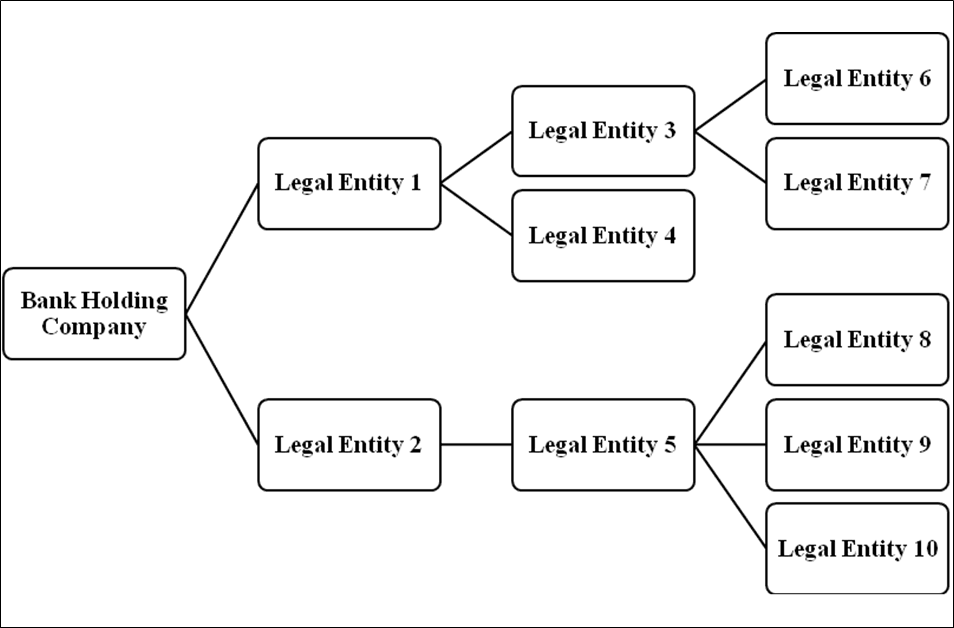
In this example, at the first level of consolidation, calculation of net cash outflows and HQLA is done on a solo basis for legal entities 6, 7, 8, 9, and 10 as they do not have any subsidiaries. For regulated entities, intercompany transactions are not eliminated; whereas in the case of non-regulated or foreign subsidiaries, intercompany transactions are eliminated to the next level of consolidation that is, legal entities 3 and 5. The restricted HQLA from entities 6 and 7 are consolidated to the extent of their net cash outflows, based on the respective approaches, while the unrestricted HQLA is transferred fully to legal entity 3. The cash inflows and outflows are consolidated to the full extent.
At the second level of consolidation that is, legal entity 3, intercompany transactions are eliminated till legal entity 1, if LE 3 is a non-regulated or foreign subsidiary. The HQLA is calculated as a sum of the consolidated restricted and unrestricted HQLA of entities 6 and 7 and the HQLA of legal entity 3. The net cash outflow is calculated based on the cash flows of entities 3, 6, and 7, post-elimination of intercompany transactions if applicable. The consolidated HQLA is calculated based on the procedure detailed in the following section.
This process continues in a step-by-step manner until the bank holding company level.
NOTE:
· The stock of HQLA is calculated based on the US Federal Reserve LCR calculation approach for all subsidiaries. Only the approach to net cash outflow calculation changes based on the type of subsidiary as detailed earlier.
· The amount of HQLA that is consolidated is determined after applying the relevant haircuts that is; the post haircut value of HQLA is compared with the net cash outflow to estimate the consolidated HQLA.
· The restricted HQLA is consolidated based on the sequence of the quality of the asset that is, Level 1 HQLA is consolidated first, followed by Level 2A and 2B.
· In the case of modified holding companies, the net cash outflow is calculated per the modified LCR approach that is, the 30-day scenario. All other calculations remain unchanged.
The following table provides a mapping of the consolidation approach followed by the application based on the type of subsidiary:
NCOF Calculation Methodology for Highest US Parent that is BHC/IHC |
Subsidiary Type |
NCOF Calculation Methodology during Consolidation |
Intercompany Transaction Elimination Level |
|---|---|---|---|
LCR Approach |
Regulated |
LCR Approach |
Up to the entity itself |
Non-Regulated |
Modified LCR Approach |
Up to the immediate parent |
|
Foreign |
Modified LCR Approach |
Up to the immediate parent |
|
Modified LCR Approach |
Regulated |
Modified LCR Approach |
Up to the entity itself |
Non-Regulated |
Modified LCR Approach |
Up to the immediate parent |
|
Foreign |
Modified LCR Approach |
Up to the immediate parent |
NOTE:
· The regulated subsidiary is a consolidated subsidiary domiciled in the USA that is expected to calculate LCR separately at its level in addition to the LCR at BHC/IHC level.
· The non-regulated subsidiary is a consolidated subsidiary domiciled in the USA that is not required to calculate LCR separately from the BHC/IHC.
· The foreign subsidiary is a consolidated subsidiary domiciled in a country other than the USA.
The application supports preconfigured calculations, scenarios, and reporting templates to ensure full compliance with BIS Basel III guidelines, US Liquidity Coverage Ratio calculation, and 5G liquidity reporting guidelines.
This section explains the rules and business assumptions that support regulatory inflow, outflow rates, and haircuts as per US Federal Reserve Regulation WW, Final Rule, and Liquidity Coverage Ratio: Liquidity Risk Measurement Standards, Sep 2014.
NOTE:
This section provides only contextual information about all the business assumptions. For more detailed information, see the OFS LRS application (UI). For detailed processes and tasks, see the Run Chart section.
Topics:
· Regulation Addressed through Business Rules
· Regulation Addressed through Business Assumptions
The application supports multiple preconfigured rules and scenarios based on regulator specified scenario parameters such as inflow rates, outflow rates, run-offs and haircuts, and so on.
Topics:
· US Liquidity Coverage Ratio Run
The list of preconfigured rules and the corresponding reference to the regulatory requirement that it addresses are provided in the following table:
Sl. No. |
Process Name |
Task Name |
Regulatory Requirement Addressed |
Regulation WW, Final Rule, Liquidity Coverage Ratio: Liquidity Risk Measurement Standards, Sep 2014 Reference |
|---|---|---|---|---|
1 |
LRM - US LCR Party and Product Type Reclassification |
LRM - Standard Party Type Reclassification |
This is a reclassification rule to reclassify all bank party types to standard party types in the FSI_PARTY_TYPE_CLASSIFICATION table. Further, all the OOB rules and Business assumptions are defined on Standard Party Type. |
|
LRM - Standard Product Type Reclassification |
This is a reclassification rule to reclassify all bank products to standard product types in the FSI_REG_PROD_TYPE_RECLASS table. Further, all the OOB rules and Business assumptions are defined on Standard Product Type. |
|
||
LRM - Classification of Products as Open Maturity |
This rule is used to identify which products bank is treating as Open Maturity Products. Based on which the cash flows movement from STG_ACCOUNT_CASH_FLOWS TO FCT_ACCOUNT_CASH_FLOWS of the products marked as Open Maturity is aggregated and posted to Open Maturity Time Bucket. As part of the OOB solution, the products marked as open maturity includes Credit Cards, Current Account and Saving Account, Common Equity, Equity, Other Equity, Other Preference Shares, Preference Shares - Cumulative, Preference Shares - Non-Cumulative, Home Equity, and Overdraft. |
|
||
2 |
LRM - US LCR GL Data Population |
LRM - Capital Accounting Head Reclassification |
This rule reclassifies capital account head to standard account head items. |
|
3 |
LRM - US LCR Mitigant Data Population |
LRM - Mitigant Sub Type Classification |
This is a reclassification rule to reclassify all Mitigants products to standard product type in FCT_MITIGANTS. |
|
4 |
LRM - US LCR Account Derived Attributes |
LRM - Time Bucket Assignment for Account Attributes |
This rule updates the time bucket assignment for account attributes like Effective Maturity, Embedded Option Next Call Date, and Effective Residual Maturity. |
|
LRM - Lendable Amount Calculation |
This computation rule is used to compute the Lendable Amount. The lendable amount is the portion of Fair Value at which covered company can lend/sell the asset. In the OOB solution, the lendable amount is 100% of the fair value of the asset. The lendable amounts can vary based on product type, customer type, and so on. You can update the rule based on dimensional combination if required. The lendable value is required for the FR2052 reports. In the application, a placeholder rule is created for the calculation of this value. It is recommended to improvise the rule to include other relevant variables like product /customer type and so on to arrive at the lendable value. |
|
||
LRM - Classification Of Customers As Retail And Wholesale |
This rule is used to identify the customer as retail or wholesale based on customer type. This identifier is further used in business assumptions to identify whether a customer is retail or wholesale. |
|
||
LRM - Classification Of Trust To Retail |
This rule reclassifies if a trusted customer can be treated as retail. Identification of Trust is done based on customer type. By default, Trust is treated as wholesale. A trusted customer is treated as retail based on the following criteria: · Is solely for the benefit of natural persons. · Does not have a corporate trustee. · Terminates within 21 years and 10 months after the death of grantors or beneficiaries of the trust living on the effective date of the trustor within 25 years, if applicable under state law. |
§ __.3 Definitions.pg.337 |
||
LRM - Classification Of Small Business Customers To Retail |
This rule reclassifies if a small business customer can be treated as retail. The identification of the small business customer is done based on customer type. By default, small business customers are treated as wholesale. A business customer is treated as a retail customer, based on the following criteria: · The bank manages its transactions with the business customer, including deposits, unsecured funding, and credit facility and liquidity facility transactions, in the same way, it manages its transactions with individuals. · Transactions with the business customer have liquidity risk characteristics that are similar to comparable transactions with individuals. · The total aggregate funding raised from the business customer is less than $1.5 million. |
§ __.3 Definitions.pg.337 |
||
LRM - Identification Of Customer As Sovereign Or MDB Or US GSE |
This rule is used to identify customers is a Sovereign or MDB or US GSE with 0 % risk weight. This flag is defined as the ease of defining business assumptions. |
|
||
LRM - Undrawn Amount Within Liquidity Horizon Update |
This rule computes a portion of the undrawn amount that can be withdrawn in the liquidity horizon period. OOB considers Hundred Percent of the undrawn amount can be drawn. The user can update the rule based on a multi-dimensional combination like the product, customer, currency, and so on if required. |
|
||
LRM - Country liquidity risk indicator for NCOF |
This computation rule updates account liquidity risk flag for a legal entity having debt securities issued by a foreign sovereign in that foreign currency. The rule checks if that legal entity has foreign operations other than pure trading operations. |
|
||
LRM - Mitigant Country Liquidity Risk Flag Update For NCOF |
This computation rule updates the mitigant's liquidity risk flag for a legal entity having debt securities issued by a foreign sovereign in that foreign currency. The rule checks if that legal entity has foreign operations other than pure trading operations. |
|
||
LRM_FSI_MTM_COLL_VALL_FLI_POP |
This T2T populates the absolute value of the largest 30-consecutive calendar day cumulative net mark-to-market collateral outflow or inflow realized during the preceding 24 months resulting from derivative transaction valuation changes. The data is populated from FSI_MTM_COLL_VAL_CHANGE to FLI_LRM_INSTRUMENT for the legal entities selected in the run. In the case of consolidated run, data is moved only for the consolidated legal entity. |
|
||
5 |
LRM - US LCR Time Bucketing and Account Cash Flow Population |
LRM - Spot or Forward Rate Assignment for Currency Conversion |
This rule assigns the spot or forward rate assignment for currency conversion. |
|
6 |
LRM - US LCR Account Insured and Uninsured Amount Computation |
LRM - US LCR Insurance Eligible Currency Population |
This rule is used to identify eligible currency applicable for the insurance scheme. |
|
US_LCR_INS_UNINS_AMT_CAL |
This DT calculates the insured and un-insured amount at the Account Customer Level. This is performed at the ownership category level. |
|
||
LRM - Account Fully Covered |
This rule updates account fully covered flag in the FSI_LRM_INSTRUMENT table. If the EOP balance of the account is the same as the insured amount, then the account is considered as fully insured. |
|
||
LRM - Insurance Scheme Cover Type Update |
This rule is used to identify whether an account is fully insured or partially insured or uninsured in the FSI_LRM_INSTRUMENT table. If EOP balance is the same as the insured amount then it is fully insured. If the insured amount is zero then it is uninsured and partially insured elsewhere. |
|
||
7 |
LRM - US LCR Account Stable Amount Computation |
LRM - US LCR Deposit Stability - Stable Amount Calculation |
This rule calculates a stable amount of a deposit account. The stable retail deposit means a retail deposit that is entirely covered by deposit insurance and is held by the depositor in a transactional account or the depositor that holds the account has another established relationship with the bank such as another deposit account, a loan, bill payment services, or any similar service or product provided to the depositor that the bank demonstrates to the satisfaction of the agency would make deposit withdrawal highly unlikely during a liquidity stress event. If the deposit account satisfies the criteria of a stable amount, then the EOP balance is considered as a stable amount. |
§ __.3 Definitions.pg.339 |
LRM - US LCR Deposit Stability - Less Stable Amount Calculation |
This rule calculates the less stable amount of a deposit account. If the deposit account does not satisfy the criteria of a stable amount, then the EOP balance is considered a less stable amount. |
|
||
LRM - US LCR Account Fully Stable Calculation |
This rule is used to identify whether an account is fully stable or not in the FSI_LRM_INSTRUMENT table. If the stable amount is the same as EOP balance then yes else No. |
|
||
8 |
LRM - US LCR Account Operational Amount Computation |
LRM - Meets Operational Services Flag Update |
This rule updates the operation services flag based on the deposit primary purpose. If the deposit primary purpose is the same as operational services specified in the regulation then yes else No. The operational services include the following: payment remittance, payroll administration and control over the disbursement of funds, transmission, reconciliation, and confirmation of payment orders, daylight overdraft, determination of intra-day and final settlement positions, settlement of securities transactions, transfer of recurring contractual payments, client subscriptions and redemptions, scheduled distribution of client funds, escrow, funds transfer, stock transfer, and agency services, including payment and settlement services, payment of fees, taxes, and other expenses; and collection and aggregation of funds. All operational deposits placed by the bank are identified similarly to that of operational deposits placed by the customer. The operational amount is identified for both assets and liabilities using the same derivation logic. |
Definition of “Operational Services”(pg.no.222) |
LRM - Classification Of Deposits As Operational And Non-Operational Amount |
This rule classifies a deposit is an operational deposit or not. To recognize a deposit as an operational deposit for purposes of this part, a covered company must comply with the requirements of the operational deposit. The related operational services must be performed according to a legally binding written agreement, and: · The termination of the agreement must be subject to a minimum 30 calendar-day notice period; or · As a result of the termination of the agreement or transfer of services to a third-party provider, the customer providing the deposit would incur significant contractual termination costs or switching costs; · The deposit must be held in an account designated as an operational account; · The customer must hold the deposit at the covered company for the primary purpose of obtaining the operational services provided by the covered company; · The deposit account must not be designed to create an economic incentive for the customer to maintain excess funds therein through increased revenue, reduction in fees, or other offered economic incentives; · The covered company must demonstrate that the deposit is empirically linked to the operational services and that it has a methodology that takes into account the volatility of the average balance for identifying any excess amount, which must be excluded from the operational deposit amount; |
§ __.3 Definitions.pg.340 |
||
|
· The deposit must not be provided in connection with the covered company’s provision of prime brokerage services, which, for the purposes of this part, are a package of services offered by the covered company whereby the covered company, among other services, executes, clears, settles, and finances transactions entered into by the customer or a third-party entity on behalf of the customer (such as an executing broker), and where the covered company has a right to use or rehypothecate assets provided by the customer, including in connection with the extension of margin and another similar financing of the customer, subject to applicable law, and includes operational services provided to a non-regulated fund; · The deposits must not be for arrangements in which the covered company (as a correspondent) holds deposits owned by another depository institution bank (as the respondent) and the respondent temporarily places excess funds in an overnight deposit with the covered company. |
|
||
9 |
LRM - US LCR Pre - HQLA Classification |
LRM - Instruments - Liquid And Readily Marketable Flag Update |
This rule reclassifies an account as liquid and readily marketable based on the following criteria: · It is traded in an active secondary market · Has more than 2 committed market makers · Has a two-way market · Has timely and observably market prices · Has high trading volumes |
Common Rule: |
LRM - Mitigants - Liquid And Readily Marketable Flag Update |
This rule reclassifies a mitigant as liquid and readily marketable based on the following criteria: · It is traded in an active secondary market · Has more than 2 committed market makers · Has a two-way market · Has timely and observably market prices · Has high trading volumes |
Common Rule: |
||
10 |
LRM - US LCR HQLA Reclassification |
LRM - Corporate Debt Security |
This rule reclassifies a liquid and readily marketable corporate debt security as a Level 2B high-quality liquid asset if it meets the criteria specified as follows: · It is classified as an investment grade. · It is issued or guaranteed by an entity whose obligations have a proven record as a reliable source of liquidity in repurchase or sales markets during stressed market conditions. Reliability is proven if the price has not decreased or haircut increased by 20% over a 30-day stress period. · It is not an obligation of a financial sector entity and not an obligation of a consolidated subsidiary of a financial sector entity. |
Common Rule: |
LRM - Publicly Traded Shares of Common Stock |
This rule reclassifies a publicly traded common equity share as a Level 2B high-quality liquid asset if it meets the criteria specified as follows: · It is included in Russell 100 Index or an index that the bank’s supervisor in a foreign jurisdiction recognizes for inclusion in Level 2B assets if the share is held in that jurisdiction. · Issued in US Dollars or in the currency of the jurisdiction in which the bank operates and holds the common equity share to cover net cash outflows in that jurisdiction. · Issued by an entity whose publicly traded common equity shares have a proven record as a reliable source of liquidity in repurchase or sales markets during stressed market conditions. Reliability is proven if the price has not decreased or haircut increased by 40% over a 30-day stress period. · Not issued by a financial sector entity and not issued by a consolidated subsidiary of a financial sector entity. · If held by a depository institution, it is not acquired in satisfaction of a debt previously contracted (DPC). |
Common Rule: |
||
LRM - U.S. GSE Securities |
This rule reclassifies security issued by or guaranteed as to the timely payment of principal and interest by, a U.S. government-sponsored enterprise, that is investment grade under 12 CFR part 1 as of the calculation date, as a Level 2A high-quality liquid asset provided the claim is senior to preferred stock. |
Common Rule: |
||
LRM - Instruments - Certain Sovereign and Multilateral Organization Securities For Level2A |
This rule reclassifies security issued by, or unconditionally guaranteed as to the timely payment of principal and interest by, a sovereign entity, the Bank for International Settlements, the International Monetary Fund, the European Central Bank, European Community, or a multilateral development bank, as a Level 2A high-quality liquid asset if it meets the criteria specified as follows: · It is assigned a zero percent risk weight. · It is liquid and readily-marketable. · It is issued or guaranteed by an entity whose obligations have a proven record as a reliable source of liquidity in repurchase or sales markets during stressed market conditions. · It is not an obligation of a financial sector entity and not an obligation of a consolidated subsidiary of a financial sector entity. |
Common Rule: |
||
LRM - Certain Foreign Sovereign Debt Securities for Issuer |
This rule reclassifies security issued by a sovereign entity that is not assigned a zero percent risk weight, where the sovereign entity issues the security in its own currency, the security is liquid and readily-marketable, and the bank holds the security in order to meet its net cash outflows in the jurisdiction of the sovereign entity, as a Level 1 high-quality liquid asset. |
Common Rule: |
||
LRM - Certain Foreign Sovereign Debt Securities for Guarantor |
This rule reclassifies security unconditionally guaranteed as to the timely payment of principal and interest by a sovereign entity that is not assigned a zero percent risk weight, where the security is issued in the currency of the sovereign entity, is liquid and readily-marketable, and the bank holds the security in order to meet its net cash outflows in the jurisdiction of the sovereign entity, as a Level 1 high-quality liquid asset. |
Common Rule: |
||
LRM - Certain Sovereign and Multilateral Organization Securities for Issuer as Level1 Asset |
This rule reclassifies security issued by a sovereign entity, the Bank for International Settlements, the International Monetary Fund, the European Central Bank, European Community, or a multilateral development bank, as a Level 1 high-quality liquid asset if it meets the criteria specified as follows: · It is assigned a zero percent risk weight. · It is liquid and readily-marketable. · It is issued or guaranteed by an entity whose obligations have a proven record as a reliable source of liquidity in repurchase or sales markets during stressed market conditions; and. · It is not an obligation of a financial sector entity and not an obligation of a consolidated subsidiary of a financial sector entity. |
Common Rule: |
||
LRM - Certain Sovereign and Multilateral Organization Securities for Guarantor as Level1 Asset |
This rule reclassifies security unconditionally guaranteed as to the timely payment of principal and interest by a sovereign entity, the Bank for International Settlements, the International Monetary Fund, the European Central Bank, European Community, or a multilateral development bank, as a Level 1 high-quality liquid asset if it meets the criteria specified as follows: · It is assigned a zero percent risk weight. · It is liquid and readily-marketable. · It is issued or guaranteed by an entity whose obligations have a proven record as a reliable source of liquidity in repurchase or sales markets during stressed market conditions; and. · It is not an obligation of a financial sector entity and not an obligation of a consolidated subsidiary of a financial sector entity. |
Common Rule: |
||
LRM - United States Government Securities |
This rule reclassifies the following securities as Level 1 high-quality liquid assets: A security issued by, or unconditionally guaranteed as to the timely payment of principal and interest by, the U.S. Department of the Treasury A security issued by any other U.S. government agency whose obligations are fully and explicitly guaranteed by the full faith and credit of the U.S. government provided that they are liquid and readily-marketable. |
Common Rule: |
||
LRM - Foreign Withdrawable Reserves For Instruments As Level 1 Asset |
This rule reclassifies any reserves held in a foreign central bank that do not have restrictions on use, that is are freely withdrawable, and denominated in the local currency of that foreign country, as Level 1 high-quality liquid assets. The classification of reserves as Level 1 high quality liquid assets includes term deposits held at the foreign central bank that fulfill any one of the criteria specified as follows: · Can be withdrawn on demand prior to maturity. · Can be pledged as collateral for the term or automatically-renewing overnight advances from a Federal Reserve Bank. |
Common Rule: |
||
LRM - Instrument - Federal Reserve Bank Balances |
This rule reclassifies reserves held with any US Federal Reserve Bank, both held directly or through a correspondent bank, as Level 1 high-quality liquid assets. The classification of reserves as Level 1 high-quality liquid assets includes term deposits held at a US Federal Reserve Bank, both directly or through a correspondent bank, that fulfill any one of the criteria specified as follows: · Can be withdrawn on demand prior to maturity · Can be pledged as collateral for the term or automatically-renewing overnight advances from a Federal Reserve Bank |
Common Rule:
|
||
11 |
LRM - US LCR Mitigant HQLA Reclassification |
LRM - Mitigants - Corporate Debt Security As L2B |
This rule reclassifies a liquid and readily marketable corporate debt security, received as a mitigant, as a Level 2B high-quality liquid asset if it meets the criteria specified as follows: · It is classified as investment grade · It is issued or guaranteed by an entity whose obligations have a proven record as a reliable source of liquidity in repurchase or sales markets during stressed market conditions. Reliability is proven if the price has not decreased or haircut increased by 20% over a 30-day stress period. · It is not an obligation of a financial sector entity and not an obligation of a consolidated subsidiary of a financial sector entity. |
Common Rule: |
LRM - Mitigant - Publicly Traded Shares Of Common Stock As L2B |
This rule reclassifies a publicly traded common equity share, received as a mitigant, as a Level 2B high-quality liquid asset if it meets the criteria specified as follows: · It is included in Russell 100 Index or an index that the bank’s supervisor in a foreign jurisdiction recognizes for inclusion in Level 2B assets if the share is held in that jurisdiction · Issued in US Dollars or in the currency of the jurisdiction in which the bank operates and holds the common equity share to cover net cash outflows in that jurisdiction · Issued by an entity whose publicly traded common equity shares have a proven record as a reliable source of liquidity in repurchase or sales markets during stressed market conditions. Reliability is proven if the price has not decreased or haircut increased by 40% over a 30-day stress period. · Not issued by a financial sector entity and not issued by a consolidated subsidiary of a financial sector entity. · If held by a depository institution, is not acquired in satisfaction of a debt previously contracted (DPC) · If held by a consolidated subsidiary of the bank, it can include the publicly traded common equity share in its Level 2B liquid assets only if the share is held to cover net cash outflows of its consolidated subsidiary in which the publicly traded common equity share is held. |
Common Rule: |
||
LRM - Mitigant - U.S. GSE Securities For Guarantor As Level 2A |
This rule reclassifies security received as a mitigant, which is guaranteed as to the timely payment of principal and interest by a U.S. government-sponsored enterprise, that is investment grade under 12 CFR part 1 as of the calculation date, as a Level 2A high-quality liquid asset provided the claim is senior to preferred stock. |
Common Rule: |
||
LRM - Mitigant - U.S. GSE Securities For Issuer As Level 2A |
This rule reclassifies security, received as a mitigant, issued by a U.S. government-sponsored enterprise, that is investment grade under 12 CFR part 1 as of the calculation date, as a Level 2A high-quality liquid asset provided the claim is senior to preferred stock. |
Common Rule: |
||
LRM - Mitigant - Certain Sovereign and Multilateral Organization Securities for L2A |
This rule reclassifies security, received as a mitigant, issued by, or unconditionally guaranteed as to the timely payment of principal and interest by, a sovereign entity, the Bank for International Settlements, the International Monetary Fund, the European Central Bank, European Community, or a multilateral development bank, as a Level 2A high-quality liquid asset, if it meets the criteria specified as follows: · It is assigned a zero percent risk weight · It is liquid and readily-marketable · It is issued or guaranteed by an entity whose obligations have a proven record as a reliable source of liquidity in repurchase or sales markets during stressed market conditions; and · It is not an obligation of a financial sector entity and not an obligation of a consolidated subsidiary of a financial sector entity. |
Common Rule: |
||
LRM - Mitigants - Certain Foreign Sovereign Debt Securities for Issuer |
This rule reclassifies security, received as a mitigant, issued by a sovereign entity that is not assigned a zero percent risk weight, where the sovereign entity issues the security in its own currency, the security is liquid and readily-marketable, and the bank holds the security in order to meet its net cash outflows in the jurisdiction of the sovereign entity, as a Level 1 high-quality liquid asset. |
Common Rule: |
||
LRM - Mitigant - Certain Foreign Sovereign Debt Securities For Guarantor As Level 1 |
This rule reclassifies security, received as a mitigant, unconditionally guaranteed as to the timely payment of principal and interest by a sovereign entity that is not assigned a zero percent risk weight, where the security is issued in the currency of the sovereign entity, is liquid and readily-marketable, and the bank holds the security in order to meet its net cash outflows in the jurisdiction of the sovereign entity, as a Level 1 high-quality liquid asset. |
Common Rule: |
||
LRM - Mitigants - Certain Sovergn and Multilateral Organization Securities for Guarantor as L1 Asset |
This rule reclassifies security, received as a mitigant, unconditionally guaranteed as to the timely payment of principal and interest by a sovereign entity, the Bank for International Settlements, the International Monetary Fund, the European Central Bank, European Community, or a multilateral development bank, as a Level 1 high-quality liquid asset if it meets the criteria specified as follows: · It is assigned a zero percent risk weight · It is liquid and readily-marketable · It is issued or guaranteed by an entity whose obligations have a proven record as a reliable source of liquidity in repurchase or sales markets during stressed market conditions; and · It is not an obligation of a financial sector entity and not an obligation of a consolidated subsidiary of a financial sector entity |
Common Rule: |
||
LRM - Mitigants - Certain Svrgn and Multilateral Organization Securities for Issuer as Level1 Asset |
This rule reclassifies security, received as a mitigant, issued by a sovereign entity, the Bank for International Settlements, the International Monetary Fund, the European Central Bank, European Community, or a multilateral development bank, as a Level 1 high-quality liquid asset if it meets the criteria specified as follows: · It is assigned a zero percent risk weight · It is liquid and readily-marketable · It is issued or guaranteed by an entity whose obligations have a proven record as a reliable source of liquidity in repurchase or sales markets during stressed market conditions; and · It is not an obligation of a financial sector entity and not an obligation of a consolidated subsidiary of a financial sector entity. |
Common Rule: |
||
LRM - Mitigants - United States Government Securities For Guarantor As Level 1 Assets |
This rule reclassifies security received as a mitigant that is unconditionally guaranteed as to the timely payment of principal and interest by, the U.S. Department of the Treasury, as a Level 1 high-quality liquid asset. |
Common Rule: |
||
LRM - Mitigants - United States Government Securities For Issuer As Level 1 Assets |
This rule reclassifies the following securities received as mitigants, as Level 1 high-quality liquid assets: · A security issued by the U.S. Department of the Treasury. · A security issued by any other U.S. government agency whose obligations are fully and explicitly guaranteed by the full faith and credit of the U.S. government provided that they are liquid and readily-marketable. |
Common Rule: |
||
12 |
LRM - US LCR Substitutable Collateral HQLA Reclassification |
LRM - Substitutable Collateral - Corporate Debt Security As L2B |
This rule reclassifies a liquid and readily marketable corporate debt security, which can be substituted by a bank's counterparty for an existing mitigant, as a Level 2B high-quality liquid asset if it meets the criteria specified as follows: · It is classified as investment grade · It is issued or guaranteed by an entity whose obligations have a proven record as a reliable source of liquidity in repurchase or sales markets during stressed market conditions. Reliability is proven if the price has not decreased or haircut increased by 20% over a 30-day stress period. · It is not an obligation of a financial sector entity and not an obligation of a consolidated subsidiary of a financial sector entity. |
Common Rule: |
LRM - Substitutable Collateral - Publicly Traded Shares Of Common Stock As L2B |
This rule reclassifies a publicly traded common equity share, which can be substituted by a bank's counterparty for an existing mitigant, as a Level 2B high-quality liquid asset if it meets the criteria specified as follows: · It is included in Russell 100 Index or an index that the bank’s supervisor in a foreign jurisdiction recognizes for inclusion in Level 2B assets if the share is held in that jurisdiction. · Issued in US Dollars or in the currency of the jurisdiction in which the bank operates and holds the common equity share to cover net cash outflows in that jurisdiction · Issued by an entity whose publicly traded common equity shares have a proven record as a reliable source of liquidity in repurchase or sales markets during stressed market conditions. Reliability is proven if the price has not decreased or haircut increased by 40% over a 30-day stress period. · Not issued by a financial sector entity and not issued by a consolidated subsidiary of a financial sector entity. · If held by a depository institution, is not acquired in satisfaction of a debt previously contracted (DPC). · If held by a consolidated subsidiary of the bank, it can include the publicly traded common equity share in its Level 2B liquid assets only if the share is held to cover net cash outflows of its consolidated subsidiary in which the publicly traded common equity share is held. |
Common Rule: |
||
LRM - Substitutable Collateral - Certain Sovereign and Multilateral Organization Securities for L2A |
This rule reclassifies security, which can be substituted by a bank's counterparty for an existing mitigant, issued by, or unconditionally guaranteed as to the timely payment of principal and interest by, a sovereign entity, the Bank for International Settlements, the International Monetary Fund, the European Central Bank, European Community, or a multilateral development bank, as a Level 2A high-quality liquid asset, if it meets the criteria specified as follows: · It is assigned a zero percent risk weight. · It is liquid and readily-marketable. · It is issued or guaranteed by an entity whose obligations have a proven record as a reliable source of liquidity in repurchase or sales markets during stressed market conditions. · It is not an obligation of a financial sector entity and not an obligation of a consolidated subsidiary of a financial sector entity. |
Common Rule: |
||
LRM - FSI - Substitutable Collateral U.S. GSE Securities Level 2A for Issuer |
This rule reclassifies security, which can be substituted by a bank's counterparty for an existing mitigant, issued by a U.S. government-sponsored enterprise, that is investment grade under 12 CFR part 1 as of the calculation date, as a Level 2A high-quality liquid asset provided the claim is senior to preferred stock. |
Common Rule: |
||
LRM - FSI -Substitutable Collateral U.S. GSE Securities Level 2A for Guarantor |
This rule reclassifies security which can be substituted by a bank's counterparty for an existing mitigant, which is guaranteed as to the timely payment of principal and interest by a U.S. government-sponsored enterprise, that is investment grade under 12 CFR part 1 as of the calculation date, as a Level 2A high-quality liquid asset provided the claim is senior to preferred stock. |
Common Rule: |
||
LRM - Substitutable Collateral - Certain Foreign Sovereign Debt Securities For Guarantor As Level 1 |
This rule reclassifies security, which can be substituted by a bank's counterparty for an existing mitigant, unconditionally guaranteed as to the timely payment of principal and interest by a sovereign entity that is not assigned a zero percent risk weight, where the security is issued in the currency of the sovereign entity, is liquid and readily-marketable, and the bank holds the security in order to meet its net cash outflows in the jurisdiction of the sovereign entity, as a Level 1 high-quality liquid asset. |
Common Rule: |
||
LRM - Substitutable Collateral - Certain Foreign Sovereign Debt Securities for Issuer As Level 1 |
This rule reclassifies security, which can be substituted by a bank's counterparty for an existing mitigant, issued by a sovereign entity that is not assigned a zero percent risk weight, where the sovereign entity issues the security in its own currency, the security is liquid and readily-marketable, and the bank holds the security in order to meet its net cash outflows in the jurisdiction of the sovereign entity, as a Level 1 high-quality liquid asset. |
Common Rule: |
||
LRM - Substitutable Collateral - United States Government Securities For Issuer As Level 1 Assets |
This rule reclassifies the following securities which can be substituted by a bank's counterparty for an existing mitigant, as Level 1 high-quality liquid assets: A security issued by the U.S. Department of the Treasury A security issued by any other U.S. government agency whose obligations are fully and explicitly guaranteed by the full faith and credit of the U.S. government provided that they are liquid and readily-marketable. |
Common Rule: |
||
LRM - Substitutable Collateral - United States Government Securities For Guarantor As Level 1 Assets |
This rule reclassifies security received as a mitigant that is unconditionally guaranteed as to the timely payment of principal and interest by, the U.S. Department of the Treasury, as a Level 1 high-quality liquid asset. |
Common Rule: |
||
LRM - Substitutable Collateral- Crtn Svrgn and Multilateral Org Securities for Issuer as Level1 Asset |
This rule reclassifies security, which can be substituted by a bank's counterparty for an existing mitigant, issued by a sovereign entity, the Bank for International Settlements, the International Monetary Fund, the European Central Bank, European Community, or a multilateral development bank, as a Level 1 high-quality liquid asset if it meets the criteria specified as follows: · It is assigned a zero percent risk weight. · It is liquid and readily-marketable. · It is issued or guaranteed by an entity whose obligations have a proven record as a reliable source of liquidity in repurchase or sales markets during stressed market conditions. · It is not an obligation of a financial sector entity and not an obligation of a consolidated subsidiary of a financial sector entity. |
Common Rule: |
||
LRM - Substitutable Colla - Crtn Svrgn and Multilateral Org Securities for Guarantor as Level1 Asset |
This rule reclassifies security, which can be substituted by a bank's counterparty for an existing mitigant, unconditionally guaranteed as to the timely payment of principal and interest by a sovereign entity, the Bank for International Settlements, the International Monetary Fund, the European Central Bank, European Community, or a multilateral development bank, as a Level 1 high-quality liquid asset if it meets the criteria specified as follows: · It is assigned a zero percent risk weight. · It is liquid and readily-marketable. · It is issued or guaranteed by an entity whose obligations have a proven record as a reliable source of liquidity in repurchase or sales markets during stressed market conditions. · It is not an obligation of a financial sector entity and not an obligation of a consolidated subsidiary of a financial sector entity. |
Common Rule: |
||
13 |
LRM - US LCR Post - HQLA Classification |
LRM - Instrument - Transferability Restriction Flag Update For Equity |
This computation rule updates the transferability restriction flag as Yes for Level 2B common equities held by a legal entity which is a consolidated subsidiary of a depository institution. Common equities held by such subsidiary entities are restricted during consolidation that is allowed to be consolidated only to the extent required to cover their own net cash outflows. This flag is updated for the bank's own assets and for assets placed as collateral by the bank. |
Common Rule: |
LRM - Instruments - Meets HQLA Operational Requirements Flag Update |
This computation rule identifies those assets classified as HQLA that meet all the operational requirements which are set forth by the regulator to be considered for inclusion in the stock of HQLA. It is derived based on the Operational Capability to Monetize HQLA and Controlled by Treasury Flags. This flag is updated for the bank's own assets and for assets placed as collateral by the bank as Yes if they meet all the operational requirements and No if they do not. |
Common Rule: |
||
LRM - Instruments - Meets Generally Applicable HQLA Criteria Flag |
This computation rule identifies those unencumbered or partially encumbered assets that fulfill all the generally applicable HQLA criteria specified by the regulator to be considered for inclusion in the stock of HQLA. This flag is updated for bank's own assets which are unencumbered and partially encumbered as Yes if they meet all the generally applicable HQLA criteria and No if they do not. |
Common Rule: |
||
LRM - Instruments - Eligible High-Quality Liquid Assets Flag Update |
This computation rule identifies those unencumbered or partially encumbered assets classified as HQLA that fulfill both the HQLA operational requirements and generally applicable criteria and marks them as eligible for inclusion in the stock of HQLA. This flag is updated for the bank's own assets which are unencumbered and partially encumbered. |
Common Rule: |
||
LRM - Instruments - Meets Generally Applicable HQLA Criteria on Unwind Flag Update |
This computation rule identifies those encumbered assets that fulfill all the generally applicable HQLA criteria specified by the regulator to be considered for inclusion in the stock of HQLA on the unwinding of the transaction which resulted in the assets' encumbrance. This flag is updated for bank's own assets placed as collateral as Yes, if they meet all the generally applicable HQLA criteria except for encumbrance status and No if they do not. |
Common Rule: |
||
LRM - Instruments - Eligible High Quality Liquid Assets on Unwind Flag Update |
This computation rule identifies those encumbered assets classified as HQLA that fulfill both the HQLA operational requirements and generally applicable criteria, with the exception of being unencumbered. It marks such assets as eligible for inclusion in the stock of HQLA on the unwinding of the transaction which resulted in the assets' encumbrance. This flag is updated for the bank's own assets which are unencumbered and partially encumbered. |
Common Rule: |
||
LRM - Mitigants - Transferability Restriction Flag Update For Equity |
This computation rule updates the transferability restriction flag as Yes for Level 2B common equities received as mitigants and held by a legal entity which is a consolidated subsidiary of a depository institution. Common equities held by such subsidiary entities are restricted during consolidation that is allowed to be consolidated only to the extent required to cover their own net cash outflows. This flag is updated for assets received as mitigants. |
Common Rule: |
||
LRM - Mitigants - Meets HQLA Operational Requirements Flag Update |
This computation rule identifies those mitigants classified as HQLA that meet all the operational requirements which are set forth by the regulator to be considered for inclusion in the stock of HQLA. It is derived based on the Operational Capability to Monetize HQLA and Controlled by Treasury Flags. This flag is updated for mitigants as Yes if they meet all the operational requirements and No if they do not. |
Common Rule: |
||
LRM - Mitigants - Meets Generally Applicable HQLA Criteria Flag Update |
This computation rule identifies those mitigants, where the bank has re-hypothecation rights but are not re-hypothecated, that fulfill all the generally applicable HQLA criteria specified by the regulator to be considered for inclusion in the stock of HQLA. This flag is updated for re-hypothecate mitigants that have not been re-hypothecated or have been partially re-hypothecated as Yes if they meet all the generally applicable HQLA criteria and No if they do not. |
Common Rule: |
||
LRM - Mitigants - High Quality Liquid Assets Eligibility Flag Update |
This computation rule identifies those mitigants classified as HQLA, where the bank has re-hypothecation rights but are not re-hypothecated, which fulfill both the HQLA operational requirements and generally applicable criteria and marks them as eligible for inclusion in the stock of HQLA. This flag is updated for mitigants which are not re-hypothecated or are partially re-hypothecated |
Common Rule: |
||
LRM - Counterparty Assets - Meets Generally Applicable HQLA Criteria on Unwind Flag Update |
This computation rule identifies those re-hypothecated mitigants that fulfill all the generally applicable HQLA criteria specified by the regulator to be considered for inclusion in the stock of HQLA on the unwinding of the transaction which resulted in the mitigant assets' encumbrance. This flag is updated for assets received as mitigants, that are placed by the bank as collateral as Yes if they meet all the generally applicable HQLA criteria except for encumbrance status and No if they do not. |
Common Rule: |
||
LRM - Mitigants - Eligible High Quality Liquid Assets on Unwind Flag Update |
This computation rule identifies those re-hypothecated mitigants classified as HQLA that fulfill both the HQLA operational requirements and generally applicable criteria, with the exception of being unencumbered. It marks such mitigants as eligible for inclusion in the stock of HQLA on unwind of the transaction which resulted in the mitigant assets' encumbrance. This flag is updated for mitigant received under re-hypothecation rights which have been either fully or partially re-hypothecated. |
Common Rule: |
||
14 |
LRM - Underlying Account Attribute Population |
LRM - Downgrade Impact Amount for Other Liabilities |
This rule calculates the Downgrade Impact Amount for products other then Derivatives. The computation logic is EOP minus the value of underlying collateral received. |
|
15 |
LRM - US LCR Stock Calculation |
LRM - Instruments - Hedge Termination Cost Adjusted Value |
This computation rule identifies all high quality liquid assets that have a hedge associated with them and computes the value of the unencumbered portion of such assets to be included in the stock as less of the hedge termination cost. |
Common Rule: |
LRM - Mitigants - Value to be Included in the Stock of HQLA |
This rule computes the value of mitigants, classified as high-quality liquid assets, to be included in the stock by multiplying it with the portion of the mitigant which is not re-hypothecated. |
Common Rule: |
||
LRM - Reserves and Term Deposits - Value to be Included in the Stock of HQLA |
This rule computes the value of central bank reserves to be included in the stock of Level 1 assets less of pass-through reserves if any. Additionally, it computes the value of term deposits classified as Level 1 assets as less of the withdrawal penalty, if any. |
Common Rule: |
||
LRM - Total Cash Received from Repo Transaction |
This rule computes the total value of cash received from repurchase transactions where the underlying asset is a high quality liquid asset. |
Supplementary Information: |
||
LRM - Vault Cash Updation |
This rule computes the total value of vault cash that is to be deducted from the stock of Level 1 liquid assets. |
Supplementary Information: |
||
16 |
LRM - US LCR Determining Revised Maturity |
LRM - Conservative Approach for Outflows |
This rule determines the maturity for all the Outflows as per the US final Rules Determining maturity section. |
Common Rule: |
LRM - Conservative Approach for Inflows |
This rule determines the maturity for all the Inflows as per the US final Rules Determining maturity section. |
Common Rule: |
||
LRM - Revised Maturity - Exception For Conservative Approach - Debt Securities |
This rule determines the maturity for all the Exceptions for the conservative approach for debt securities as per the US final Rules Determining maturity section. |
Common Rule: |
||
LRM - Exception For Conservative Approach |
This rule determines the maturity for all the Exceptions for the conservative approach for Borrowings as per the US final Rules Determining maturity section. |
Common Rule: |
||
LRM - Updating Revised Maturity Date Surrogate Key With Maturity Date Surrogate Key |
This rule updates the Revised Maturity Date to Original Maturity Date. |
|
||
LRM - Revised Maturity Time Bucket |
The rule updates the Time Bucket Surrogate Key for Revised Maturity. |
|
||
LRM - Updating Columns Using Revised Maturity Date |
This rule updates Effective Residual Maturity Band Surrogate Key, Residual Maturity Band Surrogate Key, and Residual Maturity Time Bucket Using Revised Maturity Date. |
|
||
17 |
LRM - US LCR Adjustment Reclassification
|
LRM - Adjustments to Level 2B-Secured Lending Transaction |
This rule identifies all the secured lending transactions maturing within the LCR horizon, which are to be unwound where the mitigant received is a Level 2B high-quality liquid asset. It updates the type of adjustment to the stock of HQLA due to such an unwind as the deduction of the collateral received as part of such a transaction. |
Common Rule: |
LRM - Adjustments to Level 2B-Secured Funding Transaction |
This rule identifies all the secured funding transactions maturing within the LCR horizon, which are to be unwound where the collateral posted is a Level 2B high-quality liquid asset. It updates the type of adjustment to the stock of HQLA due to such an unwind as the addition of the collateral posted as part of such a transaction. |
Common Rule: |
||
LRM - Adjustments to Level 2B-Collateralized Derivatives Transaction-Deduction |
This rule identifies all the collateralized derivatives transactions maturing within the LCR horizon, which are to be unwound where the mitigant received is a Level 2B high-quality liquid asset. It updates the type of adjustment to the stock of HQLA due to such an unwind as the deduction of the collateral received as part of such a transaction. |
Common Rule: |
||
LRM - Adjustments to Level 2B-Collateralized Derivatives Transaction-Addition |
This rule identifies all the collateralized derivatives transactions maturing within the LCR horizon, which are to be unwound where the collateral posted is a Level 2B high-quality liquid asset. It updates the type of adjustment to the stock of HQLA due to such an unwind as the addition of the collateral posted as part of such a transaction. |
Common Rule: |
||
LRM - Adjustments to Level 2B-Asset Exchange Deduction |
This rule identifies all the high-quality liquid asset exchange transactions maturing within the LCR horizon, which are to be unwound where the asset received by the bank is a Level 2B high-quality liquid asset. It updates the type of adjustment to the stock of HQLA due to such an unwind as the deduction of the asset received as part of such a transaction. |
Common Rule: |
||
LRM - Adjustments to Level 2B-Asset Exchange Addition |
This rule identifies all the high-quality liquid asset exchange transactions maturing within the LCR horizon, which are to be unwound where the asset provided by the bank is a Level 2B high-quality liquid asset. It updates the type of adjustment to the stock of HQLA due to such an unwind as the addition of the asset provided by the bank as part of such a transaction. |
Common Rule: |
||
LRM - Adjustments to Level 2A-Secured Lending Transaction |
This rule identifies all the secured lending transactions maturing within the LCR horizon, which are to be unwound where the mitigant received is a Level 2A high quality liquid asset. It updates the type of adjustment to the stock of HQLA due to such an unwind as the deduction of the collateral received as part of such a transaction. |
Common Rule: |
||
LRM - Adjustments to Level 2A-Secured Funding Transaction |
This rule identifies all the secured funding transactions maturing within the LCR horizon, which are to be unwound where the collateral posted is a Level 2A high quality liquid asset. It updates the type of adjustment to the stock of HQLA due to such an unwind as the addition of the collateral posted as part of such a transaction. |
Common Rule: |
||
LRM - Adjustments to Level 2A-Collateralized Derivatives Transaction-Deduction |
This rule identifies all the collateralized derivatives transactions maturing within the LCR horizon, which are to be unwound where the mitigant received is a Level 2A high quality liquid asset. It updates the type of adjustment to the stock of HQLA due to such an unwind as the deduction of the collateral received as part of such a transaction. |
Common Rule: |
||
LRM - Adjustments to Level 2A-Collateralized Derivatives Transaction-Addition |
This rule identifies all the collateralized derivatives transactions maturing within the LCR horizon, which are to be unwound where the collateral posted is a Level 2A high quality liquid asset. It updates the type of adjustment to the stock of HQLA due to such an unwind as the addition of the collateral posted as part of such a transaction. |
Common Rule: |
||
LRM - Adjustments to Level 2A-Asset Exchange Deduction |
This rule identifies all the high quality liquid asset exchange transactions maturing within the LCR horizon, which are to be unwound where the asset received by the bank is a Level 2A high quality liquid asset. It updates the type of adjustment to the stock of HQLA due to such an unwind as the deduction of the asset received as part of such a transaction. |
Common Rule: |
||
LRM - Adjustments to Level 2A-Asset Exchange Addition |
This rule identifies all the high quality liquid asset exchange transactions maturing within the LCR horizon, which are to be unwound where the asset provided by the bank is a Level 2A high quality liquid asset. It updates the type of adjustment to the stock of HQLA due to such an unwind as the addition of the collateral posted as part of such a transaction. |
Common Rule: |
||
LRM - Adjustments to Level 1-Secured Lending Transaction-Deduction |
This rule identifies all the secured lending transactions maturing within the LCR horizon, which are to be unwound where the mitigant received is a Level 1 high quality liquid asset. It updates the type of adjustment to the stock of HQLA due to such an unwind as the deduction of the collateral received as part of such a transaction. |
Common Rule: |
||
LRM - Adjustments to Level 1-Secured Lending Transaction-Addition |
This rule identifies all the secured lending transactions maturing within the LCR horizon, which are to be unwound where the mitigant received is a high quality liquid asset. It updates the type of adjustment to the stock of HQLA due to such an unwind as the addition of the outstanding amount extended by the bank to the counterparty as part of such a transaction. |
Common Rule: |
||
LRM - Adjustments to Level 1-Secured Funding Transaction-Deduction |
This rule identifies all the secured funding transactions maturing within the LCR horizon, which are to be unwound where the collateral posted is a high quality liquid asset. It updates the type of adjustment to the stock of HQLA due to such an unwind as the deduction of the outstanding amount extended by the counterparty to the bank as part of such a transaction. |
Common Rule: |
||
LRM - Adjustments to Level 1-Secured Funding Transaction-Addition |
This rule identifies all the secured funding transactions maturing within the LCR horizon, which are to be unwound where the collateral posted is a Level 1 high quality liquid asset. It updates the type of adjustment to the stock of HQLA due to such an unwind as the addition of the collateral posted as part of such a transaction. |
Common Rule: |
||
LRM - Adjustments to Level 1-Collateralized Derivatives Transaction-Deduction |
This rule identifies all the collateralized derivatives transactions maturing within the LCR horizon, which are to be unwound where the mitigant received or collateral posted is a Level 1 high quality liquid asset. It updates the type of adjustment to the stock of HQLA due to such an unwind as the deduction of the Level 1 collateral received as part of such a transaction and deduction of the amount received as part of a sell transaction where the mitigant received or collateral posted is a Level 1 asset. |
Common Rule: |
||
LRM - Adjustments to Level 1-Collateralized Derivatives Transaction-Addition |
This rule identifies all the collateralized derivatives transactions maturing within the LCR horizon, which are to be unwound where the mitigant received or collateral posted is a Level 1 high quality liquid asset. It updates the type of adjustment to the stock of HQLA due to such an unwind as the addition of the Level 1 collateral posted as part of such a transaction and addition of the amount paid as part of a buy transaction where mitigant received or collateral posted is a Level 1 asset. |
Common Rule: |
||
LRM - Adjustments to Level 1-Asset Exchange Deduction |
This rule identifies all the high quality liquid asset exchange transactions maturing within the LCR horizon, which are to be unwound where the asset received by the bank is a Level 1 high quality liquid asset or cash. It updates the type of adjustment to the stock of HQLA due to such an unwind as the deduction of the asset or cash received as part of such a transaction. |
Common Rule: |
||
LRM - Adjustments to Level 1-Asset Exchange Addition |
This rule identifies all the high quality liquid asset exchange transactions maturing within the LCR horizon, which are to be unwound where the asset provided by the bank is a Level 1 high quality liquid asset or cash. It updates the type of adjustment to the stock of HQLA due to such an unwind as the addition of the asset or cash posted as collateral as part of such a transaction. |
Common Rule: |
||
18
|
LRM - FR2052A 5G - Inflows |
LRM - FR2052A 5G - Onshore Indicator Update |
This rule classifies the line items to be reported for FR2052A 5G Inflows -Unsecured Info 'Onshore Placements and Offshore Placements' and Outflows - Wholesale Info 'Onshore Borrowing and Offshore Borrowing' section. |
|
LRM - FR2052A 5G - Inflows - Unencumbered Assets |
This rule classifies the line items to be reported for FR2052A 5G Inflows- Unencumbered Assets section. |
|
||
LRM - FR2052A 5G - Inflows - Capacity |
This rule classifies the line items to be reported for FR2052A 5G Inflows- Capacity section. |
|
||
LRM - FR2052A 5G - Inflows - Unrestricted Reserve Balances |
This rule classifies the line items to be reported for FR2052A 5G Inflows- Unrestricted Reserve Balances section. |
|
||
LRM - FR2052A 5G - Inflows - Unrestricted Reserve Balances For Cash |
This rule classifies the line items to be reported for FR2052A 5G Inflows- Unrestricted Reserve Balances For Cash section. |
|
||
LRM - FR2052A 5G - Inflows - Restricted Reserve Balances |
This rule classifies the line items to be reported for FR2052A 5G Inflows- Restricted Reserve Balances section. |
|
||
LRM - FR2052A 5G - Inflows - Restricted Reserve Balances For Cash |
This rule classifies the line items to be reported for FR2052A 5G Inflows- Unrestricted Reserve Balances For Cash section. |
|
||
LRM - FR2052A 5G - Inflows - Unsettled Asset Purchases |
This rule classifies the line items to be reported for FR2052A 5G Inflows- Restricted Reserve Balances For Cash section. |
|
||
LRM - FR2052A 5G - Inflows - Unsecured - Other Loans |
This rule classifies the line items to be reported for FR2052A 5G Inflows- Unsecured - Other Loans section. |
|
||
LRM - FR2052A 5G - Inflows - Unsecured |
This rule classifies the line items to be reported for FR2052A 5G Inflows- Unsecured section. |
|
||
LRM - FR2052A 5G - Inflows - Unsecured - Excess Nostro Balances |
This rule classifies the line items to be reported for FR2052A 5G Inflows- Unsecured - Excess Nostro Balances section. |
|
||
LRM - FR2052A 5G - Inflows - Secured |
This rule classifies the line items to be reported for FR2052A 5G Inflows- Secured section. |
|
||
LRM - FR2052A 5G - Inflows - Other - Derivatives Receivables |
This rule classifies the line items to be reported for FR2052A 5G Inflows- Other - Derivatives Receivables section. |
|
||
LRM - FR2052A 5G - Inflows - Other - TBA Sales |
This rule classifies the line items to be reported for FR2052A 5G Inflows- Other - TBA Sales section. |
|
||
LRM - FR2052A 5G - Inflows - Other - Undrawn Committed Facilities |
This rule classifies the line items to be reported for FR2052A 5G Inflows- Other - Undrawn Committed Facilities section. |
|
||
LRM - FR2052A 5G - Inflows - Other - Lock-up Balance |
This rule classifies the line items to be reported for FR2052A 5G Inflows- Other - Lock-up Balance section. |
|
||
LRM - FR2052A 5G - Inflows - Other - Principal Payments Receivable |
This rule classifies the line items to be reported for FR2052A 5G Inflows- Other - Principal Payments Receivable section. |
|
||
19 |
LRM - FR2052A 5G - Outflows |
LRM - FR2052A 5G - Outflows - Others - MTM Impact On Derivative Positions |
This rule classifies the line items to be reported for FR2052A 5G Outflows - Others - MTM Impact On Derivative Positions section. |
|
LRM - FR2052A 5G - Outflows - Wholesale - Other Unsecured Financing |
This rule classifies the line items to be reported for FR2052A 5G Outflows - Wholesale - Other Unsecured Financing section. |
|
||
LRM - FR2052A 5G - Wholesale Outflows |
This rule classifies the line items to be reported for FR2052A 5G Wholesale Outflows section. |
|
||
LRM - FR2052A 5G - Outflows - Wholesale - Other Asset-Backed Financing |
This rule classifies the line items to be reported for FR2052A 5G Outflows - Wholesale - Other Asset-Backed Financing section. |
|
||
LRM - FR2052A 5G Outflows - Unsecured - Commercial Paper - On Off Shore Borrowings |
This rule classifies the line items to be reported for FR2052A 5G Outflows - Unsecured - Commercial Paper - On Off Shore Borrowings section. |
|
||
LRM - FR2052A 5G - Outflows - Wholesale - Unsecured - Long Term Debt - Unsecured - Structured Notes |
This rule classifies the line items to be reported for FR2052A 5G Outflows - Wholesale - Unsecured - Long Term Debt - Unsecured - Structured Notes section. |
|
||
LRM - FR2052A 5G - Outflows - Unsecured - Wholesale CD And Draws On Committed Lines |
This rule classifies the line items to be reported for FR2052A 5G Outflows - Unsecured - Wholesale CD And Draws On Committed Lines section. |
|
||
LRM - FR2052A 5G - Outflows - Secured - Other Secured Financing Transactions |
This rule classifies the line items to be reported for FR2052A 5G Outflows - Secured - Other Secured Financing Transactions section. |
|
||
LRM - FR2052A 5G - Outflows - Secured Except Collateral Swaps |
This rule classifies the line items to be reported for FR2052A 5G Outflows - Secured Except Collateral Swaps section. |
|
||
LRM - FR2052A 5G - Outflows - Secured - Collateral Swaps |
This rule classifies the line items to be reported for FR2052A 5G Outflows - Secured - Collateral Swaps section. |
|
||
LRM - FR2052A 5G - Outflows - Deposits - Transactional And Non-Transactional Accounts |
This rule classifies the line items to be reported for FR2052A 5G Outflows - Deposits - Transactional And Non-Transactional Accounts section. |
|
||
LRM - FR2052A 5G - Outflows - Deposits - Operational And Non-Operational And Escrow |
This rule classifies the line items to be reported for FR2052A 5G Outflows - Deposits - Operational And Non-Operational And Escrow section. |
|
||
LRM - FR2052A 5G - Outflows - Deposits - Reciprocal - Non-Reciprocal |
This rule classifies the line items to be reported for FR2052A 5G Outflows - Deposits - Reciprocal - Non-Reciprocal section. |
|
||
LRM - FR2052A 5G - Outflows - Deposits - Affiliated - Non-Affiliated And Other Sweep |
This rule classifies the line items to be reported for FR2052A 5G Outflows - Deposits - Affiliated - Non-Affiliated And Other Sweep section. |
|
||
LRM - FR2052A 5G - Outflows - Deposits - Other Third-Party Deposits |
This rule classifies the line items to be reported for FR2052A 5G Outflows - Deposits - Other Third-Party Deposits section. |
|
||
LRM - FR2052A 5G - Outflows - Others |
This rule classifies the line items to be reported for FR2052A 5G Outflows - Others section. |
|
||
LRM - FR2052A 5G Outflows - Others - Facilities And Retail Mortgage Commitments |
This rule classifies the line items to be reported for FR2052A 5G Outflows - Others - Facilities And Retail Mortgage Commitments section. |
|
||
20 |
LRM - FR2052A 5G - Supplemental Info |
LRM - FR2052A 5G - Supplemental Info Initial Margin Posted - House |
This rule classifies the line items to be reported for FR2052A 5G Supplemental Info Initial Margin Posted - House section. |
|
LRM - FR2052A 5G - Supplemental Info Initial Margin Posted - Customer |
This rule classifies the line items to be reported for FR2052A 5G Supplemental Info Initial Margin Posted - Customer section. |
|
||
LRM - FR2052A 5G - Supplemental Info Variation Margin Posted - House |
This rule classifies the line items to be reported for FR2052A 5G Supplemental Info Variation Margin Posted - House section. |
|
||
LRM - FR2052A 5G - Supplemental Info Variation Margin Posted - Customer |
This rule classifies the line items to be reported for FR2052A 5G Supplemental Info Variation Margin Posted - Customer section. |
|
||
LRM - FR2052A 5G - Supplemental Info Margin Received |
This rule classifies the line items to be reported for FR2052A 5G Supplemental Info Initial Margin Received section. |
|
||
LRM - FR2052A 5G - Supplemental Info Variation Margin Received |
This rule classifies the line items to be reported for FR2052A 5G Supplemental Info Variation Margin Received section. |
|
||
LRM - FR2052A 5G - Supplemental Info Collateral Disputes Deliverables |
This rule classifies the line items to be reported for FR2052A 5G Supplemental Info Collateral Disputes Deliverables section. |
|
||
LRM - FR2052A 5G - Supplemental Info Collateral Disputes Receivables |
This rule classifies the line items to be reported for FR2052A 5G Supplemental Info Collateral Disputes Receivables section. |
|
||
LRM - FR2052A 5G - Supplemental Info Sleeper Collateral Receivables |
This rule classifies the line items to be reported for FR2052A 5G Supplemental Info Sleeper Collateral Receivables section. |
|
||
LRM - FR2052A 5G - Supplemental Info Sleeper Collateral Deliverables |
This rule classifies the line items to be reported for FR2052A 5G Supplemental Info Sleeper Collateral Deliverables section. |
|
||
LRM - FR2052A 5G - Supplemental Info Derivative Collateral Substitution Risk |
This rule classifies the line items to be reported for FR2052A 5G Supplemental Info Derivative Collateral Substitution Risk section. |
|
||
LRM - FR2052A 5G - Supplemental Info Other Collateral Substitution Risk |
This rule classifies the line items to be reported for FR2052A 5G Supplemental Info Other Collateral Substitution Risk section. |
|
||
LRM - FR2052A 5G - Supplemental Info Derivative Collateral Substitution Capacity |
This rule classifies the line items to be reported for FR2052A 5G Supplemental Info Derivative Collateral Substitution Capacity section. |
|
||
LRM - FR2052A 5G - Supplemental Info Other Collateral Substitution Capacity |
This rule classifies the line items to be reported for FR2052A 5G Supplemental Info Other Collateral Substitution Capacity section. |
|
||
LRM - FR2052A 5G - Structured and Non Structured Debt Issued |
This rule classifies the line items to be reported for FR2052A 5G Structured and Non Structured Debt Issued section. |
|
The list of preconfigured rules to the regulatory requirement that it addresses is provided in the following table:
Sl. No. |
Rule Name |
Rule Description |
Regulatory Requirement Addressed |
|---|---|---|---|
1 |
LRM - Propagating Effect Of Assumptions On Cash Outflows And Inflows |
LRM - Propagating Effect Of Assumptions On Cash Outflows And Inflows |
This rule adds the adjusted cash flow to original cash flow when changing balance is selected from the Run Management window and if the original balance is selected there is no impact on the actual cash flow amount. |
2 |
LRM - US LCR Adjustment Computation |
LRM - Level 1-Asset Exchange- Adjusted Amount Calculation |
This rule identifies the amount to be added to and deducted from the stock of Level 1 high quality liquid assets due to the unwinding of each asset exchange transaction. |
LRM - Level 1-Collateralized Derivatives Transaction - Adjusted Amount Calculation |
This rule identifies the amount to be added to or deducted from the stock of Level 1 high quality liquid assets due to the unwinding of each Collateralized Derivatives transaction. |
||
LRM - Level 1-Secured Funding Transaction- Adjusted Amount Calculation |
This rule identifies the amount to be added to and deducted from the stock of Level 1 high quality liquid assets due to the unwinding of each Secured Funding transaction. |
||
LRM - Level 1-Secured Lending Transaction- Adjusted Amount Calculation |
This Rule identifies the amount to be added to and deducted from the stock of Level 1 high quality liquid assets due to the unwinding of each Secured Lending transaction. |
||
LRM - Level 2B Adjusted Amount Calculation |
This Rule identifies the amount to be added or deducted from the stock of Level 2B high quality liquid assets due to the unwinding of each transaction. |
||
LRM - Level 2A Adjusted Amount Calculation |
This rule identifies the amount to be added or deducted from the stock of Level 2A high quality liquid assets due to the unwinding of each transaction. |
||
LRM - Level 1-Collateralized Derivatives Transaction - Adjusted Amount Paid Calculation |
This rule identifies the amount paid to be added from the stock of Level 1 high quality liquid assets due to the unwinding of each Collateralized Derivatives transaction. |
||
3 |
LRM - Peak Net Cashflow Computation |
LRM - Cash flows for LCR Computation |
This Rule populates the cash flows for every eligible legal entity for calculation of unmodified liquidity coverage ratio and stores at a Legal entity and currency combination in the FCT_LRM_LE_SUMMARY table. |
LRM - Cash flows for LCR Computation for handling cash comingling |
This Rule populates the comingled cash flows for every eligible legal entity for calculation of unmodified liquidity coverage ratio and stores at a Legal entity and currency combination in the FCT_LRM_LE_SUMMARY table. |
||
LRM - US LCR NCOF Computation |
This Rule populates the net cash flows for every eligible legal entity for calculation of unmodified liquidity coverage ratio and stores at a Legal entity and currency combination in the FCT_LRM_LE_SUMMARY table. |
||
LRM_CUMM_CASHFLOW_CALC |
This DT calculates the cumulative cash flows in FSI_PEAK_NET_CASH_OUTFLOW after excluding all the Intercompany Transactions. |
||
LRM - Total Aggregated Cashflows Computation |
This Rule calculates the Add-On amount in the FSI_PEAK_NET_CASH_OUTFLOW table. |
||
LRM - Net Cash Outflows Amount Computation |
This Rule calculates the Net Cumulative Cash Outflow amount in the FSI_PEAK_NET_CASH_OUTFLOW table. |
||
LRM - 24 Month Derivative Amount Computation |
This rule computes the outflow amount due to potential derivative valuation changes. This amount is the absolute value of the largest 30-consecutive calendar day cumulative net mark-to-market collateral outflow or inflow realized during the preceding 24 months resulting from derivative transaction valuation changes. |
||
4 |
LRM - US LCR Adjusted Stock Calculation |
LRM - US LCR Level 1 Adjustments Amount Calculation |
This Rule calculates the Adjustment Amount for Asset Level 1 in the FCT_LRM_LE_SUMMARY table. |
LRM - US LCR Level 2A Adjustments Amount Calculation |
This Rule calculates the Adjustment Amount for Asset Level 2A in the FCT_LRM_LE_SUMMARY table. |
||
LRM - US LCR Level 2B Adjustments Amount Calculation |
This Rule calculates the Adjustment Amount for Asset Level 2B in the FCT_LRM_LE_SUMMARY table. |
||
LRM - US LCR Level 1 Adjusted Asset Amount Calculation |
This Rule calculates the Adjusted Asset Amount post Adjustment for Asset Level 1 in the FCT_LRM_LE_SUMMARY table. |
||
LRM - US LCR Level 2A Adjusted Asset Amount Calculation |
This Rule calculates the Adjusted Asset Amount post Adjustment for Asset Level 2A in the FCT_LRM_LE_SUMMARY table. |
||
LRM - US LCR Level 2B Adjusted Asset Amount Calculation |
This Rule calculates the Adjusted Asset Amount post Adjustment for Asset Level 2B in the FCT_LRM_LE_SUMMARY table. |
||
LRM - US LCR Adjusted Level 2 Cap Excess Amount Calculation |
This Rule calculates the Adjusted Level 2 Cap Excess Amount in FCT_LRM_LE_SUMMARY table. |
||
LRM - US LCR Adjusted Level 2B Cap Excess Amount Calculation |
This Rule calculates the Adjusted Level 2B Cap Excess Amount in FCT_LRM_LE_SUMMARY table. |
||
LRM - US LCR Adjusted Excess HQLA Calculation |
This Rule calculates the Adjusted Excess HQLA Amount in FCT_LRM_LE_SUMMARY table. |
||
LRM - US LCR Unadjusted Level 2 Cap Excess Amount Calculation |
This Rule calculates the Unadjusted Level 2 Cap Excess Amount in FCT_LRM_LE_SUMMARY table. |
||
LRM - US LCR Unadjusted Level 2B Cap Excess Amount Calculation |
This Rule calculates the Unadjusted Level 2B Cap Excess Amount in FCT_LRM_LE_SUMMARY table. |
||
LRM - US LCR Unadjusted Excess HQLA Calculation |
This Rule calculates the Unadjusted Excess HQLA Amount in FCT_LRM_LE_SUMMARY table. |
||
5 |
LRM - US LCR Ratio Computation |
LRM - US SHQLA Computation |
This Rule calculates the Stock of HQLA in FCT_LRM_LE_SUMMARY table. |
LRM - US LCR Computation |
This Rule calculates the Liquidity Coverage Ratio in FCT_LRM_LE_SUMMARY table. |
||
6 |
LRM - FR2052A 5G - Inflows - Computation |
LRM - FR2052A 5G - Unencumbered Assets And Capacity Computation |
This Rule computes the reporting amount and reporting time bucket in FSI_LRM_INSTRUMENT for FR2052A 5G Inflows- Unencumbered Assets And Capacity section. |
LRM - FR2052A 5G - Unrestricted Reserve Balances Computation |
This Rule computes the reporting amount and reporting time bucket in FSI_LRM_INSTRUMENT for FR2052A 5G Inflows- Unrestricted Reserve Balances section. |
||
LRM - FR2052A 5G - Inflows - Unrestricted Reserve Balances - Cash Balances Computation |
This Rule computes the reporting amount and reporting time bucket in FSI_LRM_INSTRUMENT for FR2052A 5G Inflows- Unrestricted Reserve Balances - Cash Balances section. |
||
LRM - FR2052A 5G - Restricted Reserve Balances Computation |
This Rule computes the reporting amount and reporting time bucket in FSI_LRM_INSTRUMENT for FR2052A 5G Inflows- Restricted Reserve Balances section. |
||
LRM - FR2052A 5G - Unsettled And Forward Asset Purchases Computation |
This Rule computes the reporting amount and reporting time bucket in FSI_LRM_INSTRUMENT for FR2052A 5G Inflows- Unsettled And Forward Asset Purchases section. |
||
LRM - FR2052A 5G - Inflows - Unsecured Computation |
This Rule computes the reporting amount and reporting time bucket in FSI_LRM_INSTRUMENT for FR2052A 5G Inflows- Unsecured section. |
||
LRM - FR2052A 5G - Excess Nostro Balances Computation |
This Rule computes the reporting amount and reporting time bucket in FSI_LRM_INSTRUMENT for FR2052A 5G Inflows- Excess Nostro Balances section. |
||
LRM - FR2052A 5G - Inflows - Secured Computation |
This Rule computes the reporting amount and reporting time bucket in FSI_LRM_INSTRUMENT for FR2052A 5G Inflows- Secured section. |
||
LRM - FR2052A 5G - Inflows - Others Computation |
This Rule computes the reporting amount and reporting time bucket in FSI_LRM_INSTRUMENT for FR2052A 5G Inflows- Others section. |
||
7 |
LRM - FR2052A 5G - Outflows - Computation |
LRM - FR2052A 5G - Outflows - Others MTM Impact on Derivative Positions Computation |
This Rule computes the reporting amount and reporting time bucket in FSI_LRM_INSTRUMENT for FR2052A 5G Outflows - Other MTM Impact on Derivative Positions section. |
LRM - FR2052A 5G - Wholesale And Other Unsecured Financing Computation |
This Rule computes the reporting amount and reporting time bucket in FSI_LRM_INSTRUMENT for FR2052A 5G Outflows - Wholesale And Other Unsecured Financing section. |
||
LRM - FR2052A 5G - Outflows - Wholesale - Unsecured Computation |
This Rule computes the reporting amount and reporting time bucket FSI_LRM_INSTRUMENT for FR2052A 5G Outflows - Wholesale - Unsecured section. |
||
LRM - FR2052A 5G - Outflows - Secured Computation |
This Rule computes the reporting amount and reporting time bucket in FSI_LRM_INSTRUMENT for FR2052A 5G Outflows - Secured section. |
||
LRM - FR2052A 5G - Outflows - Deposits - Non-Transactional Computation |
This Rule computes the reporting amount and reporting time bucket in FSI_LRM_INSTRUMENT for FR2052A 5G Outflows - Deposits - Non-Transactional section. |
||
LRM - FR2052A 5G - Outflows - Deposits - Operational Escrow Computation |
This Rule computes the reporting amount and reporting time bucket in FSI_LRM_INSTRUMENT for FR2052A 5G Outflows - Deposits - Operational Escrow section. |
||
LRM - FR2052A 5G - Outflows - Deposits - Reciprocal And Sweep Computation |
This Rule computes the reporting amount and reporting time bucket in FSI_LRM_INSTRUMENT for FR2052A 5G Outflows - Deposits - Reciprocal And Sweep section. |
||
LRM - FR2052A 5G - Outflows - Deposits - Third Party Computation |
This Rule computes the reporting amount and reporting time bucket in FSI_LRM_INSTRUMENT for FR2052A 5G Outflows - Deposits - Third Party section. |
||
LRM - FR2052A 5G - Outflows - Others Computation |
This Rule computes the reporting amount and reporting time bucket FSI_LRM_INSTRUMENT for FR2052A 5G Outflows- Others section. |
||
8 |
LRM - FR2052A 5G - Supplemental - Computation |
LRM - FR2052A 5G - Supplemental Margin Posted Computation |
This Rule computes the reporting amount and reporting time bucket in FSI_LRM_INSTRUMENT for FR2052A 5G Supplemental Margin Posted section. |
LRM - FR2052A 5G - Collateral Deliverables And Receivables Computation |
This Rule computes the reporting amount and reporting time bucket in FSI_LRM_INSTRUMENT for FR2052A 5G Collateral Deliverables And Receivables section. |
||
LRM - FR2052A 5G - Debt Maturing In Greater Than Thirty days Computation - Primary Market Maker |
This Rule computes the reporting amount and reporting time bucket in FSI_LRM_INSTRUMENT for FR2052A 5G Structured and Non Structured Debt Issued section. |
The application supports multiple assumptions with preconfigured rules and scenarios based on regulator-specified scenario parameters such as inflow rates, outflow rates, run-offs and haircuts, and so on. The list of preconfigured business assumptions and the corresponding reference to the regulatory requirement that it addresses is provided in the following table:
Sl. No. |
Assumption Name |
Assumption Description |
Regulatory Requirement Addressed |
Regulation WW, Final Rule, Liquidity Coverage Ratio: Liquidity Risk Measurement Standards, Sep 2014 Reference |
|---|---|---|---|---|
1 |
High Quality Liquidity Asset Haircut |
US LCR - High Quality Liquidity Asset Haircut |
The haircuts to be applied to high quality liquid assets are pre-defined as part of this assumption. This assumption specifies the fair value, as determined under the U.S. generally accepted accounting principles (GAAP), of a covered company’s Level 2A liquid assets and Level 2B liquid assets, are subject to haircuts of 15 and 50 percent. |
Common Rule: Subpart C § __.3 Definitions; Page 325 - 340 Subpart C § __.20 High-Quality Liquid Asset Criteria; Page 343 - 347 Supplementary Information: Section II B 2 Qualifying Criteria for Categories of HQLA; Page 46 - 102 |
2 |
Asset Exchange Cash Inflows |
US LCR - Asset Exchange Cash Inflows |
The inflow rates to be applied on asset exchange transactions are pre-defined as part of this assumption. This assumption specifies the regulation on LCR and asset exchange inflow rates which depend on the level of assets the covered company receives at maturity and covered company must post at maturity. |
Common Rule: Subpart C § __.33(f) Secured lending and asset exchange cash inflow amount.; Page 375 Supplementary Information: Section II C 4(f) Secured lending and asset exchange cash inflow amount page 275-288 |
3 |
Asset Exchange Cash Outflows Non Re-hypothecated Collateral |
US LCR - Asset Exchange Cash Outflows where collateral re-hypothecation maturity date less than or equal to 30 days |
The outflow rates to be applied to asset exchange transactions where the underlying collateral is not re-hypothecated are pre-defined as part of this assumption. This assumption specifies the regulation on LCR and asset exchange outflow rates which depend on the level of assets the covered company receives at maturity and covered company must post at maturity. |
Common Rule: Subpart C § __.32(j) Secured funding and asset exchange outflow amount Page 369 Supplementary Information: Section II C 3(j) Secured Funding Transactions and Asset Exchange Outflow Amounts page 240 -261 |
4 |
Asset Exchange Cash Outflows Re-hypothecated Collateral |
Asset Exchange Cash Outflows Re-hypothecated Collateral |
The outflow rates to be applied to asset exchange transactions where the underlying collateral is re-hypothecated are pre-defined as part of this assumption. This assumption specifies the rule regulation on LCR and asset exchange outflow rates which depend on the level of assets the covered company receives at maturity and covered company must post at maturity. |
Common Rule: Subpart C § __.32(j) Secured funding and asset exchange outflow amount ;Page 369 Supplementary Information: Section II C 3(j) Secured Funding Transactions and Asset Exchange Outflow Amounts page 240 -261 |
5 |
Collateral Outflow Derivative Collateral substitution |
US LCR - Collateral outflow due to collateral substitution collateral in derivatives |
The outflow rates due to collateral substitution on derivatives are pre-defined as part of this assumption. This assumption specifies the outflow rates which depend on the level of collateral pledged to the covered company by the counterparty and the level of substitutable collateral which the counterparty may replace without the consent of the bank. |
Common Rule: Subpart C § __.32(f) collateral outflow amount; Page 369 Supplementary Information: Section II C3(f) Collateral outflow amount. page 183-194 |
6 |
Collateral Outflow Derivative Collateral Valuation Change |
US LCR - collateral outflow due to derivative collateral potential valuation changes |
The outflow rates due to collateral valuation change on derivatives are pre-defined as part of this assumption. This assumption specifies a 20 percent outflow on the fair value of any collateral securing a derivative transaction pledged to the counterparty by the bank that is not a Level 1 liquid asset. |
Common Rule: Subpart C § __.32(f) collateral outflow amount; Page 369 Supplementary Information: Section II C3(f) Collateral outflow amount. page 183-194 |
7 |
Collateral Outflow Derivative contractually due Collateral |
US LCR - Collateral Outflow due to contractually due collateral in derivatives |
The outflow rates due to collateral that the covered company has to maintain with a counterparty on derivatives are pre-defined as part of this assumption. This assumption specifies 100 percent outflow on the fair value of the collateral that the bank is contractually required to pledge to the counterparty. |
Common Rule: Subpart C § __.32(f) collateral outflow amount; Page 369 Supplementary Information: Section II C3(f) Collateral outflow amount. page 183-194 |
8 |
Collateral Outflow Derivative Excess Collateral |
US LCR - Collateral Outflow due to excess collateral in derivatives |
The outflow rates due to excess collateral that counterparty has maintained with the covered company on derivatives are pre-defined as part of this assumption. This assumption specifies that on the excess collateral, 100 percent of the fair value of the collateral that the bank requires must be returned to the counterparty. This is because the collateral pledged to the bank exceeds the current collateral requirement of the counterparty under the governing contract. It also specifies that it cannot be re-hypothecated because it is not excluded as eligible HQLA by the bank. |
Common Rule: Subpart C § __.32(f) collateral outflow amount; Page 369 Supplementary Information: Section II C3(f) Collateral outflow amount. page 183-194 |
9 |
Collateral Outflow Downgrade Trigger |
US LCR - Collateral outflow due change in financial condition |
The outflow rates due to rating downgrade are pre-defined as part of this assumption. This assumption specifies a 100 percent outflow of all additional amounts of collateral that the bank is contractually required to pledge or to fund under the terms of any transaction. This results in change in the bank’s financial condition. |
Common Rule: Subpart C § __.32(f) collateral outflow amount; Page 369 Supplementary Information: Section II C3(f) Collateral outflow amount. page 183-194 |
10 |
Collateral Outflow Secured Lending Collateral substitution |
US LCR - Collateral outflow due to collateral substitution in secured lending |
The outflow rates due to collateral substitution on secured lending transactions are pre-defined as part of this assumption. This assumption specifies that on the collateral substitution, the outflow rates depend on the level of collateral pledged to the covered company by the counterparty. It also specifies the level of substitutable collateral which the counterparty may replace without the consent of the bank. |
Common Rule: Subpart C § __.32(f) collateral outflow amount; Page 369 Supplementary Information: Section II C3(f) Collateral outflow amount. page 183-194 |
11 |
Collateral Outflow Secured Lending contractually due Co |
US LCR - Collateral Outflow due to contractually due collateral in secured funding |
The outflow rates due to collateral that the covered company has to maintain with a counterparty on secured lending transactions are pre-defined as part of this assumption. This assumption specifies 100 percent of the fair value of the collateral that the bank is contractually required to pledge to the counterparty. |
Common Rule: Subpart C § __.32(f) collateral outflow amount; Page 369 Supplementary Information: Section II C3(f) Collateral outflow amount. page 183-194 |
12 |
Collateral Outflow Secured Lending Excess Collateral |
US LCR - Collateral Outflow due to excess collateral in secured Lending |
The outflow rates due to excess collateral that counterparty has maintained with the covered company on secured lending transactions are pre-defined as part of this assumption. This assumption specifies that on the excess collateral, 100 percent of the fair value of the collateral must be returned to a counterparty by the bank as the collateral pledged to the bank exceeds the current collateral requirement of the counterparty under the governing contract. It also specifies that it cannot be re-hypothecated and it is not excluded as eligible HQLA by the bank. |
Common Rule: Subpart C § __.32(f) collateral outflow amount; Page 369 Supplementary Information: Section II C3(f) Collateral outflow amount. page 183-194 |
13 |
Commitment Outflow Depository Institutions |
US LCR - commitment credit and liquidity facility extended to depository institutions |
The outflow rates for committed liquid and credit facilities extended to depository institutions are pre-defined as part of this assumption. This assumption specifies the outflow rate which varies depending on the affiliation of the depository institution to the covered company. If the depository institution is an affiliate of the covered company then the outflow rate is zero percent whereas fifty percent for other depository institutions. |
Common Rule: Subpart C § __.32 Commitment Outflow Amount; Page 361 Supplementary Information: Section II C(e) Commitment Outflow Amount. page 169 -184 |
14 |
Commitment Outflow for Issuing CP or Security |
US LCR - Commitment Outflow amount for issuing CP or Security excluding equity |
The outflow rates for committed liquid and credit facilities extended for issuing CP or security are pre-defined as part of this assumption. This assumption specifies 100 percent of the undrawn amount of all committed credit and liquidity facilities extended to a special purpose entity that issues or has issued commercial paper or securities (other than equity securities issued to a company of which the special purpose entity is a consolidated subsidiary) to finance its purchases or E28operations. |
Common Rule: Subpart C § __.32 Commitment Outflow Amount; Page 361 Supplementary Information: Section II C(e) Commitment Outflow Amount. page 169 -184 |
15 |
Commitment Outflow Retail Customers |
US LCR - Committed credit and liquidity facility extended to retail customers |
The outflow rates for committed liquid and credit facilities extended to retail customers are pre-defined as part of this assumption. This assumption specifies 5 percent of the undrawn amount of all committed credit and liquidity facilities extended by the covered company to retail customers or counterparties. |
Common Rule: Subpart C § __.32 Commitment Outflow Amount; Page 361 Supplementary Information: Section II C(e) Commitment Outflow Amount. page 169 -184 |
16 |
Commitment Outflow Wholesale Customers |
US LCR - Committed credit and liquidity facility extended to whole sale customers |
The outflow rates for committed liquid and credit facilities extended to other wholesale customers are pre-defined as part of this assumption. This assumption specifies the outflow rates for other wholesale customers vary depending on type of facility (liquidity or credit) and whether the customer is a financial sector entity or not. |
Common Rule: Subpart C § __.32 Commitment Outflow Amount; Page 361 Supplementary Information: Section II C(e) Commitment Outflow Amount. page 169 -184 |
17 |
Debt Security Outflow Amount |
US LCR - Outflow Rates for debt securities where the bank is the primary market maker |
The outflow rates debt securities issued by the covered company are pre-defined as part of this assumption. This assumption specifies the outflow amount for debt securities issued by the bank which matures more than 30 calendar days after the calculation date. The bank or a consolidated subsidiary of the bank is the primary market maker in such debt securities and this includes 3 percent of all such debt securities that are not structured securities and 5 percent of all such debt securities that are structured securities. |
Common Rule: Subpart C § __.32 Debt Security Outflow Amount; Page 369 Supplementary Information: Section II C(i) Debt Security Outflow Amount; page 237-240 |
18 |
Exclusions for Inflows - Credit and Liquidity Facility |
US LCR - Exclusions for Inflows - Credit, Liquidity or other Facilities to be excluded |
The cash flows from credit and liquidity facilities provided to the covered company are excluded as part of this assumption. This assumption specifies that the amounts arising from any credit or liquidity facility extended to a covered company are excluded from the denominator of the proposed LCR. |
Common Rule: Subpart C § __.33 Items Not Included as Inflows; Page 373 Supplementary Information: Section II C 4(a) Items Not Included as Inflows; page 266-271 |
19 |
Exclusions for Inflows - Derivative Mortgage commitments |
US LCR - Exclusions for Inflows Derivative Mortgage commitments, Forward Sale Mortgages |
The cash flows from derivative mortgage commitments are excluded as part of this assumption. This assumption specifies that the amount that a covered company expects to receive or is contractually entitled to receive from derivative transactions which are due to forward sales of mortgage loans and any derivatives that are mortgage commitments are excluded from the denominator of the proposed LCR. |
Common Rule: Subpart C § __.33 Items Not Included as Inflows; Page 373 Supplementary Information: Section II C 4(a) Items Not Included as Inflows; page 266-271 |
20 |
Exclusions for Inflows - Non Performing Assets |
Exclusions for Inflows - Non Performing Assets |
The cash flows from non-performing assets are excluded as part of this assumption. This assumption specifies that the cash flows from non-performing assets are excluded from the denominator of the proposed LCR in the following cases, when the amount payable to the covered company or any outstanding exposure to a customer or counterparty that is a non-performing asset as of a calculation date or that the covered company has a reason to expect becomes a non-performing exposure in 30 calendar days or less from a calculation date. |
Common Rule: Subpart C § __.33 Items Not Included as Inflows; Page 373 Supplementary Information: Section II C 4(a) Items Not Included as Inflows; page 266-271 |
21 |
Exclusions for Inflows - Open Maturity |
US LCR - Exclusions for Inflows - Open Maturity |
The cash flows from open maturity products are excluded as part of this assumption. This assumption specifies the items that have no contractual maturity date or items that mature more than 30 calendar days after a calculation date are excluded from the denominator of the proposed LCR. |
Common Rule: Subpart C § __.33 Items Not Included as Inflows; Page 373 Supplementary Information: Section II C 4(a) Items Not Included as Inflows; page 266-271 |
22 |
Exclusions for Inflows - Operational Deposits |
US LCR - Exclusions for Inflows - Operational Deposits of Financial Sector Entities |
The cash flows from operational deposits placed by the covered company are excluded as part of this assumption. This assumption specifies that the covered company’s inflows derived from any operational deposits at another regulated financial company are excluded from the denominator of the proposed LCR. |
Common Rule: Subpart C § __.33 Items Not Included as Inflows; Page 373 Supplementary Information: Section II C 4(a) Items Not Included as Inflows; page 266-271 |
23 |
Less Stable Retail Outflows |
US LCR - Retail outflow amount for less stable portion of the deposits |
The outflow rate for the less stable portion of retail deposits which are not brokered deposits is pre-defined as part of this assumption. This assumption specifies that a bank’s retail funding outflow amount as of the calculation date includes (regardless of maturity or collateralization) 3 percent of all stable retail deposits held at the bank and 10 percent of all other retail deposits held at the bank. |
Common Rule: Subpart C § __.32 Funding Outflow Amount; Page 359 Supplementary Information: Section II C3(a) Retail Funding Outflow Amount; page 155-161 |
24 |
Mortgage Commitment Outflow Amount |
US LCR - Outflow rates for mortgage commitments |
The outflow rates for commitments extended for mortgage loans are pre-defined as part of this assumption. This assumption specifies that the mortgage commitment outflow amount as of a calculation date is 10 percent of the number of funds the bank has contractually committed for its own origination of retail mortgages. This can be drawn upon 30 calendar days or less from such a calculation date. |
Common Rule: Subpart C § __.32 Mortgage commitment outflow amount; Page 361 Supplementary Information: Section II C 3(d) Mortgage commitment page 168-169 |
25 |
Net Derivatives Receivables or Payables |
US LCR - Net Derivatives Receivables or Payables |
The cash flow movements for derivative transactions are pre-defined as part of this assumption. This assumption specifies that the determination of total net cash outflow using the add-on approach, the net derivatives cash inflow and outflow is not part of add on computations. Hence these cash flows are moved to open maturity bucket. |
Common Rule: Subpart C § __.30 Total net cash outflow amount; Page 354-356 Supplementary Information: Section II C 1(a) Peak Day Approach; page 137-144 |
26 |
Non Maturing Deposits Placed |
US LCR- Non-Maturing Deposits cash flows maturity to be considered in day1 |
The maturity adjustments are pre-defined as part of this assumption. This assumption specifies that the transactions, except for operational deposits, that do not have maturity dates are considered to have a maturity date on the first calendar day after the calculation date. |
Common Rule: Subpart C § __.31 Determining Maturity; Page 356-358 Supplementary Information: Section II C 2 Determining Maturity; page 147-154 |
27 |
Other Cash Inflows - Retail and Wholesale |
US LCR - Other Cash Inflows which are not included in any inflow assumptions |
This business assumption is used to exclude cash inflows from retail and wholesale customers which are non-performing. This assumption specifies that any amounts payable to the bank from an obligation of a customer or counterparty that is a non-performing asset must be made as per the calculation date. |
Common Rule: Subpart C § __.33 Items Not Included as Inflows; Page 373 Supplementary Information: Section II C 4(a) Items Not Included as Inflows; page 266-271 |
28 |
Other Cash Inflows - Revolving Credit |
US LCR - Other Cash Inflows which are not included in any of the Inflow assumptions |
The inflow rates for revolving credit which are secured are pre-defined as part of this assumption. This assumption specifies that any other inflows which are not included need to be given a zero percent inflow. This assumption is defined to include zero percent of inflows coming for revolving credit which are secured. |
Common Rule: Subpart C § __.33 Other Cash Inflow Amounts; Page 379 Supplementary Information: Section II C 4(a) Other Cash Inflow Amounts; page 290 |
29 |
Other Retail Outflows |
US LCR - Retail funding from retail customer that is not a retail deposit |
The outflow rates from retail customers other than retail deposits are pre-defined as part of this assumption. This assumption specifies the outflow rates from retail customers which are 40 percent of all funding from a retail customer or counterparty that is not a retail deposit or a brokered deposit provided by a retail customer or counterparty; or a debt instrument issued by the bank that is owned by a retail customer or counterparty. |
Common Rule: Subpart C § __.32 Retail Funding Outflow Amount; Page 359 Supplementary Information: Section II C(a) Retail Funding Outflow Amount; page 155-161 |
30 |
Retail Brokered Other Maturity Deposits |
US LCR - Brokered deposit outflow for maturity deposits (not reciprocal or sweep) |
The outflow rates for retail brokered (non-reciprocal, non-sweep) non-maturity deposits are pre-defined as part of this assumption. This assumption specifies the brokered deposit outflow amount for retail customers or counterparties as of the calculation date. This includes 100 percent of all brokered deposits provided by a retail customer or counterparty that are not brokered sweep or reciprocal deposits and which matures in 30 calendar days or less from the calculation date. This also includes 10 percent of all brokered deposits provided by a retail customer or counterparty that are not brokered sweep or reciprocal deposits and which mature later than 30 calendar days from the calculation date. |
Common Rule: Subpart C § __.32 Brokered Deposit Outflow Amount; Page 366 Supplementary Information: Section II C(g) Brokered Deposit Outflow Amount; Page 194 - 214 |
31 |
Retail Brokered Other Non Maturity Deposits |
US LCR - Brokered deposit outflow for non-maturity deposit (not reciprocal or sweep) |
The outflow rates for retail brokered (non-reciprocal, non-sweep) maturity deposits are pre-defined as part of this assumption. This assumption specifies the brokered deposit outflow amount for retail customers or counterparties as of the calculation date which includes 20 percent of all brokered deposits that are not brokered sweep or reciprocal deposits which are held in a transactional account with no contractual maturity date, where the entire amount is covered by deposit insurance and 40 percent of all brokered deposits that are not brokered sweep or reciprocal deposits which are held in a transactional account with no contractual maturity date, where less than the entire amount is covered by deposit insurance. |
Common Rule: Subpart C § __.32 Brokered Deposit Outflow Amount; Page 366 Supplementary Information: Section II C(g) Brokered Deposit Outflow Amount; Page 194 - 214 |
32 |
Retail Brokered Reciprocal Deposits |
US LCR - Outflow rates for brokered reciprocal deposits from retail customers |
The outflow rates for retail brokered reciprocal deposits are pre-defined as part of this assumption. This assumption specifies the brokered deposit outflow amount for retail customers or counterparties as of the calculation date which includes 10 percent of all reciprocal brokered deposits, where the entire amount is covered by deposit insurance and 25 percent of all reciprocal brokered deposits where less than the entire amount is covered by deposit insurance. |
Common Rule: Subpart C § __.32 Brokered Deposit Outflow Amount; Page 366 Supplementary Information: Section II C(g) Brokered Deposit Outflow Amount; Page 194 - 214 |
33 |
Retail Brokered Sweep Deposits |
US LCR - Outflow rates for brokered sweep deposits from retail customers |
The outflow rates for retail brokered sweep deposits are pre-defined as part of this assumption. This assumption specifies the brokered sweep deposit outflow amount for retail customers or counterparties as of the calculation date which includes 10 percent in cases where deposit originating company is subsidiary or affiliate of the covered company. Here the entire amount of the deposits is covered by deposit insurance and 25 percent in cases where deposit originating company is subsidiary or affiliate of the covered company. The entire amount of the deposits is covered by deposit insurance and 40 percent where less than the entire amount of the deposit balance is covered by deposit insurance. |
Common Rule: Subpart C § __.32 Brokered Deposit Outflow Amount; Page 366 Supplementary Information: Section II C(g) Brokered Deposit Outflow Amount; Page 194 - 214 |
34 |
Retail Cash Inflows |
US LCR - Retail Cash Inflow Amount |
The inflow rates from retail customers are pre-defined as part of this assumption. This assumption specifies that the retail cash inflow amount as of the calculation date includes 50 percent of all payments contractually payable to the bank from retail customers or counterparties. |
Common Rule: Subpart C § __.33 Retail Cash Inflow Amount; Page 375 Supplementary Information: Section II C 4(c) Retail Cash Inflow Amount; page 272-273 |
35 |
Secured Lending Cash Inflows - Collateral Non- Re-hypothecated |
US LCR -Secured Lending Cash Inflows where the underlying Collateral is Non- Re-hypothecated |
The inflow rates from secured lending transactions where the collateral is re-hypothecated are pre-defined as part of this assumption. This assumption specifies the outflow rate of secured lending transactions which depends on the collateral securing the lending transaction which is either re-hypothecated or not. If the collateral is re-hypothecated and cannot be returned to the counterparty within 30 days then outflow is zero percent of all contractual payments. |
Common Rule: Subpart C § __.33(f) Secured lending and asset exchange cash inflow amount.; Page 375 Supplementary Information: Section II C 4(f) Secured lending and asset exchange cash inflow amount page 275-288 |
36 |
Secured Lending Cash Inflows - Collateral Re-hypothecated |
Secured Lending Cash Inflows - Collateral Re-hypothecated |
The inflow rates from secured lending transactions where the collateral is not re-hypothecated are pre-defined as part of this assumption. This assumption specifies if the collateral securing the transaction is not re-hypothecated then: 0 percent of all contractual payments, to the extent that the payments are secured by Level 1 liquid asset. 15 percent of all contractual payments, to the extent that the payments are secured by Level 2A liquid assets. 50 percent of all contractual payments, to the extent that the payments are secured by Level 2B liquid assets. 100 percent of all contractual payments, to the extent that the payments are secured assets that are not HQLA. 50 percent of all contractual payments, to the extent that the payments are secured assets that are not HQLA and payments pursuant to collateralized margin loans. |
Common Rule: Subpart C § __.33(f) Secured lending and asset exchange cash inflow amount.; Page 375 Supplementary Information: Section II C 4(f) Secured lending and asset exchange cash inflow amount page 275-288 |
37 |
Secured Lending Cash Inflows - Underlying is Eligible HQLA |
US LCR - Secured Lending Cash Inflows - Underlying is part of Eligible HQLA |
The inflow rates from secured lending transactions where the collateral is eligible HQLA are pre-defined as part of this assumption. This assumption specifies 100 percent of all contractual payments due to the covered company which is secured lending transactions, to the extent that the payments are secured by assets that are not eligible HQLA and not re-hypothecated. |
Common Rule: Subpart C § __.33(f) Secured lending and asset exchange cash inflow amount.; Page 375 Supplementary Information: Section II C 4(f) Secured lending and asset exchange cash inflow amount page 275-288 |
38 |
Secured Wholesale Funding Outflow Amount |
US LCR - Secured funding outflow based on asset level of the underlying collateral |
The outflow rates from secured funding transactions are pre-defined as part of this assumption. This assumption specifies the secured funding outflow rates for wholesale customers. This depends on the asset level of collateral which secures the secured funding transaction. |
Common Rule: Subpart C § __.32(j) Secured funding and asset exchange outflow amount Page 369 Supplementary Information: Section II C 3(j) Secured Funding Transactions and Asset Exchange Outflow Amounts page 240 -261 |
39 |
Securities Cash Inflows |
US LCR - Securities Cash Inflow Amount |
The inflow rates from securities are pre-defined as part of this assumption. This assumption specifies the securities cash inflow amount as of the calculation date which includes 100 percent of all contractual payments that are due to the bank on securities. These are not eligible for HQLA. |
Common Rule: Subpart C § __.33 Securities cash inflow amount; Page 375 Supplementary Information: Section II C 4(e) Securities cash inflow amount; page 274-275 |
40 |
Segregated Account Inflows |
US LCR- Broker Dealer Segregated Account Inflows |
The inflow rates for broker-dealer segregated accounts are pre-defined as part of this assumption. This assumption specifies the segregated inflow amount to be calculated based on the difference between the fair value of the required balance (as of the calculation date) and the customer reserve account (as of 30 calendar days) from the calculation date. |
Common Rule: Subpart C § __.33 Broker-Dealer Segregated account inflow amount; Page 378-379 Supplementary Information: Section II C 4(g) Segregated Account Inflow Amount; Page 287-290 |
41 |
Stable Retail Outflows |
US LCR - Retail outflow amount for sable portion of the retail deposits |
The outflow rates for a stable portion of non brokered retail deposits are pre-defined as part of this assumption. This assumption specifies that a bank’s retail funding outflow amount as of the calculation date includes (regardless of maturity or collateralization 3 percent of all stable retail deposits held at the bank and 10 percent of all other retail deposits held at the bank. |
Common Rule: Subpart C § __.32 Retail Funding Outflow Amount; Page 359 Supplementary Information: Section II C(a) Retail Funding Outflow Amount; page 155-161 |
42 |
Structured Transaction Outflow Amount |
US LCR - Outflow amount where bank is the sponsor of a structured transaction |
The outflow rates for debt securities sponsored by the covered company are pre-defined as part of this assumption. This assumption specifies that the structured transaction outflow is greater in the following cases: When 100 percent of the amount of all debt obligations of the issuing entity which matures ? 30 calendar days and commitments made by the issuing entity to purchase assets within ? 30 calendar days from such calculation date When the maximum contractual amount of funding the banking organization may be required to provide the issuing entity which is ? 30 calendar days from such calculation date through a liquidity facility. |
Common Rule: Subpart C § __.32Structured Transaction Outflow Amount; Page 359 Supplementary Information: Section II C(b) Structured Transaction Outflow Amount; page 161-166 |
43 |
Third Party Placed Retail Outflows |
US LCR - Retail deposit outflow amount for the third placed deposits |
The outflow rates for non brokered retail deposits placed by the third party are pre-defined as part of this assumption. This assumption specifies that a bank’s retail funding outflow amount as of the calculation date includes (regardless of maturity or collateralization) 20 percent of all deposits placed at the bank by a third party on behalf of a retail customer or counterparty that are not brokered deposits. The retail customer or counterparty owns the account and where less than the entire amount is covered by deposit insurance. And, 40 percent of all deposits placed at the bank by a third party on behalf of a retail customer or counterparty that is not brokered deposits. The retail customer or counterparty owns the account and where less than the entire amount is covered by deposit insurance. |
Common Rule: Subpart C § __.32 Funding Outflow Amount; Page 359 Supplementary Information: Section II C(a) Retail Funding Outflow Amount; page 155-161 |
44 |
Unsecured Wholesale Cash Inflows - Revolving Credit |
US LCR - Unsecured Wholesale Cash Inflows - Exclusion of Revolving Credit |
The inflow rates from revolving credit which are not secured are pre-defined as part of this assumption. This assumption specifies the credit facilities, the amount of existing loan which is not included in the unsecured wholesale cash inflow amount. |
Common Rule: Subpart C § __.33(f) Unsecured Wholesale Cash inflow Amount; Page 375 Supplementary Information: Section II C 4(b)Unsecured Wholesale Cash inflow Amount; page 275-288 |
45 |
Unsecured Wholesale Cash Inflows- Financial Sector entity |
US LCR- Unsecured Wholesale Cash Inflows-Financial Sector entity |
The inflow rates from the financial sector entity are pre-defined as part of this assumption. This assumption specifies the inflow rates which are 100 percent of all payments contractually payable to the bank from financial sector entities, or from a consolidated subsidiary or central banks and 50 percent of all payments contractually payable to the bank from wholesale customers or counterparties that are not financial sector entities or consolidated subsidiaries. |
Common Rule: Subpart C § __.33(f) Unsecured Wholesale Cash inflow Amount; Page 375 Supplementary Information: Section II C 4(b)Unsecured Wholesale Cash inflow Amount; page 275-288 |
46 |
Unsecured Wholesale Deposit Non Operational and Non Brokered |
US LCR - Unsecured wholesale funding from non-operational and Non brokered deposits |
The outflow rates from wholesale non-operational and non brokered deposits are pre-defined as part of this assumption. This assumption specifies that the unsecured wholesale funding is not an operational deposit and it is not provided by a financial sector entity or a consolidated subsidiary. Here, 20 percent of all such funding and the entire amount is covered by deposit insurance and the funding is not a brokered deposit. Also, 40 percent of all such funding is less than the entire amount and it is covered by deposit insurance or the funding is a brokered deposit. |
Common Rule: Subpart C § __.32 Unsecured wholesale funding outflow amount; page 367-368 Supplementary Information: Section II C(h) Unsecured wholesale funding outflow amount; page 219-235 |
47 |
Unsecured Wholesale Non Operational Brokered Deposit |
US LCR - Unsecured whole funding from non-operational brokered deposits |
The outflow rates from wholesale non-operational, brokered deposits are pre-defined as part of this assumption. This assumption specifies that the unsecured wholesale funding is not an operational deposit and is not provided by a financial sector entity or consolidated subsidiary. Here, 20 percent of all such funding and the entire amount is covered by deposit insurance and the funding is not a brokered deposit. Also, 40 percent of all such funding is less than the entire amount and is covered by deposit insurance or the funding is a brokered deposit. |
Common Rule: Subpart C § __.32 Unsecured wholesale funding outflow amount; page 367-368 Supplementary Information: Section II C(h) Unsecured wholesale funding outflow amount; page 219-235 |
48 |
Unsecured Wholesale Operational Deposits |
US LCR - Unsecured wholesale funding outflow from operational deposits. |
The outflow rates from wholesale operational deposits are pre-defined as part of this assumption. This assumption specifies that 5 percent of all operational deposits, other than operational deposits that are held in escrow accounts are covered by deposit insurance. |
Common Rule: Subpart C § __.32 Unsecured wholesale funding outflow amount; page 367-368 Supplementary Information: Section II C(h) Unsecured wholesale funding outflow amount; page 219-235 |
49 |
Adjustments to Secured Non-operational Brokered Deposits |
Adjustments to Secured Non-operational Brokered Deposits |
The adjustments to secured non-operational and brokered deposits are pre-defined as part of this assumption. This assumption specifies that the secured deposit outflow rates cannot be higher than the corresponding unsecured deposit outflow rates. |
Common Rule: Subpart C § __.32(j) Secured funding and asset exchange outflow amount Page 369 Supplementary Information: Section II C 3(j) Secured Funding Transactions and Asset Exchange Outflow Amounts page 240 -261 |
50 |
Adjustments to Secured Non-operational Non-brokered Deposits |
US LCR - adjustments to Non-operational Non-brokered secured deposits |
The adjustments to secured non-operational and brokered deposits are pre-defined as part of this assumption. This assumption specifies that the secured deposit outflow rates cannot be higher than the corresponding unsecured deposit outflow rates. |
Common Rule: Subpart C § __.32(j) Secured funding and asset exchange outflow amount Page 369 Supplementary Information: Section II C 3(j) Secured Funding Transactions and Asset Exchange Outflow Amounts page 240 -261 |
51 |
Adjustments to Secured Operational Deposits |
US LCR - adjustments to secured operational deposits |
The adjustments to secured operational deposits are pre-defined as part of this assumption. This assumption specifies that the secured deposit outflow rates cannot be higher than the corresponding unsecured deposit outflow rates. |
Common Rule: Subpart C § __.32(j) Secured funding and asset exchange outflow amount Page 369 Supplementary Information: Section II C 3(j) Secured Funding Transactions and Asset Exchange Outflow Amounts page 240 -261 |
52 |
Asset Exchange Adjustments |
Open maturity collateral swap cash flows moving to corresponding maturity buckets |
This business assumption moves the asset exchange cash flows from open maturity bucket to the corresponding residual maturity bucket. This assumption specifies the determination of total net cash outflow using the Add-On approach. The asset exchange cash inflows and outflows are not part of add-on computations. Hence these cash flows are moved to open maturity bucket. |
Common Rule: Subpart C § __.30 Total net cash outflow amount; Page 354-356 Supplementary Information: Section II C 1(a) Peak Day Approach; page 137-144 |
The modified LCR calculation is prescribed by the US Federal Reserve for smaller banks, which requires the stock of HQLA to be sufficient to cover net cash outflows over a liquidity horizon of 30 days. These banks are required to compute a less stringent LCR, because of their relatively small size and lower complexity. The inflow and outflow rates for such banks are 70% of those prescribed under the LCR approach.
Topics:
· Changes vis-à-vis Liquidity Coverage Ratio Calculation
· Calculating Net Cash Outflows (NCOF)
· Consolidating as per Modified LCR Approach
The changes in the modified LCR calculations vis-a-vis US Fed LCR calculations are as follows:
1. 30-day LCR horizon, which means HQLA adjustments, cash inflows, and outflows are based on transactions that mature in 30 days.
2. 70% of the LCR outflow and inflow rates are used in the modified LCR calculations. HQLA haircut values remain unchanged.
3. The denominator is calculated per the BIS approach and not based on the add-on approach.
All other conditions remain unchanged between LCR and modified LCR calculations.
As per the US Federal Reserve, the net cash outflow calculated on a cumulative basis on the last day of the liquidity horizon is taken as the denominator value for the modified LCR calculations. The liquidity horizon prescribed by the US Federal Reserve for the calculation of modified LCR is 30 calendar days.
A numerical example for Net Cash Outflow Calculation - Modified LCR: The following table illustrates the modified LCR approach. For computational convenience, we have taken the liquidity horizon as 10 days instead of 30 days.
Calculation Day |
Non-Maturity Cash Outflows |
Cash Outflows with Maturity equal to Calculation Day |
Cash Inflows with Maturity equal to Calculation Day |
|---|---|---|---|
Day 1 |
200 |
100 |
90 |
Day 2 |
200 |
20 |
5 |
Day 3 |
200 |
10 |
5 |
Day 4 |
200 |
15 |
20 |
Day 5 |
200 |
20 |
15 |
Day 6 |
200 |
0 |
0 |
Day 7 |
200 |
0 |
0 |
Day 8 |
200 |
10 |
8 |
Day 9 |
200 |
15 |
17 |
Day 10 |
200 |
25 |
40 |
Total |
200 |
215 |
200 |
Cumulative Cash Outflows = 200+215 = 415
Net Cash Outflows = 415 - Min (0.75* 415, 200) = 215
Consolidation for a modified BHC is done as follows:
a. US Consolidated Subsidiaries Subject to Modified LCR Requirements:
For a US-based legal entity that is a consolidated subsidiary of a modified LCR parent company, consolidation is done as follows:
i. The application identifies whether the subsidiary is a US consolidated subsidiary.
ii. If condition (i) is fulfilled, it identifies whether the US consolidated subsidiary is subject to modified LCR requirement that is, whether the subsidiary in question is a regulated entity.
iii. If condition (ii) is fulfilled, then it calculates the net cash outflow based on the US Federal Reserve modified LCR approach that is, based on the cumulative cash flows on the 30th day, eliminating inter-company transactions at the level of the consolidated subsidiary.
iv. Consolidates post-haircut restricted HQLA to the extent of the consolidated subsidiary’s net cash outflow that is, to the extent required to satisfy modified LCR requirements of that subsidiary as part of the modified parent company’s HQLA.
v. Consolidates the entire amount of post-haircut unrestricted HQLA held at the consolidated subsidiary as part of the modified parent company’s HQLA.
vi. Consolidates all cash inflows and outflows which are part of the net cash flow calculation.
b. For US Consolidated Subsidiaries Not Subject to Modified LCR Requirements:
i. The application identifies whether the subsidiary is a US consolidated subsidiary.
ii. If condition (i) is fulfilled, it identifies whether the US consolidated subsidiary is subject to modified LCR requirement that is, whether the subsidiary in question is a regulated entity.
iii. If condition (ii) is not fulfilled, it eliminates all inter-company transactions till the level of the immediate parent of the consolidated subsidiary and then calculates the net cash outflow based on the US Federal Reserve modified LCR approach that is, based on the cumulative cash flows on the 30th day.
iv. Consolidates post-haircut restricted HQLA to the extent of the consolidated subsidiary’s net cash outflow and the entire amount of post-haircut unrestricted HQLA as part of the modified parent company’s HQLA.
v. Consolidates all cash inflows and outflows which are part of the net cash flow calculation.
c. For Non-US Consolidated Subsidiaries:
i. The application identifies whether the subsidiary is a US consolidated subsidiary.
ii. If condition (i) is not fulfilled, it eliminates all inter-company transactions till the level of the immediate parent of the consolidated subsidiary and then calculates the net cash outflow based on the US Federal Reserve modified LCR approach that is, based on the cumulative cash flows on the 30th day.
iii. The application consolidates post-haircut restricted HQLA to the extent of the consolidated subsidiary’s net cash outflow and the entire amount of post-haircut unrestricted HQLA as part of the modified parent company’s HQLA.
iv. The application consolidates all cash inflows and outflows which are part of the net cash flow calculation.
These steps are repeated for each level in the organization structure until the final consolidation level as selected in the Run is reached. The Consolidated HQLA calculated at the level of the immediate subsidiary of the BHC is added to the HQLA held by the BHC. All intercompany cash flows are eliminated and the LCR is calculated per the modified LCR approach.
This section explains the FR2052a and FR2052b related calculations.
Topics:
· FR2052A Reporting Validations
The intermediate calculations include the following topics.
Topics:
· Calculating Effective Drawdown Date
· Treating Commingled Securitization Cash Flows
· Treating Central Bank Reserves and Deposits
The funding start date, end date, and draw notice period are used to determine the effective drawdown date for the outflow of cash flows for loans or commitments provided by the bank to its customers. The application calculates the effective drawdown date for assets that have a drawdown associated with them as follows:
a. If the funding start date is greater than the As of Date, effective drawdown date equals the funding start date.
b. If the funding start date is less than the As of Date, funding end date is less than the As of Date. If the draw notice period is greater than 0 and the sum of the funding end date and draw notice period is greater than the As of Date, then the effective drawdown date equals the sum of the funding end date and draw notice period.
c. If the funding start date is less than the As of Date, funding end date is less than the As of Date, draw notice period is greater than 0 and the sum of the funding end date and draw notice period is less than or equal to the As of Date, then effective drawdown date equals the As of Date.
d. If the funding start date is less than the As of Date, funding end date is less than the as of the date and draw notice period equals 0, then the effective drawdown date equals the funding end date.
NOTE:
The outflow rates are applied to cash outflows based on the effective drawdown date computed as above. If the effective drawdown date is less than the LCR horizon, the appropriate drawdown rates are applied based on other regulatory criteria.
If the commingling indicator is ‘Yes’ for a particular securitization then all cash flows of such a securitization are commingled with the cash flows of its parent entity. Such commingled cash flows are treated as available for use by the parent entity under normal conditions that is when there is no downgrade.
For a rating downgrade that results in the activation of the downgrade trigger for securitization, all access to commingled cash flows by the parent company becomes restricted and these are segregated from the parent company’s cash flows. In this case, all cash inflows and outflows related to the securitization are completely removed from the calculation of the net cash outflow, except the downgrade impact amount which is posted as an outflow.
In a consolidated Run, the application treats commingled securitization cash flows as follows:
a. The application checks if the commingling indicator value for securitizations from SPV/SIV which is part of the consolidated entity’s organization structure. If the commingling indicator is ‘No’, the application treats the SPV/SIV as a standalone entity and does not commingle the cash flows. The regular consolidation process is followed, refer section Liquidity Coverage Ratio for more information.
b. If the commingling indicator is ‘Yes’ and Run type is Contractual Run, the cash inflows and outflows of the securitization are commingled with the parent company’s cash flows. Separate identification of the legal entity of such cash flows that is, SPV/SIV information is maintained.
c. If the commingling indicator is Yes and Run type is BAU or stress Run, the application checks if ratings downgrade is specified as part of the business assumption included in the Run. If the downgrade is not specified, the cash flows continue to remain commingled.
d. If rating downgrade is specified, the application checks if a downgrade trigger exists for the securitization. If there is no downgrade trigger, the cash flows continue to remain commingled.
e. If a downgrade trigger exists, the application checks if the trigger is activated based on the ratings downgrade specified as part of the business assumption included in the Run. If the downgrade trigger is not activated, the cash flows continue to remain commingled.
f. If downgrade trigger is activated based on the downgrade specified, the application segregates and excludes all the securitization cash inflows and outflows from the computation of net cash outflows and posts the downgrade impact amount calculated as per the procedure detailed as part of the above section Downgrade Impact Amount for Securitizations as an outflow.
NOTE:
In a Solo Run, the application does not include any cash flows from commingled securitizations in the parent company’s calculations. These are included only when calculations are done on a consolidated basis.
Central bank reserves are deposits with the central bank with the Product Type as Central Bank Reserves. These are obtained in the Correspondent Accounts table. In addition to the product type, such reserves have an additional attribute, Reserve Requirement, captured. Excess reserve at each Central Bank is calculated as follows:

Central bank reserves and excess central bank reserves do not have a maturity associated with them and are bucketed in the first time bucket that is, Day 1 bucket for FR2052b reporting.
NOTE:
Banks may place deposits with their Central Bank which has a maturity associated with them. Such deposits are bucketed based on their respective maturities for FR 2052a and b reporting.
The attributes required for reclassification of substitutable collateral to the HQLA level is taken at a less granular level. Currently, the application expects specific details of the asset substitutable as collateral such as the instrument code, issuer code, guarantor code, and so on. Since such a substitution has not yet occurred, a generic set of attributes is defined within the contract for the assets substitutable in the future. For example, the contract states the issuer type, guarantor type, and product of the asset which are substituted. In the event of a substitution, the specific assets which are substituted have these broad attributes along with asset-specific details. The broad characteristics are sufficient for the HQLA classification.
Operational expenses are expenses such as salaries, rents, and so on incurred at frequent intervals for the day-to-day running of the business. These are essentially income statement line items and the forecasted values of such expenses are reported as part of the FR 2052b template. Download for these items is across multiple tenors specified as days, each of which is bucketed appropriately based on a 30/360 convention.
The items in FR 2052b that are treated as operational expenses include:
a. 14.3 Operating Cash Inflows
b. 16.1 Common Dividends
c. 16.2 Operating Expenses
For example, operating expenses are provided 100 in 1 day, 200 in 5 days, 300 in 10 days, and 400 in 60 days. They are bucketed in FR 2052b as follows:
Time Bucket |
Time Bucket Size (in Days) |
Time Bucket Start Day |
Time Bucket End Day |
Operating Expenses |
|---|---|---|---|---|
Day 1 |
1 |
1 |
1 |
100 |
> 1 Day <= 1 month |
29 [=(30*1) - 1] |
2 |
30 [=30*1] |
500 [=200+300] |
> 1 month <= 3 months |
60 [=(30*3) - 30] |
31 |
90 [=30*3] |
400 |
NOTE:
Day count convention of 30/360 is used where 1 Month = 30 days and 1 Year = 360 Days.
The CDS spread as reported in FR 2052b template is the spread associated with the legal entity itself. This is not the instrument level spread of the counterparty. Currently, the spread is taken at an instrument level. This is taken at a legal entity and tenor (in days) combination. In consolidated reporting, the spread associated with the consolidation entity is reported. If the 5 year CDS spread is unavailable, the spread for the tenor closest to 5 years must be reported.
The funding price and funding amount are captured for ABCP multi-seller funding curve, ABCP single seller funding curve, unsecured bank funding curve, and unsecured holding company funding curve at a legal entity and tenor granularity. These values are directly reported as part of line items 20 and 21 in FR 2052b reporting template.
If multiple funding prices are available that are bucketed in a single time bucket, a weighted average of the funding price is calculated based on the funding amount. For example, unsecured bank funding curve information is provided as follows:
Tenor (in Days) |
Funding Price (in %) |
Funding Amount |
|---|---|---|
40 |
4 |
100 |
60 |
5 |
150 |
90 |
6 |
250 |
In this case, all 3 tenors occur in the > 1 month less than or equal to 3 months bucket for FR 2052b reporting. In such a case, the weighted average of these prices must be reported.
Total funding amount = 100 + 150 +250 = 500
Weights are calculated as follows:
Funding Price |
4 |
5 |
6 |
|---|---|---|---|
Weight |
0.2 [=100/500] |
0.3 [=150/500] |
0.5 [=250/500] |
Weighted Price |
0.8 [=4*0.2] |
1.5 [=5*0.3] |
3 [=6*0.5] |
Weighted average price = 0.8 + 1.5 + 3 = 5.3
The lendable haircut is available at a product level and not at an account level as currently expected by the application. This is updated in the business processor that computes the lendable value.
Secured funding transactions require covered company to place collateral for the borrowings which are received from the counterparty. Secured funding is borrowings from repurchase transactions, Federal Home Loan Bank advances, secured deposits from municipalities or other public sector entities (which typically require collateralization in the United States), loans of collateral to effect customer short positions, and other secured wholesale funding arrangements with Federal Reserve Banks, regulated financial companies, non-regulated funds, or other counterparties. Secured funding could give rise to cash outflows or increased collateral requirements in the form of additional collateral or higher quality collateral to support a given level of secured debt. Collaterals are also placed for some derivatives transactions such as collateral swap, futures, forwards, and securitization, and so on.
The information required at the placed collateral level is as follows:
a. Placed collaterals are securities or other assets such as credit cards, loans, and so on.
b. All the attributes required for the HQLA classification and collateral amount is provided as the download for each placed collateral.
c. The mapping of placed collateral and corresponding secured funding transactions are provided as a download.
d. The underlying asset level, underlying asset amount, contractually required collateral amount, downgrade impact amount are computed for each secured funding transactions.
i. Collateral posted or the underlying amount is the sum of the value of all collaterals placed for the secured funding.

ii. Underlying asset level: the asset level of the placed collateral for the secured funding. Ifs where the multiple collaterals were placed for a secured funding transaction with varying asset levels, the asset level corresponding to the lowest liquidity value is assigned as the underlying asset level for the secured funding transaction. For example, if Level 1 and Level 2A assets are placed as collateral for FHLB borrowing, the underlying asset level for the FHLB borrowings is Level 2A.

NOTE:
The contractually due collateral calculation for derivative transactions is specified in the Net Exposure section.
iii. The downgrade impact amount computations are explained in the Calculation of Downgrade Impact Amount section.
The Federal Reserve Board issued certain data validations on the 5G Reporting lines. These validations are pre-built in the out of the box solution. These are packaged along with the US LCR run and will be executed alongside the calculations.
The following table lists the validations:
Name of the Validation |
Description |
|---|---|
Validation 1: Weekend maturities |
This check verifies that the cash flows are not reported using weekend values. The day buckets reflect the date on which the cash flows are observed. |
Validation 2: Internal transactions reported on consolidated reporting entity |
This check verifies that the transactions reported on the consolidated legal entity do not have the [Internal] flag set to True. |
Validation 3: Internal transactions reported without internal counterparty |
This check verifies that transactions reported with an 'Internal' counterparty set to 'True', also report the Internal counterparty value. |
Validation 4: Lendable value in excess of market value |
This check verifies that the lendable value measure does not exceed the market value measure. |
Validation 5: 3rd party reporting entity exposures versus consolidated. |
This check verifies that the sum of third party exposures of the 1st tier entities matches the consolidated group's third-party exposures. |
Validation 6: Symmetry of intercompany transactions |
This check verifies that symmetry exists for internal transactions between affiliates. This means that identical product groupings should be matching for inflows and outflows when transactions are internal. [Reporting entity] and [Internal counterparty] pairs are to be matched for a given set of product groupings. |
Validation 7: Large haircuts on secured transactions |
This check highlights potential errors in the reporting of [Maturity amount] and [Collateral Class] for secured transactions. This check computes an absolute haircut % for each record. |
Validation 8: Mismatched currency reporting |
This check verifies that the currency attributes linked to [Market value], [Lendable value], [Forward start amount] and [Maturity amount] correspond to the appropriate currency fields |
Validation 9: Missing required products by entity type |
This validation checks that for a given entity type (BHC, lead bank, branch, and so on) includes all products which are expected for the type of the reporting entity. This check highlights potential errors where products that are generally expected for a particular reporting entity, given its type (BHC, lead bank, branch, and so on), are not reported. |
Validation 10: Improper Intra entity consolidation |
This check verifies that for transactions where the [Internal] field is set to True, the values for [Reporting entity] and [Internal counterparty] are not the same. |
Validation 11: Duplicate records |
Numeric values are expected to be aggregated across all unique combinations of all the other fields (text) in each table. An error occurs when two or more records exist with the same combination of text fields. This check identifies errors where FR 2052a records submitted do not reflect distinct groupings of non-numeric fields. |
Validation 12: Invalid or Missing Counterparty Field |
This check identifies rows where values in the [Counterparty] field: · Are missing when it is required to be reported. Or, · Are invalid values when it is required to be reported. |
Validation 13: Missing or Not applicable collateral class field |
This check identifies rows where values in the [Collateral class] field: · Are missing when it is required to be reported. Or, · Are reported when it does not apply to the product. |
Validation 14: Large other product or counterparty balance |
This check identifies instances where the balance amount is more than $1bn where, either the product or counterparty belongs to the 'Other' category. Any product with a counterparty field as 'Other', having $1bn or more against a legal entity. Any counterparty where the products belong to 'Other' categories (listed) having $1bn or more against a legal entity. |
The U.S. Federal Reserve issued the Final Rule for Regulation YY, that is Enhanced Prudential Standards for Bank Holding Companies and Foreign Banking Organizations, required to be established under Dodd-Frank guidelines. This rule covers requirements around liquidity risk, capital planning, stress testing, risk-based capital, leverage requirements among many others. OFS Liquidity Risk Management covers the liquidity risk related aspects of Regulation YY for both US bank holding companies (BHC) as well as foreign banking organizations (FBO).
As part of Regulation YY, banks are expected to compute their buffer requirement that is net cash flow needs under stress scenarios across multiple stress horizons. The regulatory stress horizons include overnight, 30 days, 90 days, and 1 year. The method of computing net stressed cash flow need differs for US BHCs and FBOs. Additionally, banks are expected to maintain a sufficient quantity of buffer assets to meet the buffer requirements under stress conditions. US BHCs and US intermediate holding companies of FBOs are required to main sufficient buffer to cover a 30-day stress scenario while US branches and agencies of FBOs are expected to maintain a buffer to cover a 14-day stress scenario.
The application supports both approaches for computing buffer and buffer requirement thus addressing the needs of both US BHCs and FBOs.
Regulation YY states that assets designated as HQLA as per US LCR can be considered liquidity buffer eligible assets under most conditions. Hence the application leverages the existing HQLA identification rules for identifying liquidity buffer making regulation YY specific changes wherever required. Additionally, it computes all interim metrics such as insured amount, stable amount, operational amount, downgrade impact amount, and so on required as part of US LCR to make it available for defining regulation YY stress scenarios. The process flow is detailed below:
Topics:
· Identifying Liquid and Readily Marketable Assets
· Identifying Eligible Buffer Assets
· Calculating Available Liquidity Buffer
· Calculating Interim Measures
· Identifying Intercompany, Internal and External Transactions
· Calculating Buffer Requirement
Regulation YY allows highly liquid assets to be included in the available buffer. Highly liquid assets are assets that meet the following criteria:
1. Have low credit and market risk
2. Are traded in an active secondary two-way market that has observable market prices, committed market makers, a large number of market participants, and a high trading volume
3. Are types of assets that investors historically have purchased in periods of financial market distress during which liquidity has been impaired
This definition is very similar to the US LCR definition of liquid and readily marketable assets and so the application re-uses these classification rules. See the Identification of Assets as Liquid and Readily Marketable section for more details.
The following assets can be classified as liquidity buffer assets as per Regulation YY provided they are liquid and readily marketable:
1. Cash
2. Securities issued or guaranteed by the US government, US government agency or US government-sponsored enterprise
3. Any asset classified as HQLA under the US LCR, provided the bank demonstrates to the regulator that it merits inclusion
The application re-uses the US LCR HQLA classification rules for determining eligible buffer assets. See the Identification and Treatment of Level 1 Assets, Identification and Treatment of Level 2A Assets and Identification and Treatment of Level 2B Assets sections for details. Cash, in US LCR, is used for determining the value of reserves, while it gets a separate treatment in regulation YY. As per regulation YY, all securities issued by the US government, government agencies or GSEs are classified as buffer assets provided they are liquid and readily marketable. In US LCR, there are additional parameters for the inclusion of such securities. The application has taken these changes vis-à-vis US LCR into account while re-using the US LCR HQLA classification rules for buffer asset classification.
Additionally, an asset must meet the following criteria to be considered buffer eligible:
1. Unencumbered, including any asset held as a hedge
2. Bank has demonstrated the capability to monetize the asset
3. Must be sufficiently diversified
These criteria are similar to the US LCR criteria that an asset must meet operational requirements and generally applicable HQLA criteria to be included in the stock of HQLA. The application re-uses these rules for identifying liquidity buffer assets that are eligible to be included in the available liquidity buffer. See sectionIdentifying Eligible HQLA for details on the classification of an asset as meeting HQLA operational requirements and generally applicable HQLA criteria.
The application supports this classification for the bank's own unencumbered assets, mitigants received under re-hypothecation rights, placed collateral, and substitutable collateral.
An asset identified as buffer-eligible based on the criteria specified in the Identifying Eligible Buffer Assets section above is included as part of the available liquidity buffer. The application provides users the ability to define and apply haircuts under multiple stress scenarios. The haircuts are applied to the buffer eligible assets to determine the available liquidity buffer. The application determines the value to be included in the available liquidity buffer as follows:
1. Cash
The EOP balance of cash, both restricted and unrestricted, is included.
2. Central bank reserves
In the case of Federal Reserve Bank Balances and Foreign Withdrawable Reserves, the value is calculated as follows:
{(Reserve EOP Balance - Pass-through Balance) + (Excess Reserve EOP Balance - Pass-through Balance) + (Fair Value of Term Deposit - Withdrawal Penalty)} - Minimum Reserves
3. All other assets
The fair value of all other buffer eligible assets is included.
The available liquidity buffer is calculated as the sum of the haircut-adjusted values of all buffer eligible assets.
NOTE:
The application does not adjust the available liquidity buffer for the unwinding of transactions which is required as part of US LCR. The regulator does not specify this as a requirement in Regulation YY.
The application does not provide preconfigured haircuts for YY calculations as the values are not explicitly specified by the regulator. These are required to be specified by banks as per their own requirements through the business assumptions UI supported by OFS LRM.
If an asset is used as a hedge, then the hedge termination cost is deducted from the value of such an asset before inclusion in the available liquidity buffer.
The application computes all the other measures supported as part of US LCR such a downgrade impact amount, contractually due collateral, excess collateral, and so on. You can view other LCR related measures and apply business assumptions based on these measures. The list of all the interim measures that are computed and stored are as follows:
· Contractually Due Collateral
· Excess Collateral Due
· Contractually Receivable Collateral
· Excess Collateral Receivable
· Downgrade Impact Amount
· Stable Amount
· Uninsured Amount
· Highly Stable Amount
· Insured Amount
· Less Stable Amount
· Downgrade Impact Amount
· Excess Mitigant Value
· Deficit Mitigant Value In Reporting Currency
· Maximum 30 Days Cumulative Collateral Amount Over 24 Month
NOTE:
These measures are only being computed and stored to apply business assumptions.
The application identifies intercompany, internal, and external transactions based on the consolidation level for which the Run is executed as per the following approach:
1. Any transactions between entities within the immediate organization structure of the consolidated entity are considered intercompany transactions and are eliminated during calculations.
2. Any transactions between an entity within the immediate structure of the consolidation entity and an entity outside the immediate structure of the consolidation entity but within the larger organizational structure of which the consolidation entity is a part are considered internal transactions.
3. Any transactions between an entity within the immediate structure of the consolidation entity and an entity outside the larger organizational structure of which the consolidation entity is a part, that is third party entities, are considered external transactions.
This is illustrated with the help of the following organization structure charts:
Illustration 1: Intercompany Transaction Identification for US BHC
The organization structure of a US BHC is given below where the US BHC itself is the consolidation level for calculations:
Figure 2: Intercompany Transaction Identification for US BHC

In this example, any transactions between entities highlighted in red color that is entities within the immediate structure of the consolidation entity, are considered intercompany transactions and are eliminated during calculations. Any transactions between an entity highlighted in red color and an entity highlighted in purple color are considered internal transactions. Any transactions between an entity highlighted in red color and any other entity not part of this organization structure are treated as external transactions.
Illustration 2: Intercompany Transaction Identification for US FBOs
For example, an FBO has an Intermediate Holding Company, a Branch as well as Agency within the US. The identification of intercompany, internal, and external transactions when the consolidation entity differs is highlighted below. In each example, the transactions between entities highlighted in red color are considered intercompany transactions. The transactions between an entity highlighted in red color and an entity highlighted in purple color are considered internal transactions. All other transactions are considered external.
1. When consolidation entity US Combined Operations
Figure 3: Intercompany Transaction Identification for US FBOs- consolidation entity US Combined Operations

2. When consolidation entity is US IHC
Figure 4: Intercompany Transaction Identification for US FBOs- consolidation entity US IHC

3. When consolidation entity is US Agency
Figure 5: Intercompany Transaction Identification for US FBOs- consolidation entity US Agency
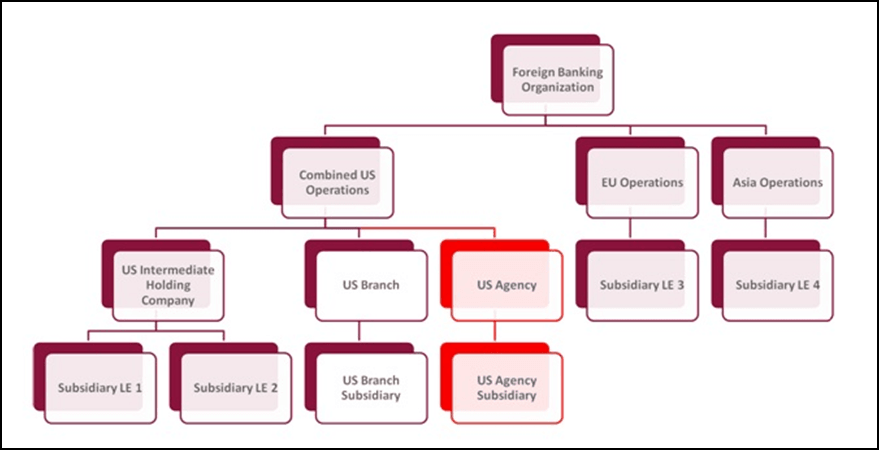
4. When consolidation entity is US Branch
Figure 6: Intercompany Transaction Identification for US FBOs- consolidation entity US Branch

As per the Dodd-Frank guidelines, Bank Holding Companies (BHCs) and Foreign Banking Organizations (FBOs) are expected to conduct stress tests across multiple horizons to assess the potential impact of liquidity stress scenarios on their cash flows, liquidity position, profitability, and solvency. The buffer requirement is computed based on the stressed cash flows. US BHCs must maintain a minimum buffer equal to the net stressed cash flow need across 30 days. And US IHCs of FBOs must maintain a minimum buffer equal to the net stressed cash flow need across 30 days while US Branches and Agencies of FBOs must maintain a minimum of buffer equal to the net stressed cash flow need across 14 days. In the case of FBOs, the external stressed cash flow sources must only be used to cover the external stressed cash flow needs. OFS LRM supports the calculation of buffer requirement for US BHCs as well as FBOs as per the procedure given below. Since these calculations differ, the application identifies whether the BHC is US-based or is an FBO by looking up the domicile of the BHC and then automatically selects the relevant computational process.
Topics:
· Computing Buffer Requirement for US BHCs
· Computing Buffer Requirement for FBOs
The application computes buffer requirement for US BHCs and all its subsidiaries as follows:
1. The Application obtains the contractual cash flows.
2. Intercompany transactions are identified separately and eliminated during calculations.
3. The cash flows from internal and external sources are bucketed based on the time bucket definition selected as part of the Contractual Run.
4. The application computes all the other measures supported as part of US LCR calculations such a downgrade impact amount, contractually due collateral, excess collateral, and so on. These are calculated and stored to apply business assumptions.
5. The BAU and stress assumptions are applied to bucketed cash flows as part of the BAU or Stress Run. OFS LRM supports a range of business assumptions to define BAU and Stress Runs. The application does not provide preconfigured scenario values for the Regulation YY Liquidity Risk Calculation but requires users to create their own assumptions, as part of the Business Assumption window, with the relevant inflow and outflow rates. For detailed information on each business assumption supported by OFS LRM, see Chapter 6 Business Assumption; section Business Assumption Definition in the Oracle Financial Services Liquidity Risk Measurement and Management User Guide.
6. The net stressed cash flow need is computed for each user-specified stress horizon as follows:

Where,
I = Period from open maturity to horizon
N = Horizon in days
Cash Flow Sources = Cash inflows post business assumptions
Cash Flow Needs = Cash outflows post business assumptions
The liquidity buffer requirement is equal to the net stressed cash flow need calculating for each stress horizon.
The net stressed cash flow calculation for BHCs is illustrated below considering 3 stress horizons 1 day, 5 days, and 10 days:
Table 15: Net Stressed Cash Flow calculation for BHCs
|
Level 0 Time Buckets |
|||||||||
|---|---|---|---|---|---|---|---|---|---|---|
Day 1 |
Day 2 |
Day 3 |
Day 4 |
Day 5 |
Day 6 |
Day 7 |
Day 8 |
Day 9 |
Day 10 |
|
Cash Flow Sources (Inflows) |
||||||||||
Housing Loan |
20 |
18 |
11 |
24 |
17 |
19 |
14 |
10 |
19 |
23 |
Credit Card |
13 |
15 |
15 |
12 |
13 |
15 |
10 |
12 |
13 |
11 |
Balances With Banks |
12 |
10 |
12 |
9 |
9 |
5 |
10 |
6 |
12 |
11 |
Total Cash Flow Sources |
45 |
43 |
38 |
45 |
39 |
39 |
34 |
28 |
44 |
45 |
Cumulative Cash Flow Sources (a) |
45 |
88 |
126 |
171 |
210 |
249 |
283 |
311 |
355 |
400 |
Cash Flow Needs (Outflows) |
||||||||||
Deposits |
15 |
23 |
24 |
30 |
28 |
17 |
19 |
11 |
21 |
12 |
Borrowings |
16 |
6 |
16 |
10 |
23 |
10 |
17 |
20 |
14 |
18 |
Funding Lines |
6 |
6 |
5 |
5 |
6 |
7 |
6 |
7 |
5 |
5 |
Total Cash Flow Needs |
37 |
35 |
45 |
45 |
57 |
34 |
42 |
38 |
40 |
35 |
Cumulative Cash Flow Needs (b) |
37 |
72 |
117 |
162 |
219 |
253 |
295 |
333 |
373 |
408 |
Net Stressed Cash Flow Need For Each Horizon (Abs(Min(0,a - b)) |
0 |
|
|
|
9 |
|
|
|
|
8
|
The application computes internal and external stressed cash flow need for US IHC, US Branches, US Agencies, and their respective subsidiaries as follows:
1. The Application obtains the contractual cash flows.
2. Intercompany, internal, and external transactions are identified separately. Intercompany transactions are eliminated during calculations.
3. The cash flows from internal and external sources are bucketed separately based on the time bucket definition selected as part of the Contractual Run.
4. The application computes all the other measures supported as part of US LCR calculations such a downgrade impact amount, contractually due collateral, excess collateral, and so on. These are calculated and stored to apply business assumptions.
5. The BAU and stress assumptions are applied to bucketed cash flows as part of the BAU or Stress Run. OFS LRM supports a range of business assumptions to define BAU and Stress Runs. The application does not provide preconfigured scenario values for the Regulation YY Liquidity Risk Calculation but requires users to create their own assumptions, as part of the Business Assumption window, with the relevant inflow and outflow rates. For detailed information on each business assumption supported by OFS LRM, refer to Chapter 6 Business Assumption; section Business Assumption Definition in the Oracle Financial Services Liquidity Risk Measurement and Management User Guide.
6. The net external stressed cash flow for each day within each horizon is calculated as follows:

Where,
I : 0 to n that is each day in the period from open maturity to horizon
N : Horizon in days
External Stressed Cash Flow Sources : Cash inflows from external counterparties post business assumptions
External Stressed Cash Flow Needs : Cash outflows from external counterparties post business assumptions
7. The application computes the net stressed intra-group cash flow for each day within each horizon as follows:

Stressed Intra-group Cash Flow Sources : Total cash inflows from internal counterparties post business assumptions for each day
Stressed Intra-group Cash Flow Needs : Total cash outflows from internal counterparties post business assumptions for each day
8. The application computes the daily cumulative net stressed intra-group cash flow as follows:

9. If the daily cumulative net stressed intra-group cash flow for any day is a negative value, it is considered as a daily cumulative net stressed intra-group cash flow need.
10. The absolute value of the largest negative daily cumulative net stressed intra-group cash flow occurring during the horizon is considered the net internal stressed cash flow need
11. The application computes the net stressed cash flow need or the liquidity buffer requirement as follows:

The net stressed cash flow calculation for BHCs is illustrated in the following table considering 3 stress horizons 1 day, 5 days, and 10 days:
Table 16: Net Stressed Cash Flow Calculation for BHCs
|
Level 0 Time Buckets |
|
|||||||||
|---|---|---|---|---|---|---|---|---|---|---|---|
Day 1 |
Day 2 |
Day 3 |
Day 4 |
Day 5 |
Day 6 |
Day 7 |
Day 8 |
Day 9 |
Day 10 |
|
|
External cash flow sources (Inflows) |
|||||||||||
Housing Loan |
7 |
10 |
7 |
3 |
8 |
4 |
9 |
6 |
10 |
9 |
|
Credit Card |
2 |
2 |
3 |
4 |
3 |
6 |
4 |
3 |
4 |
7 |
|
Total external cash flow sources |
9 |
12 |
10 |
7 |
11 |
10 |
13 |
9 |
14 |
16 |
|
Cumulative external cash flow sources (a) |
9 |
21 |
31 |
38 |
49 |
59 |
72 |
81 |
95 |
111 |
|
External cash flow needs (Outflows) |
|||||||||||
Deposits |
9 |
7 |
7 |
10 |
14 |
11 |
7 |
9 |
5 |
15 |
|
Borrowings |
8 |
9 |
7 |
6 |
9 |
6 |
6 |
5 |
8 |
8 |
|
Total external cash flow needs |
17 |
16 |
14 |
16 |
23 |
17 |
13 |
14 |
13 |
23 |
|
Cumulative external cash flow needs (b) |
17 |
33 |
47 |
63 |
86 |
103 |
116 |
130 |
143 |
166 |
|
Net external stressed cash flow need for each horizon [c = {Abs(Min(0,a - b)}] |
8 |
|
|
|
37 |
|
|
|
|
55 |
|
Internal cash flow sources (Inflows) |
|||||||||||
Loan to Parent |
6 |
4 |
9 |
6 |
6 |
3 |
4 |
15 |
5 |
9 |
|
Loan to non-U.S. entities |
4 |
3 |
8 |
3 |
4 |
5 |
1 |
4 |
13 |
14 |
|
Total internal cash flow sources (d) |
10 |
7 |
17 |
9 |
10 |
8 |
5 |
19 |
18 |
23 |
|
Intragroup cash flow needs (Outflows) |
|||||||||||
Borrowings from parent |
8 |
6 |
2 |
5 |
8 |
4 |
2 |
9 |
7 |
4 |
|
Borrowings from non-U.S. entities |
4 |
7 |
4 |
7 |
7 |
11 |
5 |
8 |
1 |
5 |
|
Total internal cash flow needs (e) |
12 |
13 |
6 |
12 |
15 |
15 |
7 |
17 |
8 |
9 |
|
Net intra-group stressed cash flow (d - e) |
-2 |
-6 |
11 |
-3 |
-5 |
-7 |
-2 |
2 |
10 |
14 |
|
Daily cumulative net stressed intra-group cash flow (f) |
-2 |
-8 |
3 |
0 |
-5 |
-12 |
-14 |
-12 |
-2 |
12 |
|
Daily cumulative net stressed intra-group cash flow need (If f less than 0 then f, else 0) |
-2 |
-8 |
0 |
0 |
-5 |
-12 |
-14 |
-12 |
-2 |
0 |
|
Greatest daily cumulative net stressed intra-group cash flow need for each horizon (g) |
-2 |
|
|
|
-8 |
|
|
|
|
-14 |
|
Net internal stressed cash flow need for each horizon [g = Abs(g)] |
2 |
|
|
|
8 |
|
|
|
|
14 |
|
Net stressed cash flow need for each horizon (c + g) |
10 |
|
|
|
45 |
|
|
|
|
69 |
|
NOTE:
The application computes the buffer requirement for multiple horizons which are provided by the user as part of the stress horizons parameter in the Run Execution window. At a minimum, buffer requirement is to be computed for a horizon of 30 days for US BHCs and US IHCs of FBOs. Buffer requirement is to be computed for a horizon of 14 days, at a minimum, for US Branches and Agencies of FBOs.
Buffer requirement is calculated on Solo as well as the Consolidated basis.
The calculation of net cash outflows is done at the granularity of level 0 buckets which are part of the time bucket definition selected in the Run Management window. Users must ensure that the level 0 buckets are specified daily till the highest horizon for which buffer requirement is to be computed within a Run for accuracy of calculations. In this illustration, the level 0 time buckets must be defined on a daily basis till day 10.
This section explains consolidation process in regulation YY calculations.
Topics:
· Calculating Consolidated Buffer Assets
· Calculating Consolidated Buffer Requirement
The transferability restrictions on buffer assets of subsidiaries are considered while computing consolidated liquidity buffer. Restricted subsidiary assets designated as liquidity buffer are available to the parent company only to the extent that they are required to off-set cash flow needs of its subsidiary on a consolidated basis. The unrestricted subsidiary assets are freely available for the parent company’s use.
The application computes the transferable liquid assets buffer from subsidiary to parent in a manner similar to that followed in US LCR as follows:
1. The application eliminates all intercompany transactions at an account level up to the immediate parent as per the approach followed in US LCR for Foreign subsidiaries. Refer section Identification of Intercompany, Internal and External Transactions for information on intercompany transactions identification process for BHCs and FBOs. The internal cash flows must not be eliminated. It is possible to perform the following:
§ To view all intercompany transactions separately for each consolidation level.
§ To view internal and external cash outflows and inflows for US IHC, US Branches, and US Agencies of FBOs after excluding intercompany transactions.
§ To view cash outflows and inflows for US BHCs after excluding intercompany transactions.
2. The application computes the net stressed cash flow needs for each legal entity, for leaf-level on a solo basis and each node level on a consolidated basis. The method for computing net stressed cash flow needs varies for BHCs and FBOs. Refer section Calculation of Buffer Requirement for more information.
3. The application identifies the transferable portion of restricted buffer assets. The application transfers the restricted portion of the liquidity buffer of a legal entity to the parent to the extent of its net stressed cash flow needs. The out of the box transfer sequence for restricted assets are as follows:
§ Cash
§ A security issued or guaranteed by the US Government, US Government Agency or US Government Sponsored Enterprise (GSE) that is liquid and readily marketable
§ Other buffer assets classified as HQLA Level 1 Assets
§ Other buffer assets classified as HQLA Level 2A Assets
§ Other buffer assets classified as HLQA Level 2B Assets
§ Other buffer assets classified as Other Assets
This is done at each level of the consolidation entity's organizational structure.
You can view the transferable and non-transferable portion of restricted buffer assets from each subsidiary entity.
You can change the sequence of restricted assets consideration in the table DIM_LIQ_BUFFER_COMPONENTS, column N_RANK. The ranks in the column N_RANK are considered in ascending order, with the lowest rank being considered first.
4. The application transfers the unrestricted portion of liquidity buffer fully to the parent. This is done at each level of the consolidation entity's organizational structure. You can view the unrestricted buffer assets transferred from each subsidiary entity.
5. You must perform steps (a) to (d) till the highest consolidation level is reached.
6. The approach to consolidation is similar to that followed in US LCR. However, the computation of buffer and buffer requirement is based on YY guidelines.
7. The consolidated buffer is calculated at each consolidation entity as per the following formula:

8. You can view the consolidated buffer assets and their corresponding HQLA asset level at the following levels:
§ Restricted buffer assets of each entity that are consolidated with the parent entity and their corresponding HQLA asset level.
§ Restricted buffer assets of each entity that are not consolidated with the parent entity and their corresponding HQLA asset level.
§ Unrestricted buffer assets of each entity that are consolidated with the parent entity and their corresponding HQLA asset level.
§ All of the above calculations across multiple stress scenarios.
As per Regulation YY, BHCs are required to maintain a buffer to meet its consolidated buffer requirement. Also, FBOs are required to maintain sufficient buffer to meet their consolidated buffer requirement at the following levels:
· Consolidated US Operations
· Consolidated IHC Operations
· Consolidated US Branch/Agency Operations
The application computes the buffer requirement across multiple horizons in a consolidated manner as follows:
1. The application eliminates all intercompany transactions up to the legal entity selected as the consolidation entity. See the Identification of Intercompany, Internal and External Transactions section for details on identification of intercompany transactions and the difference between intercompany and internal transactions.
2. The application computes the total stressed cash inflows and outflows, both internal and external, on a consolidated basis for the consolidation entity and all its subsidiaries.
3. The application computes the net stressed cash flow needs at the level of the consolidation entity based on the methods prescribed for BHCs and FBOs by US Federal Reserve as per Regulation YY. See the Calculation of Buffer Requirement section for more information.
NOTE:
1. These calculations are done for multiple horizons in a single Run.
2. You can view the net stressed cash flow needs and its components at the following levels:
· Each solo legal entity and consolidation entities in a single Run
· Across multiple horizons in a single Run
· Across multiple stress scenarios