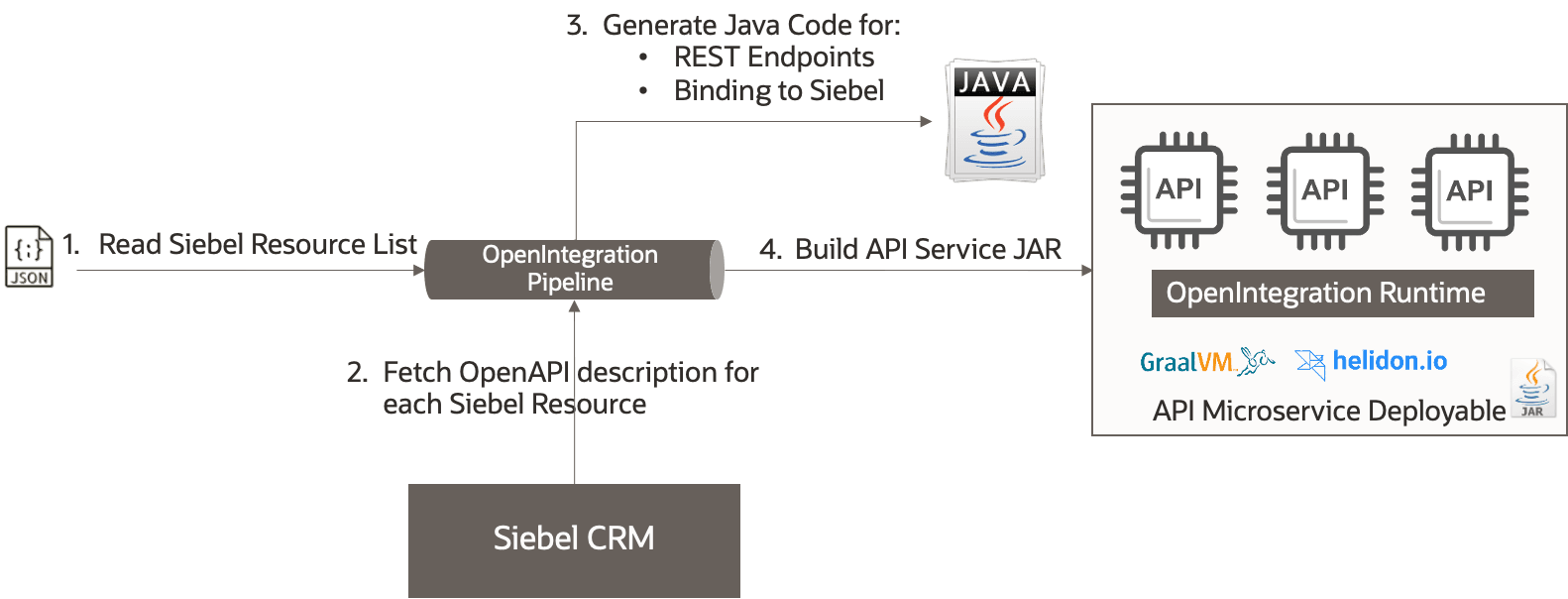
Overview of Siebel Open Integration Workflow
An Open Integration project consists of design-time and runtime considerations. At design time, you define the required service artifacts and profile details in JSON format. These files are provided as input to a pipeline process that communicates with a connected Siebel Server, downloads the OpenAPI specification, generates classes, and finally creates an executable JAR file. To use the JAR file, you can provide an additional parameter to the generation pipeline or start it manually using the provided example start.bat/sh file.
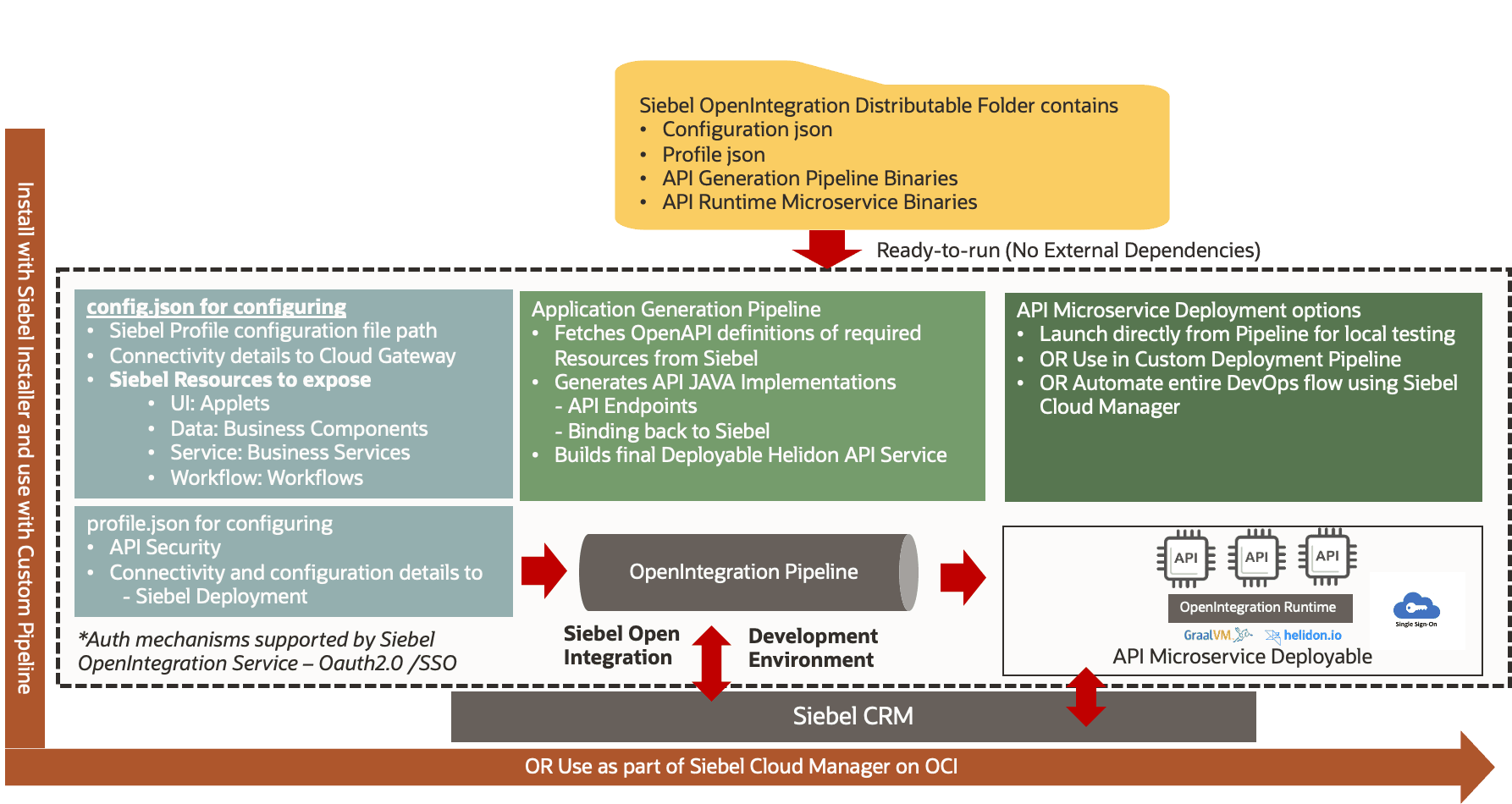
The following diagram shows the design-time pipeline communication sequence for generation of an executable jar file. For clarity, the steps are
- Provide a list of Siebel artifacts to be generated for the OpenInt micro-service
- Provide endpoint and other details within the configuration section in config.json.
- Provide profile details in profile.json
- Based on the listed artefacts, the pipeline contacts the Siebel Application Interface and retrieves the corresponding OpenAPI specification.
- The downloaded OpenAPI specification is used to generate Siebel REST endpoints and bindings to Siebel configuration.
- The Pipeline packages all required generated classes and forms the file "openint.jar" which is then used to create working API endpoints.