Costing Average Cost Items
This example details the perpetual and periodic average cost methods that are used in PeopleSoft Cost Management. For this example, this information is used:
| Inventory Business Unit | US011 | US011 |
|---|---|---|
|
Item ID |
A |
A |
|
Cost Book |
FIN |
TAX |
|
From Cost Profile |
|
|
|
Receipt Cost Method (CM_TYPE) |
Actual |
Actual |
|
Cost Flow (CM_FLOW) |
FIFO |
FIFO |
|
Deplete Cost Method (CM_METHOD) |
Perpetual Average |
Periodic Average |
|
Cost Element Option |
Production |
N/A |
For the TAX cost book, assume that the average is calculated only once, at the end of the period (periodic).
For the FIN cost book, assume that the average is calculated after each putaway.
Perpetual Average Is Calculated:
| Date/Time | Cost Element | Existing Onhand Stock | Shipments | Actual Cost of New Receipt | New Average Cost per Unit |
|---|---|---|---|---|---|
|
T1 |
100 |
None |
|
10 units @ 10/unit |
10.00/unit |
|
T1 |
200 |
None |
|
10 units @ 1/unit |
1.00/unit |
|
T3 |
100 |
10 units @ 10/unit |
|
5 units @ 20/unit |
13.33/unit |
|
T3 |
200 |
10 units @ 1/unit |
|
5 units @ 2/unit |
1.33/unit |
|
T5 |
100 |
|
6 units shipped |
|
|
|
T5 |
200 |
|
6 units shipped |
|
|
|
T7 |
100 |
9 units @ 13.3/unit |
|
5/units @ 25/unit |
17.50/unit |
|
T7 |
200 |
9 units @ 1.33/unit |
|
5/units @ 5/unit |
2.64/unit |
Periodic Average is Calculated:
| Date/Time | Cost Element | Actual Cost of New Receipt | Total Average Cost | Avg Cost/Unit to Cost all Shipments within Period |
|---|---|---|---|---|
|
T1 |
100 |
10 units @ 10/unit |
100.00 |
|
|
T1 |
200 |
10 units @ 1/unit |
10.00 |
|
|
T3 |
100 |
5 units @ 20/unit |
100.00 |
|
|
T3 |
200 |
5 units @ 2/unit |
10.00 |
|
|
T5 |
100 |
5 units @ 25/unit |
125.00 |
|
|
T5 |
200 |
5 units @ 5/unit |
25.00 |
|
|
Totals |
|
20 units |
325.00 for cost element 100 45.00 for cost element 200 |
16.25/unit for cost element 100 2.25/unit for cost element 200 |
This diagram illustrates the cost flow for a perpetual and periodic average cost item.
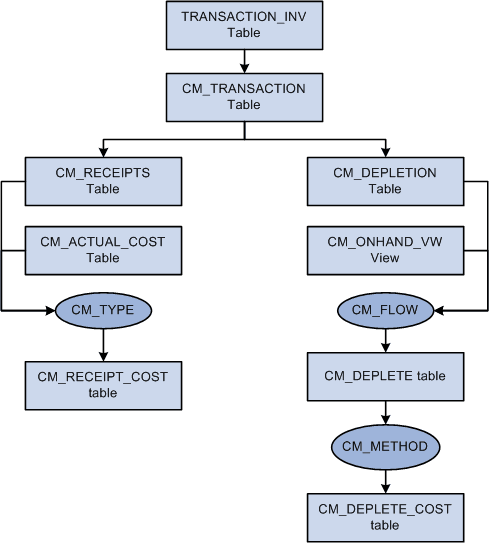
The TRANSACTION_INV Table
Transactions for PeopleSoft Inventory and PeopleSoft Manufacturing are inserted into the PeopleSoft Transaction History (TRANSACTION_INV) table. In this example, there are three transactions stocking item A into the US011 inventory business unit (020 Putaway transactions), and two transactions shipping item A out of the US011 business unit (030– Usage and Shipment transactions).
| Business Unit | Item | Date/Time | Transaction | Qty |
|---|---|---|---|---|
|
US011 |
A |
T1 |
020–Putaway |
10 |
|
US011 |
A |
T3 |
020–Putaway |
5 |
|
US011 |
A |
T5 |
030–Usages & Shipments |
6 |
|
US011 |
A |
T7 |
020–Putaway |
5 |
|
US011 |
A |
T9 |
030–Usages & Shipments |
5 |
The CM_TRANSACTION Table
The Transaction Costing process expands the transactions in TRANSACTION_INV into the PeopleSoft Cost Management CM_TRANSACTION table, adding a separate row for each business unit and cost book combination.
The CM_RECEIPTS Table
The Transaction Costing process places 020– Putaway transactions into CM_RECEIPTS.
| Business Unit | Item | Date/Time | Cost Book | Qty |
|---|---|---|---|---|
|
US011 |
A |
T1 |
FIN |
10 |
|
US011 |
A |
T1 |
TAX |
10 |
|
US011 |
A |
T3 |
FIN |
5 |
|
US011 |
A |
T3 |
TAX |
5 |
|
US011 |
A |
T7 |
FIN |
5 |
|
US011 |
A |
T7 |
TAX |
5 |
The CM_DEPLETION Table
The Transaction Costing process places 030– Usage & Shipment transactions into CM_DEPLETION.
| Business Unit | Item | Date/Time | Cost Book | Qty |
|---|---|---|---|---|
|
US011 |
A |
T5 |
FIN |
6 |
|
US011 |
A |
T5 |
TAX |
6 |
|
US011 |
A |
T9 |
FIN |
5 |
|
US011 |
A |
T9 |
TAX |
5 |
The CM_ACTUAL_COST Table
Item putaway costs are computed and placed in CM_ACTUAL_COST table.
| Business Unit | Item | Date/Time | Cost Element | Unit Cost |
|---|---|---|---|---|
|
US011 |
A |
T1 |
100 |
10.00 |
|
US011 |
A |
T1 |
200 |
1.00 |
|
US011 |
A |
T3 |
100 |
20.00 |
|
US011 |
A |
T3 |
200 |
2.00 |
|
US011 |
A |
T7 |
100 |
25.00 |
|
US011 |
A |
T7 |
200 |
5.00 |
The CM_RECEIPT_COST Table
Data from the CM_RECEIPTS table and the CM_ACTUAL_COST table are used to calculate the receipt costs for the CM_RECEIPT_COST table. This is based on the cost type entered for the cost book on the Inventory Definition - Business Unit Books page.
| Business Unit | Item | Date/Time | Cost Book | Cost Element | Unit Cost |
|---|---|---|---|---|---|
|
US011 |
A |
T1 |
FIN |
100 |
10.00 |
|
US011 |
A |
T1 |
FIN |
200 |
1.00 |
|
US011 |
A |
T1 |
TAX |
100 |
10.00 |
|
US011 |
A |
T1 |
TAX |
200 |
1.00 |
|
US011 |
A |
T3 |
FIN |
100 |
20.00 |
|
US011 |
A |
T3 |
FIN |
200 |
2.00 |
|
US011 |
A |
T3 |
TAX |
100 |
20.00 |
|
US011 |
A |
T3 |
TAX |
200 |
2.00 |
|
US011 |
A |
T7 |
FIN |
100 |
25.00 |
|
US011 |
A |
T7 |
FIN |
200 |
5.00 |
|
US011 |
A |
T7 |
TAX |
100 |
25.00 |
|
US011 |
A |
T7 |
TAX |
200 |
5.00 |
The CM_ONHAND_VW Table
The CM_ONHAND_VW table matches receipts (putaways) with depletions (usage and shipments) based on the Cost Flow field on the Cost Profiles page.
| Bus Unit | Item | Date/Time | Cost Book | T0 QTY | T2 QTY | T4 QTY | T6 QTY | T8 QTY | T10 QTY |
|---|---|---|---|---|---|---|---|---|---|
|
US011 |
A |
T1 |
FIN |
0 |
10 |
10 |
4 |
4 |
0 |
|
US011 |
A |
T1 |
TAX |
0 |
10 |
10 |
4 |
4 |
0 |
|
US011 |
A |
T3 |
FIN |
0 |
0 |
5 |
5 |
5 |
4 |
|
US011 |
A |
T3 |
TAX |
0 |
0 |
5 |
5 |
5 |
4 |
|
US011 |
A |
T7 |
FIN |
0 |
0 |
0 |
0 |
5 |
5 |
|
US011 |
A |
T7 |
TAX |
0 |
0 |
0 |
0 |
5 |
5 |
The CM_DEPLETE Table
The process matches up each depletion transaction in CM_DEPLETION with a qualifying putaway from CM_ONHAND_VW. These depleted depletions are inserted into the CM_DEPLETE table. The Cost Flow field on the Cost Profiles page determines how receipts are matched with depletions.
| Business Unit | Item | Date/Time | Cost Book | Rec Date/Time | Qty |
|---|---|---|---|---|---|
|
US011 |
A |
T5 |
FIN |
T1 |
6 |
|
US011 |
A |
T5 |
TAX |
T1 |
6 |
|
US011 |
A |
T9 |
FIN |
T1 |
4 |
|
US011 |
A |
T9 |
FIN |
T3 |
1 |
|
US011 |
A |
T9 |
TAX |
T1 |
4 |
|
US011 |
A |
T9 |
TAX |
T3 |
1 |
The CM_DEPLETE_COST Table
The process calculates the cost of depletions in the CM_DEPLETE table and placed them in the CM_DEPLETE_COST table. This is based on the Deplete Cost Method defined on the Cost Profiles page.
| Business Unit | Item | Date/Time | Cost Book | Rec Date/Time | Cost Element | Unit Cost |
|---|---|---|---|---|---|---|
|
US011 |
A |
T5 |
FIN |
T1 |
100 |
13.3333 |
|
US011 |
A |
T5 |
FIN |
T1 |
200 |
1.3333 |
|
US011 |
A |
T5 |
TAX |
T1 |
100 |
16.2500 |
|
US011 |
A |
T5 |
TAX |
T1 |
200 |
2.2500 |
|
US011 |
A |
T9 |
FIN |
T1 |
100 |
17.5000 |
|
US011 |
A |
T9 |
FIN |
T1 |
200 |
2.6428 |
|
US011 |
A |
T9 |
FIN |
T3 |
100 |
17.5000 |
|
US011 |
A |
T9 |
FIN |
T3 |
200 |
2.6428 |
|
US011 |
A |
T9 |
TAX |
T1 |
100 |
16.2500 |
|
US011 |
A |
T9 |
TAX |
T1 |
200 |
2.2500 |
|
US011 |
A |
T9 |
TAX |
T3 |
100 |
16.2500 |
|
US011 |
A |
T9 |
TAX |
T3 |
200 |
2.2500 |