Costing FIFO/LIFO Items
This example illustrates costing using the FIFO/LIFO methods. For this example, this information is used:
| Inventory Business Unit | US010 | US010 |
|---|---|---|
|
Item ID |
A |
A |
|
Cost Book |
FIN |
TAX |
|
From Cost Profile |
|
|
|
Receipt Cost Method (CM_TYPE) |
Actual |
Actual |
|
Cost Flow (CM_FLOW) |
FIFO |
LIFO |
|
Deplete Cost Method (CM_METHOD) |
Actual |
Actual |
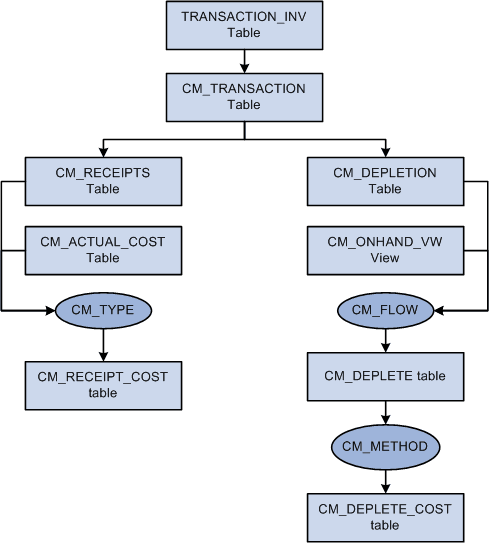
This diagram illustrates the cost flow for a FIFO or LIFO item.
The TRANSACTION_INV Table
Transactions for PeopleSoft Inventory and PeopleSoft Manufacturing are inserted into the PeopleSoft Transaction History (TRANSACTION_INV) table. In this example, there are three transactions stocking item A into the US010 inventory business unit (020 Putaway transactions), and two transactions shipping item A out of the US010 business unit (030– Usage and Shipment transactions).
| Business Unit | Item | Date/Time | Transaction | Qty |
|---|---|---|---|---|
|
US010 |
A |
T1 |
020–Putaway |
10 |
|
US010 |
A |
T3 |
020–Putaway |
5 |
|
US010 |
A |
T5 |
030–Usages & Shipments |
6 |
|
US010 |
A |
T7 |
020–Putaway |
5 |
|
US010 |
A |
T9 |
030–Usages & Shipments |
5 |
The CM_TRANSACTION Table
The Transaction Costing process expands the transactions in TRANSACTION_INV into the PeopleSoft Cost Management CM_TRANSACTION table, adding a separate row for each business unit and cost book combination.
The CM_RECEIPTS Table
The Transaction Costing process places 020– Putaway transactions into CM_RECEIPTS.
| Business Unit | Item | Date/Time | Cost Book | Qty |
|---|---|---|---|---|
|
US010 |
A |
T1 |
FIN |
10 |
|
US010 |
A |
T1 |
TAX |
10 |
|
US010 |
A |
T3 |
FIN |
5 |
|
US010 |
A |
T3 |
TAX |
5 |
|
US010 |
A |
T7 |
FIN |
5 |
|
US010 |
A |
T7 |
TAX |
5 |
The CM_DEPLETION Table
The Transaction Costing process places 030– Usage & Shipment transactions into CM_DEPLETION.
| Business Unit | Item | Date/Time | Cost Book | Qty |
|---|---|---|---|---|
|
US010 |
A |
T5 |
FIN |
6 |
|
US010 |
A |
T5 |
TAX |
6 |
|
US010 |
A |
T9 |
FIN |
5 |
|
US010 |
A |
T9 |
TAX |
5 |
The CM_ACTUAL_COST Table
Item putaway costs are computed and placed in CM_ACTUAL_COST table.
| Business Unit | Item | Date/Time | Cost Element | Unit Cost |
|---|---|---|---|---|
|
US010 |
A |
T1 |
100 |
10.00 |
|
US010 |
A |
T1 |
200 |
1.00 |
|
US010 |
A |
T3 |
100 |
20.00 |
|
US010 |
A |
T3 |
200 |
2.00 |
|
US010 |
A |
T7 |
100 |
25.00 |
|
US010 |
A |
T7 |
200 |
5.00 |
The CM_RECEIPT_COST Table
Data from the CM_RECEIPTS table and the CM_ACTUAL_COST table are used to calculate the receipt costs for the CM_RECEIPT_COST table. This is based on the cost type entered for the cost book on the Inventory Definition - Business Unit Books page.
| Business Unit | Item | Date/Time | Cost Book | Cost Element | Unit Cost |
|---|---|---|---|---|---|
|
US010 |
A |
T1 |
FIN |
100 |
10.00 |
|
US010 |
A |
T1 |
FIN |
200 |
1.00 |
|
US010 |
A |
T1 |
TAX |
100 |
10.00 |
|
US010 |
A |
T1 |
TAX |
200 |
1.00 |
|
US010 |
A |
T3 |
FIN |
100 |
20.00 |
|
US010 |
A |
T3 |
FIN |
200 |
2.00 |
|
US010 |
A |
T3 |
TAX |
100 |
20.00 |
|
US010 |
A |
T3 |
TAX |
200 |
2.00 |
|
US010 |
A |
T7 |
FIN |
100 |
25.00 |
|
US010 |
A |
T7 |
FIN |
200 |
5.00 |
|
US010 |
A |
T7 |
TAX |
100 |
25.00 |
|
US010 |
A |
T7 |
TAX |
200 |
5.00 |
The CM_ONHAND_VW Table
The CM_ONHAND_VW table matches receipts (putaways) with depletions (usage and shipments) based on the Cost Flow field on the Cost Profiles page.
| Bus Unit | Item | Date/Time | Cost Book | T0 QTY | T2 QTY | T4 QTY | T6 QTY | T8 QTY | T10 QTY |
|---|---|---|---|---|---|---|---|---|---|
|
US010 |
A |
T1 |
FIN |
0 |
10 |
10 |
4 |
4 |
0 |
|
US010 |
A |
T1 |
TAX |
0 |
10 |
10 |
9 |
9 |
9 |
|
US010 |
A |
T3 |
FIN |
0 |
0 |
5 |
5 |
5 |
4 |
|
US010 |
A |
T3 |
TAX |
0 |
0 |
5 |
0 |
0 |
0 |
|
US010 |
A |
T7 |
FIN |
0 |
0 |
0 |
0 |
5 |
5 |
|
US010 |
A |
T7 |
TAX |
0 |
0 |
0 |
0 |
5 |
0 |
The CM_DEPLETE Table
The process matches up each depletion transaction in CM_DEPLETION with a qualifying putaway from CM_ONHAND_VW. These depleted depletions are inserted into the CM_DEPLETE table. The Cost Flow field on the Cost Profiles page determines how receipts are matched with depletions.
| Business Unit | Item | Date/Time | Cost Book | Rec Date/Time | Qty |
|---|---|---|---|---|---|
|
US010 |
A |
T5 |
FIN |
T1 |
6 |
|
US010 |
A |
T5 |
TAX |
T3 |
5 |
|
US010 |
A |
T5 |
TAX |
T1 |
1 |
|
US010 |
A |
T9 |
FIN |
T1 |
4 |
|
US010 |
A |
T9 |
FIN |
T3 |
1 |
|
US010 |
A |
T9 |
TAX |
T7 |
5 |
The CM_DEPLETE_COST Table
The process calculates the cost of depletions in the CM_DEPLETE table and placed them in the CM_DEPLETE_COST table. This is based on the Deplete Cost Method defined on the Cost Profiles page.
| Business Unit | Item | Date/Time | Cost Book | Rec Date/Time | Cost Element | Unit Cost |
|---|---|---|---|---|---|---|
|
US010 |
A |
T5 |
FIN |
T1 |
100 |
10.00 |
|
US010 |
A |
T5 |
FIN |
T1 |
200 |
1.00 |
|
US010 |
A |
T5 |
TAX |
T3 |
100 |
20.00 |
|
US010 |
A |
T5 |
TAX |
T3 |
200 |
2.00 |
|
US010 |
A |
T5 |
TAX |
T1 |
100 |
10.00 |
|
US010 |
A |
T5 |
TAX |
T1 |
200 |
1.00 |
|
US010 |
A |
T9 |
FIN |
T1 |
100 |
10.00 |
|
US010 |
A |
T9 |
FIN |
T1 |
200 |
1.00 |
|
US010 |
A |
T9 |
FIN |
T3 |
100 |
20.00 |
|
US010 |
A |
T9 |
FIN |
T3 |
200 |
2.00 |
|
US010 |
A |
T9 |
TAX |
T7 |
100 |
25.00 |
|
US010 |
A |
T9 |
TAX |
T7 |
200 |
5.00 |