Understanding Document Sequencing
Statutory legal requirements in some countries require the classification of all financial transactions—generated by source documents, such as invoices or vouchers—into different transaction types. Within each transaction type, financial transactions must also be numbered sequentially. The document sequencing feature maintains these business practices by meeting both requirements.
Document sequencing is available for documents that are created either online or through background (batch) processing. When you activate document sequencing, the PeopleSoft system automatically assigns a sequence number to each document (invoice, voucher, journal, and so on) that you create. You can also enter sequence numbers manually. When the document is posted, the document sequence number is carried forward to the set of accounting transactions generated from the document. When you delete, change, or unpost a document, the document sequencing feature assigns a new sequence number to each set of accounting transactions generated from the delete, change, or unpost action for that document.
This graphic shows the hierarchy levels of Journal Type, Journal Code and Document Type as used in document sequencing.
Hierarchy of financial transactions
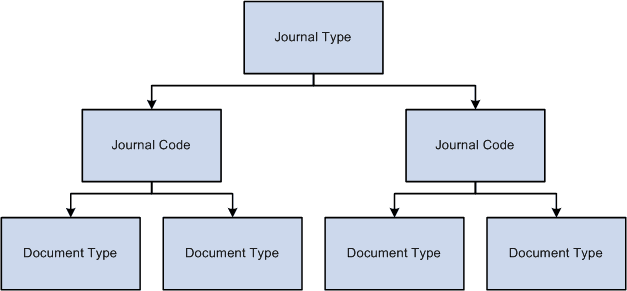
A financial transaction is categorized into three hierarchical levels:
-
Journal types—such as assets, sales, purchases, or financial journals—are the highest category level.
-
Journal codes subdivide journal types and are assigned to only one journal type, for example, subdividing the sales journal into domestic sales and export sales.
-
Document types, located within journal codes, are assigned to only one journal code.
Document sequencing occurs at either the journal code level or the document type level within a journal code. If sequencing occurs at the journal code level, all document types within a journal code share the same sequence number range. If sequencing occurs at the document type level, each document type has its own sequence number range. You can reset document sequence numbers at the schedule that you define for each journal code and document type within a journal code. Because you can derive journal type and journal code values from the document type, document type is the only required field of these three in financial transactions.
This section lists common elements and discusses:
-
How the system assigns sequence numbers.
-
Document sequencing scenarios.