Understanding U.S. Federal G-Invoicing Processing
The U.S. Federal Government Department of the Treasury implemented the G-Invoicing system to manage intra-governmental (IGT) buy sell transactions. IGT transactions result from business activities conducted between two federal entities known as trading partners. G-Invoicing provides a common platform for all IGT Buy/Sell activity.
G-Invoicing supports all four stages of the IGT Buy/Sell transaction lifecycle:
-
General Terms and Conditions (GT&C): Identify the general terms that govern Buy/Sell trades between the Requesting Agency and the Selling Agency, including roles and responsibilities for both agencies to ensure effective management of the interagency agreement.
-
Orders: Specifies the quantity of goods or services ordered.
-
Performance: Goods/services are delivered/performed by the Selling Agency and received by the Requesting Agency.
-
7600EZ: This business process allows direct vouchering by the supplier and eliminates the entry of an order in the G-Invoicing system. Note that a purchase order can still be used in the PeopleSoft business process but will not reference a G-Invoicing order.
-
Funds Settlement: Funds are transferred directly between G-Invoicing and the Federal government Intragovernmental Payment and Collection system (IPAC).
PeopleSoft provides only Buying Agency integration with the U.S. Federal Government G-Invoicing system.
G-Invoicing Process
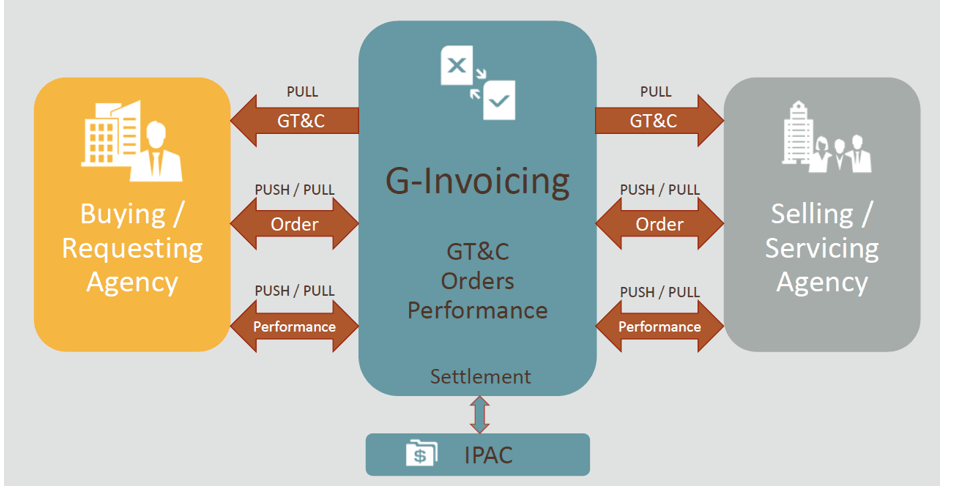
PeopleSoft Purchasing supports the Requesting Agency’s Procure-to-Pay business process for G-Invoicing with the following functionality:
-
GT&C:
-
GT&C API pulls a select set of GTC fields in from the G-Invoicing system.
-
G-Invoicing View GTC inquiry is used to view data that is stored from the inbound interface.
-
The GTC number can be referenced on the PeopleSoft purchase order header and is a key data point that identifies the purchase order is related to G-Invoicing.
-
-
Orders:
-
Orders API pulls a list of Orders from the G-Invoicing system.
-
G-Invoicing View Order inquiry is used to view data that is stored from the inbound interface.
-
The Order number can be referenced on PeopleSoft purchase header and is a key data point that identifies the purchase order is related to G-Invoicing. G-Invoicing Order line and schedule information must also be referenced and tie exactly with the G-Invoicing order information.
-
-
Performance:
-
Performance APIs are used to pull and push data between PeopleSoft Purchasing and G-Invoicing.
-
G-Invoicing View Performance inquiry is used to view Delivered/Performed transactions which originate from the Seller as well as Received/Accepted transactions which originate from the Requesting Agency.
-
Delivered/performed performance transactions can be automatically created in Purchasing as Advanced Shipping Notices and then receipts before creating vouchers in Payables. The receipts are sent back to G-Invoicing through push API as Received/Accepted transactions.
-
Evaluated Receipt Settlement (ERS) can be leveraged if enabled for the Purchase Order to automatically create PO Vouchers.
See PeopleSoft Payables: U.S. Federal G-Invoicing Processing for information on how Advances are handled.
-
-
7600EZ
-
It primarily supports the high volume of transactions for the General Services Administration (GSA) and the Government Publishing Office (GPO).
-
The GTC number can be referenced on the PeopleSoft purchase order header and is a key data point that identifies the purchase order is related to 7600EZ G-Invoicing.
-
The Order Number reference is not applicable to the PeopleSoft purchase header.
-
7600EZ APIs use pull/push REST Services to transfer transactions.
-
-
Funds Settlement: See PeopleSoft Payables: U.S. Federal G-Invoicing Processing for more information.