Payment Interface Page
Use the Payment Interface page (PAYLOAD_REQUEST) to define the run parameters for the Payment Loader process and run the process.
Navigation:
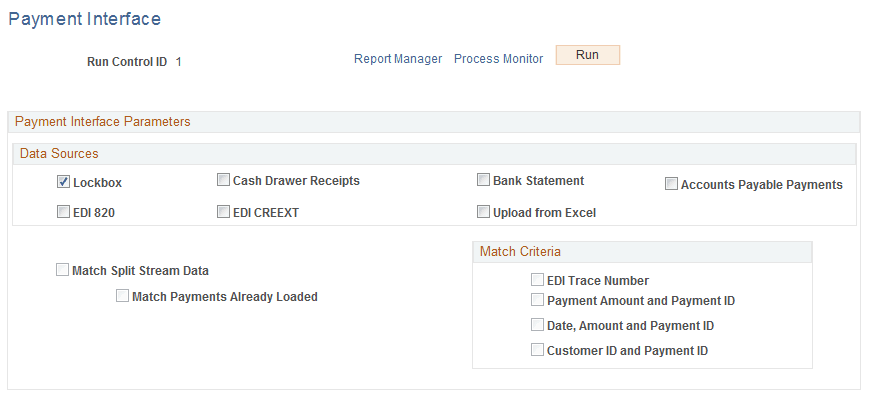
This example illustrates the fields and controls on the Payment Interface page. You can find definitions for the fields and controls later on this page.
| Field or Control | Description |
|---|---|
|
EDI 820 |
Select if loading EDI data from the United States. |
|
EDI CREEXT |
Select if loading EDI data from a European country. |
|
Upload from Excel |
Select if loading payments from a Microsoft Excel spreadsheet. |
|
Match Split Stream Data |
Select to include split stream matching as part of the payment data load process. |
|
Match Payments Already Loaded |
Select to match remittance information with cash information that you already loaded into the payment application tables. |
|
EDI Trace Number (electronic data interchange trace number) |
Select if you receive both the cash and remittance by EDI. The transmissions have matching trace numbers. The trace numbers are unique, so the two pieces can be matched by using these criteria. |
|
Payment Amount and Payment ID |
Select if you require customers to include the payment ID (this could be the check number) and payment amount in the remittance advice. The cash and remittance are matched if they have the same payment amount and payment ID. |
|
Date, Amount and Payment ID |
Select if the customer includes the payment date on the remittance. European companies use Value Date as an additional matching field. (Estimated and actual value dates determine the float.) In the United States, use the accounting date of the payment. The cash and remittance are matched if they have the same date, amount, and payment ID. |
|
Customer ID and Payment ID |
Select if the cash has a magnetic ink character recognition ID (MICR ID) with it and the remittance has a customer ID. The cash and remittance are matched if they have the same payment ID and the cash MICR ID points to the remit from customer ID that is on the remittance. |