Understanding Split Stream Processing
Split stream processing matches and unites the two parts of a payment, the cash information and the remittance advice, when they are received at different times and possibly from different data sources. EDI, lockbox, and bank statement processing support the transmission of cash by itself. Only EDI processing and the Excel Payment Upload process support the transmission of a remittance advice by itself or cash and remittance.
Note:
The Payment Loader process matches remittance information in the staging tables with cash information that is in either the staging tables or the application tables. You can use the Remittance Delete pages to find and delete unmatched remittances in the staging tables.
Split Stream Examples
Typically both the cash information and the remittance advice are received through EDI, as shown in the following example in which the customer sends the EDI remittance directly to the supplier or the customer sends the cash to their bank, their bank sends cash to the supplier's bank, and the supplier's bank sends EDI cash to the supplier.
The customer sends the EDI remittance directly to the supplier or the customer sends the cash to their bank, their bank sends cash to the supplier's bank, and the supplier's bank sends EDI cash to the supplier
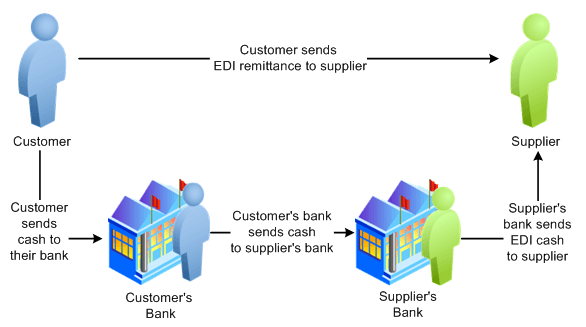
In this example, the customer sends you two EDI transmissions. The remittance advice is sent directly to you. The cash information is sent to the customer's bank, then to your bank, and then to you. As a result, you receive two separate EDI transmissions, one with cash and one with remittance information. You use split stream processing to match them and form the complete payment (linked cash and remittance information).
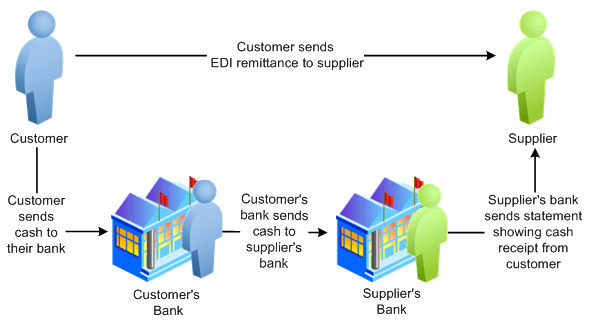
The common denominator for all methods of receiving split stream data is that the remittance information is received by EDI; only the source of the cash information varies. The method that customers use to send the cash to their bank or to your bank is irrelevant to split stream processing. Your only concern is how your bank transmits the cash information to you: as an EDI transmission, in a lockbox file or, as in the following example, as a receipt on a bank statement:
The bank transmits the cash information as an EDI transmission, in a lockbox file or, as in the example in the diagram, as a receipt on a bank statement
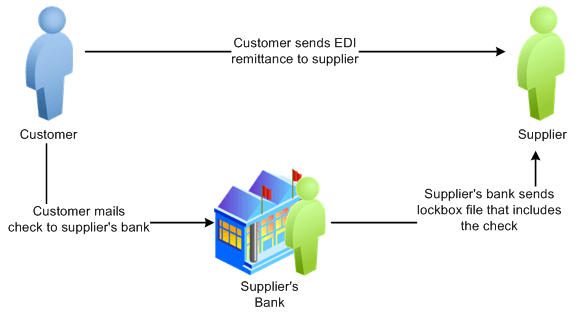
The following example shows transmission of cash information by way of a lockbox, where the customer sends an EDI remittance directly to the supplier or the customer mails a check to the supplier's bank, which sends a lockbox file, which includes the check, to the supplier.
Transmission of cash information by way of a lockbox, where the customer sends an EDI remittance directly to the supplier or the customer mails a check to the supplier's bank, which sends a lockbox file, which includes the check, to the supplier
U.S. and European business practices differ. In the United States, you usually receive payment in a lockbox file, but you are unlikely to receive payments from bank statements. In Europe, you probably do not use a lockbox, but you probably receive payments from bank statements.